

The United Nations Office at Geneva
Multimedia Newsroom
Press Conferences | UNHCR , OCHA , WHO , UNOG , UNITED NATIONS , WFP
UNOG Bi-Weekly Press Briefing 21 January 2022
PRESS BRIEFING BY THE UNITED NATIONS INFORMATION SERVICE
21 January 2022
Alessandra Vellucci, Director of the United Nations Information Service in Geneva, chaired the hybrid briefing, which was attended by spokespersons and representatives of the Office of the United Nations High Commissioner for Refugees, the World Health Organization, the World Food Programme, the Office for the Coordination of Humanitarian Affairs, and the World Food Programme.
Conditions faced by Eritrean refugees in the camps in the Tigray region, Ethiopia
Boris Cheshirkov, for the Office of the United Nations High Commissioner for Refugees (UNHCR), said the Refugee Agency was deeply alarmed at the deteriorating conditions faced by Eritrean refugees in the camps in Tigray. After three weeks with no access due to the security situation, UNHCR staff had managed to reach Mai Aini and Adi Harush refugee camps in the Tigray region of Ethiopia earlier this week for the first time since the recent air strikes in and near the camps. The team had found refugees scared and struggling to get enough to eat, lacking medicine and with little or no access to clean water.
Refugees had told UNHCR of increasing preventable deaths linked to the decline in conditions and in particular the lack of medicine and health services. Also, the lack of fuel meant that clean water could neither be pumped nor trucked to the camps, with refugees resorting to collecting water from streams, leading to a severe risk of water borne diseases. The complete inability to move supplies into the region meant that extreme hunger was an increasing concern. Refugees had resorted to selling their clothes and few belongings to try to get food.
UNHCR had been calling on all parties for a cease fire and guarantee of safe passage that would allow the Refugee Agency to relocate the more than 25,000 refugees remaining in the camps to the new site provided by the Government of Ethiopia in Dabat, in neighbouring Amhara region. If food, medicine, fuel, and other supplies could not be immediately brought in, and if UNHRC continued to be unable to relocate refugees out of harm's way, more refugees would die.
Taking questions from journalists, Mr. Cheshirkov said UNHCR and its partners faced great difficulties in delivering assistance across the region, especially in the two camps of Mai Aini and Adi Harush, which together held some 25,000 refugees. For three weeks, UNHCR had been unable to access them at all; there had been an effective blockade on humanitarian aid reaching the area since mid-December 2021. Mr. Cheshirkov, noting he could not comment on the involvement of other parties to the conflict, said that for the Refugee Agency, it was important for all parties in Ethiopia to protect civilians, as well as to respect and protect the human rights and fundamental freedoms of all people, including refugees.
Full press release available here.
Confirming Mr. Cheshirkov’s statement, Ms. Vellucci added that there were information that no humanitarian aid supplies had entered Tigray through the Semera-Abala-Mekelle corridor since 14 December 2021; as well, no fuel for humanitarian operations had been allowed to Tigray through this route since 2 August 2021.
Situation in Tonga
Christian Lindmeier, for the World Health Organization (WHO), introduced Dr Yutora Seotya, WHO Country Liaison Officer in the Kingdom of Tonga. Speaking by satellite phone from the capital of Tonga, Dr Seotya told of important destructions in the wake of the volcano explosion and the ensuing tsunami. Half of the houses had been damaged and there were also difficulties of communication. The human toll however stood at only three deceased, with a limited number of injured persons
Apart from the tsunami, Tonga had subjected to heavy ash-fall, with 2 or 3 centimeters of very fine ash contaminating the water sources as well as the air – WHO had asked people to wear masks to prevent damages to the lungs. Tonga was facing a lack of drinking water; food supply was an issue in the Ha’apai island, where many houses and shops had been washed away; finally, a fuel shortage had been reported in Vava’u and Ha’apai islands.
Given the devastating damages, and the fact that many people had seen their houses washed away by the tsunami, the psychological impact on the population stood to be huge, Dr Seotya added. The government had already deployed medical staff in affected villages.
Dr Seotya stressed that the people of Tonga were helping each other, were resilient and were working together to overcome the crisis.
Tomson Phiri, for the World Food Programme (WFP), said that it was difficult to get a full picture of the extent of the damage as most parts of the island nation were without communication and internet access. WFP teams were supporting the re-establishment of communications, telephone, and internet, in Tonga, and partial communication had been restored.
WFP was supporting the assessment of needs and priorities regarding food security. It appeared all agricultural sectors – crops, livestock, and fisheries – had been badly affected. Initial estimates showed up to 12,000 agricultural families being affected, as well as 60 to 70 percent of livestock-rearing families. Given the enormity of the volcano eruption, it was likely most families could have done nothing to protect or save their livestock from perishing; and for those that had survived, there may be very little grazing pasture and uncontaminated water supplies left.
WFP had been monitoring the food security situation in Tonga in the past year: even before the volcano eruption, 20 percent of Tongan families were already food insecure. While the extent of the damage was yet to be fully understood, it was clear that Tonga would need assistance in both the short-term and the long-term.
Jens Laerke, for the UN Office for the Coordination of Humanitarian Affairs (OCHA), remarked that the volcano was still active and that “we were not out of the wood yet”. UN staff was already in country and assessments were trickling in. Two big issues were the re-establishment of communications and the availability of clean water. But it was not fully clear what other kind of aid would be needed. According to assessments, some 50,000 persons (or half the Tongan population) may need safe water.
The good news was that countries in the region had stepped up immediately and that the airport and the ports were now operational.
There was a very strong message from the government that they would not have COVID-19 come in the country. OCHA fully agreed and was applying a “do no harm” policy. Mr. Laerke described “no-contact delivery” modalities that could be used to bring in aid without risking contamination by the coronavirus.
Answering questions from journalists, Mr. Phiri added that WFP already had engineers and programme teams in the region, as well as “stand-by arrangements” with private sector companies that provide logistical, telecom and other services. If requested, other resources could be found – there were enough “boots on the ground”.
Christian Lindmeier, for the World Health Organization (WHO), noted that casualties were few, health installations were operational, and people were able to work. Most needed were, as had already been pointed out, drinking water, food and apparently also fuel. As long as those could be brought in through the “contactless efforts” already in place, emergency teams – such as those deployed during an earthquake, for instance – were not necessary at this point.
100,000 displaced persons in Cameroon
Boris Cheshirkov, for UNHCR, said the Refugee Agency had released a supplementary appeal seeking USD 59.6 million for 100,000 persons displaced by intercommunal violence in Cameroon's Far North region. The monies would help UNHCR and its humanitarian and government partners provide vital protection and assistance to those displaced by the crisis, to cover their dire humanitarian needs over the next six months.
Clashes had started on 5 December 2021 in the border village of Ouloumsa (Far North Cameroon) following a dispute between herders, fishermen and farmers over water resources that had been dwindling because of the climate crisis. Violence had then spread to neighbouring villages, resulting in 44 people being killed, over 100 injured, and 112 villages burned to the ground.
With USD 59.6 million, UNHCR could deliver urgently needed shelter and core relief items, such as blankets, mats, and mosquito nets. Funds would also cover growing water, sanitation, and hygiene needs. Child protection; prevention and response to gender-based violence; documentation; as well as education, were also urgent priorities. UNHCR estimated that 9 out of 10 Cameroonian refugees in Chad as a result of this crises were women and children.
UNHCR would continue to work with the authorities in leading peace and reconciliation efforts in the Far North region – however, urgent action was needed to address the root causes of the conflict. Funds to support displaced people in Chad and Cameroon were now critically low and were under severe pressure due to the rapidly rising needs.
Taking questions, Mr. Cheshirkov explained that the tensions were not linked to other situations that may be continuing in Cameroon: they were intercommunal violence that had begun along the Logone river (running along the border between Cameroon and Chad) over water resources, with the surface waters of lake Chad shrinking.
The last few weeks had been much calmer, security forces having been reinforced in the area. But the tensions were still there. UNHCR had been leading peace and reconciliation efforts in Cameroon. These efforts, as well as those toward social cohesion, needed to be renewed. The Agency hoped to fund these activities with the appeal.
WHO Announcements
Christian Lindmeier, for the WHO, announced that the Strategic Advisory Group of Experts would hold a briefing, today at 2 p.m., focusing on the meeting that had taken place two days ago.
Mr. Lindmeier also said the WHO Executive Board (EB) session would begin next Monday, 24 January, at 10 a.m. All sessions would be public and live streamed. WHO Director-General, Dr Tedros, would address the Board on Monday at 10 a.m.
Also of note, on Tuesday, statements would be made by candidates for the post of Director-General – the only candidate, in this case, being Dr Tedros. The Board would then meet in private (that would be the only private meeting of the EB) and later make its recommendation to the World Health Assembly.
Answering questions, Mr. Lindmeier said that the Chair of the Executive Board was looking in the matter of the inquiry on Dr Tedros that had been requested by Ethiopia.
Other announcements
Ms. Vellucci then announced that the Human Rights Council’s Universal Periodic Review (UPR) Working Group would open its 40th session also on Monday, 24 January. The same day, the Working Group would review the human rights record of Togo (9 a.m.) as well as the human rights situation in the Syrian Arab Republic (2:30 p.m.) The session would last until 3 February, with the human rights situation in 12 States reviewed.
The Conference on Disarmament (CD) would hold the first public plenary meeting of its 2022 session on Tuesday, 25 January, at 10 a.m. in room XIX. The Conference would hear a statement by Tatiana Valovaya, Director-General of the United Nations Office at Geneva and Secretary-General of the CD. The Conference would be meeting under the presidency of Ambassador Li Song, of China.
Ms. Vellucci also announced that today at 10 a.m. New York time (6 p.m. in Geneva), the General Assembly would hold a formal meeting to hear a briefing by the Secretary-General on his priorities for 2022. Later, the Secretary-General would give a press conference in New York on the same subject (1-1:30 p.m. New York time). Both events would be broadcast live on UN Web TV.
Ms. Vellucci reminded that 24 January was International Education Day; and 27 January International Holocaust Remembrance Day. Concerning the latter, an official ceremony would take place, as was customary, at the Palais des Nations, at which journalists were welcome, Ms. Vellucci said. CinéONU would show Les derniers (The Last Ones), a movie in which three of the last survivors of the Holocaust are interviewed.
Finally, Ms. Vellucci said the President of the General Assembly had made, yesterday, a solemn appeal to Member States for the observance of the Olympic truce before the winter Games in Beijing. The truce would last from 27 January to 20 March 2022 – seven days before the beginning of the Olympic Games, and seven days after the end of the Paralympic Games.
Similar Stories
1
1
1
Press Conferences | UNHCR
End of UNHCR's 77th Annual Executive Committee (ExCom) meeting week
1
1
1
Press Conferences | UNICEF , IOM , UNHCR
UN Special Assistant to the Personal Envoy Office (SUDAN): Peace Initiatives and Efforts in Sudan; UNICEF: Dire situation of children in Gaza; IOM: Damaged Homes and Energy Attacks Risk Displacing Ukrainians for this winter; UNHCR: update on EXCOM week

1
1
1
Press Conferences | IOM , UNDRR
UN stresses importance of household preparedness for disaster risk reduction.
1
1
1
Statements , Press Conferences | OHCHR
1
1
1
Press Conferences | UNHCR , UNICEF , IFRC , OHCHR , UN WOMEN , IOM , OCHA , WHO
UNHCR – ExCom Meeting, UNICEF – Nepal Recovery, IFRC – Flash Floods, WHO – Mental Health, IOM – South Sudan Floods, OCHA – DRC Humanitarian aid, UNHCR – Sahel Displacement, UNICEF – Yemen Update, IOM – Gaza Shelter, UN Women – Gaza Women, OHCHR – Arrests and detentions of Syrians by Israeli force
2
1
2
Press Conferences | UNCTAD
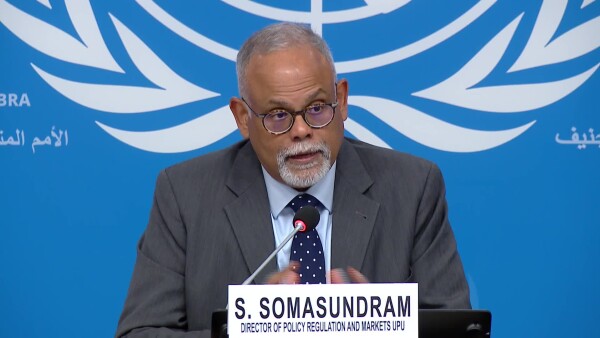
Presentation of the Trade and Developement Report 2026
Embargoed until 9 October 2026 at 11 a.m. (Geneva Time)
UNCTAD: UNCTAD’s flagship report finds that governments increasingly use industrial, trade, financial and technology policies to pursue economic and national security objectives. Market access and the ability to move into higher-value activities now depend more heavily on technology, finance and geopolitics.
1
1
1
Press Conferences | UPU
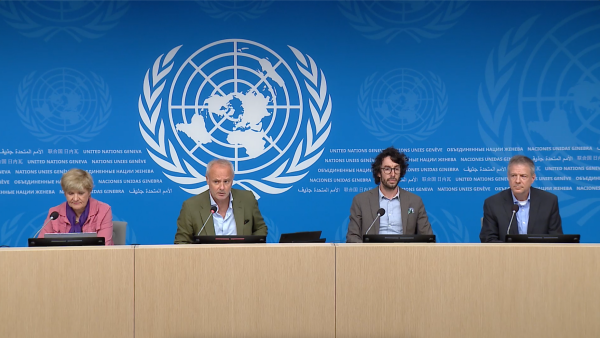
Release of the State of the Postal Sector Report 2026
1
1
1
Press Conferences | IOM , ITU , UNECE , UNICEF , WHO , WMO
UNICEF: Ebola, DRC - children orphans or separating them from parents and caregivers; IOM: Humanitarian needs in Djibouti amid arrivals from Yemen and increased migrant movements; WHO: Darfur, scale of health needs far exceeds available resources; WMO co-sponsored Global Heat Forum, Bangkok, monthly Global Seasonal Climate Update; UNECE: UN Forum of Mayors; ITU Plenipotentiary Conference 2026; WHO: child and adolescent obesity guidelines and new global roadmap to tackle pregnancy hypertension, a leading cause of maternal mortality
1
1
1
Press Conferences | OCHA , UN WOMEN , UNHCR , WFP , WHO , WTO , UNEP
OCHA – $160M CERF allocation to 12 underfunded crises; UNHCR – 5.8M refugee children remain out of school amid funding cuts; UN Women – Middle East escalation and food security among women/girls; WHO – Gaza supplies and overall situation; WFP – Yemen food insecurity and impact on global hunger ; UNEP - First International Conference of the Global Framework on Chemicals in Geneva | 16-20 November 2026
1
1
1
Press Conferences | UNHCR , WHO
Yemen's health system nears collapse amid conflict, causing rising casualties and medicine shortages.
1
1
1
Press Conferences | HRC
Update by the Expert Mechanism to Advance Racial Justice and Equality in Law Enforcement
1
1
1
Press Conferences | WIPO , WHO , UNICEF , UNHCR , IOM , WFP , FAO
WIPO Global Innovation Index 2026 launch and press conference, WHO Composition of influenza vaccines for the 2027 Southern Hemisphere flu season, UNICEF Yemen hunger and malnutrition; UNHCR Sudan displacement into Chad; IOM Ebola and population movements in DRC; WFP emergency food assistance in Nepal; and FAO food loss and waste.