

The United Nations Office at Geneva
Multimedia Newsroom
UN rights forum’s action on climate and COVID-19 vaccines shows its relevance, says President
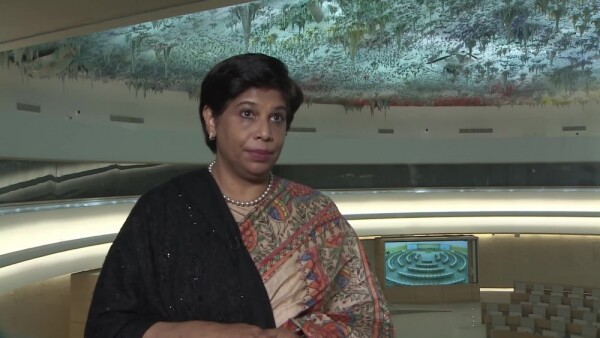
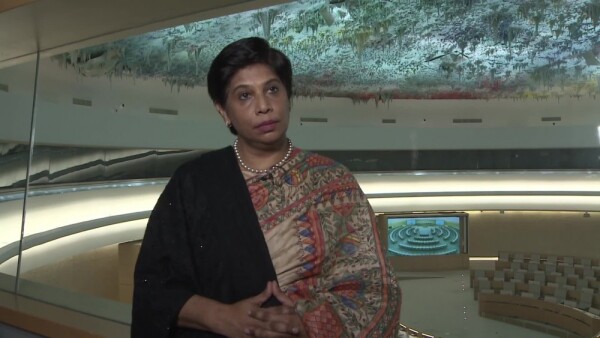
After one of the busiest years in the history of the Human Rights Council, President Nashat Shameem Khan insisted on Thursday that the UN forum remains more relevant than ever, citing action on COVID-19 vaccine inequity, climate change and no less than five Special Sessions in Geneva.
Speaking to the UN as she prepares to step down from her one-year term at the Council at the end of the month, Ambassador Khan also looked ahead to her new role at the International Criminal Court (ICC), where her appointment as Deputy Prosecutor was announced at the start of the week.
Created by the UN General Assembly in 2006, of the most important roles of the Council is to address immediate and important human rights violations around the world – not least the coronavirus pandemic and vaccine inequity - Ambassador Khan explained.
“There were some substantive issues from the COVID 19 pandemic, and one was the access to vaccines,” she said. “This is a conversation that is happening everywhere in the world, whether within countries, we have an equal access to vaccines by all communities, especially those which are most vulnerable. And secondly, are we having an equitable transfer of vaccines among countries. So, I think that conversation was really amplified this year. There was a resolution which was adopted by consensus, which was led by Ecuador, which really discussed access to vaccines and really discussed the need to have equity both within countries and amongst them.”
And in a year that brought nations together for the COP26 Climate Summit in Glasgow, the Human Rights Council amplified calls for action on cutting emissions from a rights-based perspective, despite historic resistance in some quarters, Ambassador Khan continued.
“There are many people in the world who believe that the only conversation you can have on climate change is in Bonn with the UNFCCC (United Nations Framework Convention on Climate Change), and that is none of the business of the Human Rights Council to speak about issues which are relevant to the environment. But increasingly, I think many more countries have recognized that climate change is a relevant discussion in every UN agency, in every institution. It's the business of everyone. And so we have seen proportionately with the increasing numbers of small States in the Council, we have seen an increased focus.”
By way of example of this new awareness over the risks posed by climate change, Ambassador Khan pointed to increased international activity and pronouncements on the issue, within the sphere of human rights.
Then came comments, recommendations and reports about climate change from specialised bodies appointed by the Council, known as UN Special Procedures and Treaty Body experts. This included the Committee on the Rights of the Child, which issued a report on the impact of climate change and children.
It was this kind of foundational work “over many, many years” in the climate change versus rights nexus that work culminated in two landmark resolutions at the Council this year on climate and environmental rights, Ambassador Khan explained.
“One …recognized the right to a healthy, safe and sustainable environment; and the second was the creation of a mandate for climate change and human rights. Both are incredibly significant for the world. Of course, they're very important to small island States, particularly in the Pacific, but they are significant for the whole world. And the fact that there was such an overwhelming level of support for both resolutions, I think, really indicate an increasing consensus that this is an important conversation in the context of human rights.”
Reflecting the importance placed on achieving gender equality at the UN, Ambassador Khan underscored the Council’s support for this, and inclusivity in general, in particular for small island States.
But she explained that as only the third woman to sit in the President’s seat at the Council, although she was proud of her achievement, “we need to do a lot of self-examination” about why so few women have come before her.
“Often when people speak at the Council, the question should be, are they speaking at a level which makes decisions because often in organizations and institutions, you will find 50 per cent and more representation of women, but they are often at the level where they are not they're not really making the decisions. So, the issue is, where is the leadership of women? I think this is the very important issue for the Council. How many ambassadors in Geneva are women who are still in the minority, although there's a very, very good network.”
On a positive note, Ambassador Khan added that “after much effort and commitment”, more than half of the Council’s independent experts were women. “So, I think we've achieved something there, but it could fall back at any time,” she said. “I don't think we should be complacent about it.”
Responding to concerns that any politicisation of the Council risked paralysing its work - a longstanding criticism of the Council and something that the body’s next President raised shortly after his appointment – Ambassador Khan said that the body’s diverse range of views was no surprise, given its global membership of 47 States.
It was also important to note that there was no division of the Council “in two bands of sort of developed countries and developing countries”, she said. The current dynamic was more “nuanced”, she continued, with smaller countries that were “less likely to be connected to any large power group” responsible for promoting “helpful and productive” exchanges.
“I spoke a little earlier about the recognition of the right to a healthy environment that did not start off as a consensus conversation, nor did the conversation on the creation of the mandate holder for climate change start off as a consensus conversation,” she said. “But I think it was because there was a very inclusive conversation. There was a strong involvement by smaller States, which are not connected to any kind of big power brokers and which really insisted on having this conversation that changed the nature of the discourse in the Council.”
After presiding over no less than five Special Sessions at the Human Rights Council in 2021, in addition to the three regular sessions held in February, June and September, Ambassador Khan can expect little rest before taking up her next challenge at International Criminal Court (ICC).
The former Fijian criminal prosecutor and High Court judge will take with her a greater understanding of the world of international cooperation “and the importance of diplomacy”, she insists.
“The International Criminal Court is not just a court, it's also an international institution and it's also a multilateral body. And I believe that in fact, this particular step that I take now is a logical conclusion of the way that my career path has developed for the fight for my life. So I think that it is going to be an extremely challenging experience, but it is one for which I believe my career has prepared me for. I look forward to it. As to what areas of work I would be covering, that is, of course, entirely at the discretion of the (ICC) chief prosecutor (Karim Khan). And I don't know that yet. I'm assuming that in the next few months it'll become clearer.”
ends
STORY: 2021 Human Rights Council President Nazhat Shameem Khan
TRT: 03 min 54s
SOURCE: UNTV CH
RESTRICTIONS: NONE
LANGUAGE: ENGLISH
ASPECT RATIO: 16:9
DATELINE: 16 DECEMBER 2021 GENEVA, SWITZERLAND
SHOTLIST
- Exterior wide shot, United Nations flags flying.
- Close shot, inside the UN Geneva Assembly Hall, Ambassador Khan using the gavel.
- SOUNDBITE (English): Nazhat Shameem Khan, Human Rights Council President: “There were some substantive issues from the COVID 19 pandemic, and one was the access to vaccines. This is a conversation that is happening everywhere in the world, whether within countries, we have an equal access to vaccines by all communities, especially those which are most vulnerable. And secondly, are we having an equitable transfer of vaccines among countries? So I think that conversation was really amplified this year. There was a resolution which was adopted by consensus, which was led by Ecuador, which really discussed access to vaccines and really discussed the need to have equity both within countries and amongst them”.
- Medium shot, inside the UN Geneva Assembly Hall, Ambassador Khan announcing the next speaker.
- SOUNDBITE (English): Nazhat Shameem Khan, Human Rights Council President: “There are many people in the world who believe that the only conversation you can have on climate change is in Bonn with the UNFCCC (United Nations Framework Convention on Climate Change), and that is none of the business of the Human Rights Council to speak about issues which are relevant to the environment. But increasingly, I think many more countries have recognized that climate change is a relevant discussion in every UN agency, in every institution. It's the business of everyone. And so we have seen proportionately with the increasing numbers of small States in the Council, we have seen an increased focus.”
- Medium-wide shot, inside the UN Geneva Assembly Hall.
- SOUNDBITE (English): Nazhat Shameem Khan, Human Rights Council President: “One which recognized the right to a healthy, safe and sustainable environment. And the second was the creation of a mandate for climate change and human rights, and both are incredibly significant for the world. Of course, they're very important to small island States, particularly in the Pacific, but they are significant for the whole world. And the fact that there was such an overwhelming level of support for both resolutions, I think, really indicate an increasing consensus that this is an important conversation in the context of human rights.”
- Medium shot, inside the UN Geneva Assembly Hall, Ambassador Khan concluding a Human Rights Council session.
- SOUNDBITE (English): Nazhat Shameem Khan, Human Rights Council President: “Often when people speak at the Council, the question should be, are they speaking at a level which makes decisions because often in organizations and institutions, you will find 50% and more representation of women, but they are often at the level where they are not they're not really making the decisions. So the issue is where is the leadership of women? I think this is the very important issue for the Council. How many ambassadors in Geneva are women who are still in the minority, although there's a very, very good network.”
- Medium-wide shot, inside Room XX (home of the Human Rights Council).
- SOUNDBITE (English): Nazhat Shameem Khan, Human Rights Council President: “I spoke a little earlier about the recognition of the right to a healthy environment that did not start off as a consensus conversation, nor did the conversation on the creation of the mandate holder for climate change start off as a consensus conversation. But I think it was because there was a very inclusive conversation. There was a strong involvement by smaller States, which are not connected to any kind of big power brokers and which really insisted on having this conversation that changed the nature of the discourse in the Council.”
- Close shot, inside the Assembly Hall, Ambassador Khan using the gavel.
- SOUNDBITE (English): Nazhat Shameem Khan, Human Rights Council President: “The International Criminal Court is not just a court, it's also an international institution and it's also a multilateral body. And I believe that in fact, this particular step that I take now is a logical conclusion of the way that my career path has developed for the fight for my life. So I think that it is going to be an extremely challenging experience, but it is one for which I believe my career has prepared me for. I look forward to it. As to what areas of work I would be covering, that is, of course, entirely at the discretion of the (ICC) chief prosecutor (Karim Khan). And I don't know that yet. I'm assuming that in the next few months it'll become clearer.”
- Medium-wide shot, inside Room XX (home of the Human Rights Council).
Similar Stories

1
1
1
Edited News | OCHA , UNICEF , WFP
Aid agencies warned on Friday of the fast-developing humanitarian emergency inside Taiz City in Yemen, which has been encircled by de facto Houthi forces fighting government troops along the country’s west coast.

2
17
1
2
Edited News , Press Conferences , Images | OCHA , WMO
Two UN agencies teamed up on Wednesday to issue an appeal for immediate assistance to help communities already being impacted by the strongest El Niño on record.

3
16
2
2
Edited News , B-roll , Conferences , Images | UNITED NATIONS , UNOG
Sixth Consultative Meeting on Enhancing Coordination of Peace Initiatives and Efforts for Sudan

1
1
1
Edited News | UNICEF , WHO , UNHCR
Yemen war continues to force families from homes amid hunger and disease
More than 250,000 people have now fled renewed fighting in Yemen, the UN said on Tuesday, citing particular concern for those sheltering in the southwestern city of Taiz and the wider governorate, where access is “essentially blocked”.

1
1
1
Edited News | UNICEF
A little over one year since a ceasefire agreement was announced between Hamas fighters and Israel, more than 340 children have been reported killed and hundreds more injured, the UN Children’s Fund, UNICEF, said on Friday.

1
1
1
Edited News | UNICEF , IFRC
Six weeks after Nepal’s deadly flooding disaster, communities are still struggling to rebuild their lives, but they will need sustained help as global warming increases the risk of another Himalayan catastrophe, the UN Children’s Fund (UNICEF) said on Friday.

1
1
1
Edited News | WHO
In suspected Russia plague death, testing and monitoring underway – WHO
The death of a lab worker in Russia’s Siberia region has sparked concerns about plague being the cause, the UN World Health Organization (WHO) said on Tuesday, adding that it was following the situation closely.

1
1
Edited News | OHCHR , UNOG
UN Human Rights Chief Volker Türk on Friday provided and oral update to the 63rd session of the Human rights Council on Ukraine.

1
1
1
Edited News | OHCHR , UNOG
UN Human Rights Chief Volker Türk on Friday provided and oral update to the 63rd session of the Human rights Council on the human rights situation in Haiti.

1
1
1
Edited News | WHO
Repeated delays in bringing lifesaving medicines, prosthetics and more from Israel into Gaza risk having devastating consequences on Palestinians who urgently need them in the wartorn enclave, the UN World Health Organization (WHO) said on Friday. “A truck full of non-priority supplies or the right supplies arriving too late, doesn't save lives. That's the question that actually matters," said Dr Reinhilde Van De Weerdt, WHO Representative in the OPT.

1
1
1
Edited News | WHO
DRC: Early access to care and oxygen decisive for Ebola patients’ survival – WHO
In the Democratic Republic of the Congo (DRC), health workers fighting the country’s largest-ever Ebola outbreak are struggling to overcome critical challenges to patient care, the UN World Health Organization (WHO) warned on Tuesday.

1
1
1
Edited News | OCHA , UN
Civilians in Iran are continuing to feel the consequences of months of conflict and military escalation, the UN’s top official in the country has said, as loss of life, damage to civilian infrastructure and mounting economic pressures leave many facing continued uncertainty.