

The United Nations Office at Geneva
Multimedia Newsroom
STORYLINE
As Russia’s full-scale invasion of Ukraine enters its third year, UN humanitarians warned on Friday of the severe mental health implications the ongoing war has on people affected, mainly children, but also their parents.
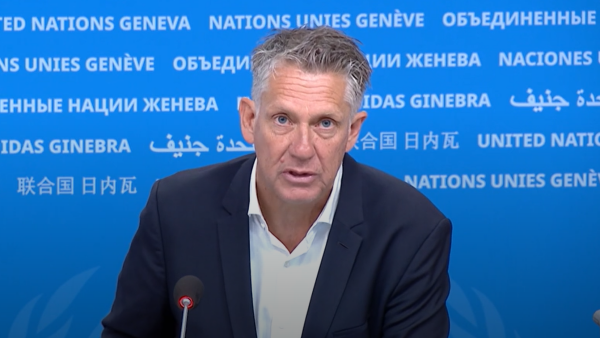
“UNICEF estimates that over the past two years of this war, children in Ukraine's frontline areas have been forced to spend between 3000 hours and 5000 hours underground. That's the equivalent of between around 4 to 7 months,” said James Elder, spokesperson for UNICEF, briefing journalists at the United Nations in Geneva. “Take a moment trying to imagine spending what would be the equivalent of 200 days over the past two years, confined to a basement, to a bunker, to a hole in the ground.”
Mr. Elder, who was speaking from the Kharkiv, said that this situation has become “absolutely devasting to mental health”. According to survey data, half of 13- to 15-year-olds have trouble sleeping, and 1 in 5 have intrusive thoughts and flashbacks – typical manifestations of post-traumatic stress disorder. Three-quarters of children and young people aged 14 to 34 have recently reported needing emotional or psychological support.
“The ongoing shelling, the increased use of drones, all this is building into an awareness that children continue to be killed and so it's hindering family’s capacity to overcome the deep stress and trauma inflicted by this war”, said James Elder. He added that “parents across Ukraine reported their children are suffering from excessive fear, anxiety, sleeplessness, phobias, sadness. And so, at a time when parental care is needed most, half of those parents surveyed reported that they are struggling to support their children.”
In its latest report from 22 February 2024, the UN Human Rights Monitoring Mission in Ukraine (HRMMU) has verified 30,457 civilian casualties since 24 February 2022 – comprising 10,582 killed and 19,875 injured, with the actual numbers likely to be significantly higher.
Millions have been displaced, thousands have lost their homes, and hundreds of medical and educational institutions have been damaged or destroyed, significantly impacting people’s rights to health and education.
Children in frontline areas have been in a school for a single week over the past four years, two years of Covid-19 and two years of full -scale war, said UNICEF. In the Kharkiv region, two out of 700 schools are delivering in-person learning. Schools would be now also very important for awareness raising programs.
“Ukraine is now the most mined country on the planet,” reported UNICEF’s spokesperson. “So, when we talk about childhood being robbed, no socialization, no school, no ability to play in those areas.” He added that “we have trained 5000 counselors and supporters to do mine risk education, which is now part of the curriculum thanks to the government. But the attacks continue, the isolation in bunkers continue, and as such, the attritional nature of this war is not just being played out on the front lines in the battlefields, but in families’ lives, in families’ homes.”
The psychological scars for children, said Mr. Elder, are deepening by the day. However, they are not the only ones who are suffering from the war.
“Some of the most vulnerable people are older people and rural areas. A lot of them have lost their loved ones, they've lost their homes, they have lost their savings. They're going into debt,” said David Fisher, head of the delegation of the International Federation of the Red Cross and Red Crescent Societies (IFRC) in Ukraine. “Ukraine Red Cross has this home-based care program that they've been doing for many years, and they have mobile health units to bring medical support into these rural areas that just absolutely have no access to it on a day-to-day basis.”
According to the IFRC, people have trouble accessing essential services, medicines, food, even water, medicine, but they are trying to build their lives. Unemployment and high prices are affecting many other vulnerable people in those communities as well.
For Mr. Fisher “recovery is the way to go. We have not only many hospitals, rehabilitation centers, schools that have been destroyed for which, some minimal repairs can make a difference. But we also need to do recovery and people's health and their livelihoods and their wellbeing,” he said. “It's time for us now as international community to be investing in this more comprehensive way instead of just relief items.”
-ends –
STORY: Ukraine: Two years of war – UNICEF, IFRC
TRT: 3:24”
SOURCE: UNTV CH
RESTRICTIONS: NONE
LANGUAGE: ENGLISH / NATS
ASPECT RATIO: 16:9
DATELINE: 23 February 2024 GENEVA, SWITZERLAND
11. Exterior medium shot: UN flag alley
22. Wide shot: speakers at the podium during a press conference
33. SOUNDBITE (English) – James Elder, spokesperson for UNICEF (from Kharkiv): “UNICEF estimates that over the past two years of this war, children in Ukraine's frontline areas have been forced to spend between 3000 hours and 5000 hours underground. That's the equivalent of between around 4 to 7 months. So, just take a moment trying to imagine spending what would be the equivalent of 200 days over the past two years, confined to a basement, to a bunker, to a hole in the ground.”
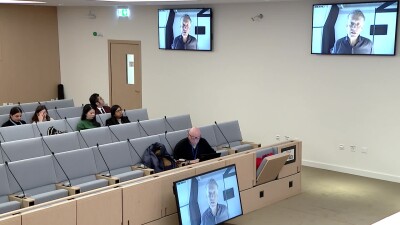
44. Wide shot: press room with journalists and screens with speaker
55. SOUNDBITE (English) – James Elder, spokesperson for UNICEF (from Kharkiv): “So the ongoing shelling, the increased use of drones, all this is building into an awareness that children continue to be killed and so it's hindering family’s capacity to overcome the deep stress and trauma inflicted by this war. Parents across Ukraine reported their children are suffering from excessive fear, anxiety, sleeplessness, phobias, sadness. And so, at a time when parental care is needed most, half of those parents surveyed reported that they are struggling to support their children.”
66. Medium shot: conference operators
77. SOUNDBITE (English) – James Elder, spokesperson for UNICEF (from Kharkiv): “Ukraine is now the most mined country on the planet. So, when we talk about childhood being robbed, no socialization, no school, no ability to play in those areas. We have trained 5000 counselors and supporters to do mine risk education, which is now part of the curriculum thanks to the government. But the attacks continue, the isolation in bunkers continue, and as such, the attritional nature of this war is not just being played out on the front lines in the battlefields, but in families’ lives, in families’ homes.”
88. Wide shot: press room with journalists and speaker on podium
99. SOUNDBITE (English) - David Fisher, IFRC head of delegation in Ukraine (from Kyiv): “Some of the most vulnerable people are older people and rural areas. A lot of them have lost their loved ones, they've lost their homes, they have lost their savings. They're going into debt. Ukraine Red Cross has this home-based care program that they've been doing for many years, and they have mobile health units to bring medical, you know, sort of support into these rural areas that just absolutely have no access to it on a day-to-day basis.”
110. Close up: journalists listening
111. SOUNDBITE (English) - David Fisher, IFRC head of delegation in Ukraine (from Kyiv): “The biggest needs, I would say, is in rural areas where just it's very hard to access basic services. Incomes are lower. And, you know, we have, you know, sort of families who have split up. And as I mentioned, like, you know, sort of older people, disabled people are the ones that are most vulnerable.”
112. Wide shot: press room with speakers at the podium, journalists in the room and screens with speaker
113. SOUNDBITE (English) - David Fisher, IFRC head of delegation in Ukraine (from Kyiv): “Recovery is the way to go. And so, we have not only many hospitals, rehabilitation centers, schools that have been destroyed for which, you know, some minimal repairs can make a difference. But we also need to do recovery and people's health and their livelihoods and their wellbeing. It's time for us now as international community to be investing in this more comprehensive way instead of just, you know, relief items.”
114. Medium shot: press room with journalists listening
115. Close up: journalist listening
116. Wide shot: press room with journalists and speaker on screens
Similar Stories
1
1
1
Edited News | OCHA , UNICEF
At least six million people in Somalia are going days without enough food, UN aid teams warned on Friday, highlighting that nearly two million of this number are young children “at high risk of illness or death”.
1
1
1
Edited News | UNICEF , WHO
Children shot, stabbed and pepper-sprayed in occupied West Bank; scores of Gaza amputees denied prosthetics, aid teams warn
Israeli military operations and surging settler attacks in the occupied West Bank are killing and maiming Palestinian children, while in Gaza tens of thousands with life-changing injuries lack access to treatment and rehabilitation, UN agencies warned on Tuesday.

1
1
1
Edited News | WHO
The risk of hantavirus spreading to the general population is “absolutely low”, the UN World Health Organization (WHO) stressed on Friday.
1
1
1
Edited News | UNHCR , IFRC
Death and destruction have continued unabated in Lebanon while communities are still unable to return to their homes despite a ceasefire that began on 17 April, humanitarians said on Tuesday.
1
1
Edited News | WHO
Deadly hantavirus on board cruise ship may be transmitted among humans - WHO
Hantavirus victims on a ship in the Atlantic Ocean may have been infected prior to joining the cruise and human-to-human transmission on board cannot be ruled out – although it is rare - the World Health Organization (WHO) said on Tuesday.
1
1
1
Edited News | OHCHR
UN rights chief concerned by upheld convictions of Cambodian activists.
1
1
1
Edited News | UNHCR , OHCHR
Middle East crisis puts aid, food, fuel further out of reach for millions already struggling – UN agencies
As the Middle East crisis continues the humanitarian fallout is worsening, with aid route disruptions and food and fuel price hikes wrecking the lives and rights of the most vulnerable, UN agencies warned on Friday.
1
1
2
Edited News | UNMAS
Demining experts from around the world have been sharing their collective shock at the widespread and growing threat from unexploded ordnance, the new head of the UN Mine Action Service (UNMAS) said on Wednesday.
1
1
1
Edited News | OHCHR , UNOG
The UN Human Rights Office in Syria conducted a 5-day visit to the northeast of the country where they received accounts of human rights violations and abuses.
1
1
1
Edited News | UNICEF
Sudan: ‘History repeating itself’ for Darfur’s children - UNICEF
Mass atrocities in Sudan’s Darfur 20 years ago reverberated as far as Hollywood, but today, a new generation of children faces attacks, hunger and displacement in an emergency largely ignored by the outside world, the UN Children’s Fund (UNICEF) warned on Tuesday.
1
1
Edited News | WHO , UNMAS
Desperate and dangerous conditions in Gaza continue to hamper recovery efforts for the wartorn enclave's people, the UN health agency said on Friday, while demining experts warned that they’ve “barely scratched the surface” in assessing the level of contamination of unexploded ordnance.
2
1
2
Press Conferences , Edited News
The continued support of UN Member States to Lebanon will be “indispensable” to boost the country’s national armed forces and provide humanitarian assistance with more than one million people still uprooted by the Middle East war, the UN's peacekeeping chief said on Wednesday.