

The United Nations Office at Geneva
Multimedia Newsroom
Les intervenants contre Ebola luttent contre la propagation de l'épidémie en RD Congo
L'épidémie mortelle du virus Ebola en RD Congo continue de se propager à travers le vaste pays malgré certains succès dans sa maîtrise, ont déclaré mardi des responsables de l'aide, dans un nouvel appel au soutien international pour aider les intervenants sur le terrain.
Points clés
- 7 200 cas d'Ebola et près de 3 500 décès signalés
- L'épidémie se propage sur une zone couvrant deux fuseaux horaires
- L'insécurité, les mauvaises routes et les lacunes de financement entravent la réponse
- Le nombre de cas hebdomadaires double dans certaines parties du Nord-Kivu
“Si nous n'avons pas les ressources, l'épidémie reviendra… elle reste une épidémie mortelle et massive,” a souligné Julien Harneis, Coordonnateur spécial de l'ONU pour Ebola.
Les dernières données du 12 septembre indiquent 7 200 cas signalés d'Ebola et près de 3 500 décès dans 62 zones de santé, selon l'Organisation mondiale de la santé (OMS) des Nations Unies. Le virus est désormais présent dans sept provinces “couvrant une très vaste zone géographique”, a déclaré le Dr Olivier le Polain, Chef de l'Unité d'épidémiologie et d'analytique pour la réponse à l'OMS. “Bien que la réponse ait été sans précédent dans son ampleur, l'épidémie continue de s'étendre.”
En partenariat avec les autorités, les agences de l'ONU et les partenaires ont aidé à lutter contre l'épidémie du virus Ebola Bundibugyo depuis que l'urgence a été déclarée à la mi-mai.
Mais il y a d'énormes défis à relever pour travailler dans des régions riches en ressources où les populations ont connu des décennies d'insécurité violente et de revers de développement.
“[Dans] de nombreuses zones, les routes sont de gigantesques nids-de-poule – même pas des nids-de-poule – les camions disparaissent dans la boue ; [dans] de nombreuses zones, l'accès, même par petit avion, est compliqué. Et puis il y a la violence contre la réponse,” a expliqué M. Harneis. “Nous avons des cas à Bunia, en Ituri et à l'autre extrémité du pays à Sud-Ubangi, c'est comme une distance de Genève à Dublin.”
Le coordonnateur de l'aide vétéran a averti que la réponse humanitaire de 1,3 milliard de dollars n'est financée qu'à 49 pour cent, tandis que l'Ebola “aggrave les choses pour tous les Congolais, “de l'aggravation des niveaux de faim à la baisse de la fréquentation des centres de santé, à l'augmentation de la mortalité maternelle” et au traitement interrompu pour les personnes vivant avec le VIH/SIDA.
“Nous avons fait beaucoup de travail positif en augmentant la capacité des lits, mais à moins d'obtenir plus de soins médicaux spécialisés, nous finirons par atteindre un plateau,” a poursuivi M. Harneis, soulignant la nécessité pour les pays de déployer immédiatement des équipes médicales d'urgence internationales.
“Si vous ne fournissez pas les soins, si vous ne financez pas les soins, si vous ne fournissez pas les ressources techniques, alors Ebola est un ennemi vivant et reviendra vers nous,” a-t-il averti, ajoutant qu'un autre milliard de dollars sera nécessaire pour soutenir la réponse au-delà des six premiers mois. “Il y a eu quelques indications de la part des États membres qu'ils pourraient être prêts à envoyer ces équipes, mais nous avons besoin d'un soutien et d'une dévotion bien plus grands de ces ressources.”
L'épidémie d'Ebola continue de se dérouler dans des zones de grands besoins humanitaires et prendra “de nombreux mois pour maîtriser complètement cette épidémie”, a insisté le Dr le Polain de l'OMS. L'épidémiologiste a décrit comment les infections commençaient à diminuer dans certaines zones mais augmentaient “exponentiellement” dans d'autres, y compris le Nord-Kivu, où le nombre de cas hebdomadaires a maintenant doublé, passant d'environ 100 à 200 cas. “Nous sommes particulièrement préoccupés par Butembo et Katwa”, un axe majeur dans la partie nord du Nord-Kivu, a expliqué le responsable de l'OMS.
Dans d'autres provinces, la situation “reste mixte”, sans nouveau cas confirmé au Sud-Kivu depuis la fin mai. “Nous avons eu un cas récent maintenant dans une nouvelle province, au Sud-Ubangi, qui nécessitera une réponse spécifique et cette réponse est en cours de mise en place en ce moment,” a déclaré le Dr le Polain.
fin
Histoire : Mise à jour sur l'Ebola en RDC – OCHA OMS
SOURCE : UNTV CH
RESTRICTIONS : AUCUNE
LANGUE : ANGLAIS / FRANÇAIS / NATS
RAPPORT D'ASPECT : 16:9
Durée : 3’02”
DATE : 15 septembre 2026 - GENÈVE, SUISSE et images de Lita, Ituri, RDC, y compris dans un centre de traitement. Veuillez créditer l'OMS.
Orateurs :
- Julien Harneis, Coordinateur spécial pour l'Ebola (OCHA)
- Dr Olivier le Polain, Chef de l'unité d'épidémiologie et d'analyse pour la réponse (OMS)
LISTE DE PLANS
- Plan extérieur moyen, allée des drapeaux de l'ONU.
- Large, salle de presse, orateurs au podium.
- EXTRAIT SONORE (Anglais) - Julien Harneis, Coordinateur spécial pour l'Ebola (OCHA) : « C'est, cela reste, une épidémie mortelle et massive, il y a certaines zones de progrès mais néanmoins dans d'autres zones nous continuons à voir une augmentation des cas.»
- Large, salle de presse, orateurs au podium.
- EXTRAIT SONORE (Anglais) - Dr Olivier le Polain, Chef de l'unité d'épidémiologie et d'analyse pour la réponse (OMS) : « Au 12 septembre, nous avons eu 7 200 cas signalés et près de 3 500 décès à travers 62 zones de santé et maintenant sept provinces, couvrant une très vaste zone géographique. Bien que la réponse ait été sans précédent dans son ampleur, l'épidémie continue de s'étendre.»
- Moyen-large, orateurs au podium et écran de télévision montrant l'orateur.
- EXTRAIT SONORE (Anglais) - Julien Harneis, Coordinateur spécial pour l'Ebola (OCHA) : « Pour décrire l'étendue, nous avons des cas à Bunia, en Ituri et à l'autre extrémité du pays à Sud-Ubangi, c'est comme une distance de Genève à Dublin.»
- Large, journalistes.
- EXTRAIT SONORE (Anglais) - Julien Harneis, Coordinateur spécial pour l'Ebola (OCHA) : « [Dans] de nombreuses zones, les routes sont de gros nids-de-poule - même pas des nids-de-poule - les camions disparaissent dans la boue ; [dans] de nombreuses zones, l'accès, même par petit avion, est compliqué. Et puis il y a la violence contre la réponse.»
- Large, journalistes.
- EXTRAIT SONORE (Anglais) - Dr Olivier le Polain, Chef de l'unité d'épidémiologie et d'analyse pour la réponse (OMS) : « En Nord-Kivu, nous voyons les cas augmenter. Au cours des deux dernières semaines, le nombre de cas hebdomadaires est passé d'environ 100 cas par semaine il y a quelques semaines, à 200 cas par semaine la semaine dernière. Donc, c'est un doublement des cas en seulement quelques semaines chez ces personnes. Nous sommes préoccupés par Butembo et Katwa en particulier - cet axe central urbain dans la partie nord du Nord-Kivu - ainsi que Beni.»
- Large, salle de presse, vidéojournaliste, écrans de télévision montrant l'orateur.
- EXTRAIT SONORE (Français) - Dr Olivier le Polain, Chef de l'unité d'épidémiologie et d'analyse pour la réponse (OMS) : « La situation est plutôt mixte, la situation est plutôt hétérogène. Mais qu’on a certains, peut-être certains signes très, très initiaux d’une épidémie qui commence à fléchir dans certaines zones, mais qui augmente de manière exponentielle dans d’autres zones. »
- Large, salle de presse.
- Moyen, journaliste.
- Large, vidéojournalistes.
- Large, vue des arbres filmée d'en bas, Ituri, RDC ; veuillez créditer l'OMS.
- Gros plan, voiture roulant sur une route en terre, filmée au niveau de la roue de la voiture, Lita, Ituri, RDC, y compris dans un centre de traitement ; veuillez créditer l'OMS
- Large, convoi de réponse à l'Ebola circulant le long d'une route en terre bordée d'arbres ; veuillez créditer l'OMS.
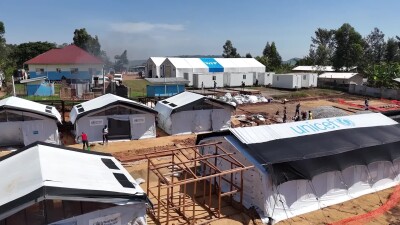
- Large, centre de traitement de l'Ebola, vue aérienne par drone ; veuillez créditer l'OMS.
- Large, centre de traitement de l'Ebola ; vue aérienne par drone ; veuillez créditer l'OMS.
- Large, centre de traitement de l'Ebola, vue aérienne par drone ; veuillez créditer l'OMS.
Similar Stories

1
1
1
Edited News | OCHA , UNICEF , WFP
Aid agencies warned on Friday of the fast-developing humanitarian emergency inside Taiz City in Yemen, which has been encircled by de facto Houthi forces fighting government troops along the country’s west coast.

2
17
1
2
Edited News , Press Conferences , Images | OCHA , WMO
Two UN agencies teamed up on Wednesday to issue an appeal for immediate assistance to help communities already being impacted by the strongest El Niño on record.

3
16
2
2
Edited News , B-roll , Conferences , Images | UNITED NATIONS , UNOG
Sixth Consultative Meeting on Enhancing Coordination of Peace Initiatives and Efforts for Sudan

1
1
1
Edited News | UNICEF , WHO , UNHCR
Yemen war continues to force families from homes amid hunger and disease
More than 250,000 people have now fled renewed fighting in Yemen, the UN said on Tuesday, citing particular concern for those sheltering in the southwestern city of Taiz and the wider governorate, where access is “essentially blocked”.

1
1
1
Edited News | UNICEF
A little over one year since a ceasefire agreement was announced between Hamas fighters and Israel, more than 340 children have been reported killed and hundreds more injured, the UN Children’s Fund, UNICEF, said on Friday.

1
1
1
Edited News | UNICEF , IFRC
Six weeks after Nepal’s deadly flooding disaster, communities are still struggling to rebuild their lives, but they will need sustained help as global warming increases the risk of another Himalayan catastrophe, the UN Children’s Fund (UNICEF) said on Friday.

1
1
1
Edited News | WHO
In suspected Russia plague death, testing and monitoring underway – WHO
The death of a lab worker in Russia’s Siberia region has sparked concerns about plague being the cause, the UN World Health Organization (WHO) said on Tuesday, adding that it was following the situation closely.

1
1
Edited News | OHCHR , UNOG
UN Human Rights Chief Volker Türk on Friday provided and oral update to the 63rd session of the Human rights Council on Ukraine.

1
1
1
Edited News | OHCHR , UNOG
UN Human Rights Chief Volker Türk on Friday provided and oral update to the 63rd session of the Human rights Council on the human rights situation in Haiti.

1
1
1
Edited News | WHO
Repeated delays in bringing lifesaving medicines, prosthetics and more from Israel into Gaza risk having devastating consequences on Palestinians who urgently need them in the wartorn enclave, the UN World Health Organization (WHO) said on Friday. “A truck full of non-priority supplies or the right supplies arriving too late, doesn't save lives. That's the question that actually matters," said Dr Reinhilde Van De Weerdt, WHO Representative in the OPT.

1
1
1
Edited News | WHO
DRC: Early access to care and oxygen decisive for Ebola patients’ survival – WHO
In the Democratic Republic of the Congo (DRC), health workers fighting the country’s largest-ever Ebola outbreak are struggling to overcome critical challenges to patient care, the UN World Health Organization (WHO) warned on Tuesday.

1
1
1
Edited News | OCHA , UN
Civilians in Iran are continuing to feel the consequences of months of conflict and military escalation, the UN’s top official in the country has said, as loss of life, damage to civilian infrastructure and mounting economic pressures leave many facing continued uncertainty.