

The United Nations Office at Geneva
Multimedia Newsroom
Press Conferences | UNICEF , UNHCR , UNOG , WFP , UNDP
Bi-Weekly Press Briefing 02 November 2021
Climate change
Alessandra Vellucci, for the UN Information Service (UNIS), said that the previous day the Secretary-General had addressed COP26 in Glasgow, providing a blunt assessment of the world state of climate. Today, the Secretary-General would meet with five regional groups, world leaders, and representatives of civil society, including youth.
Gautam Narasimhan, UNICEF’s Global Lead for Climate, Energy and Environment, said that 2021 was expected to be among the warmest years on record. At COP26 there had been many statements by world leaders in which children and youth featured prominently, but meaningful action that was actually considering children was still lacking. UNICEF had examined all of the 103 submitted National Determined Contributions (NCDs), only one third of which were found to be child sensitive. Only 12 percent of the NCDs reported that children had participated in the development of the plans. Leaders by large continued to pay lip service to child rights and child inclusion, said Mr. Narasimhan.
UNICEF was imploring governments to take three actions: 1) increase investment in climate adaptation and resilience, with developed countries needing to exceed the agreed USD 100 billion annual climate financing; 2) speed up greenhouse emission reductions, as the world’s children could not afford more delay; 3) include young people in climate negotiations and discussions, as they were the generation that would be most affected by the ongoing climate change.
Responding to questions, Mr. Narasimhan said that survey after survey showed that children and young people deeply cared about the climate change. Children would bear both the physical and mental brunt of the climate change. Every child and young person alive today had been born into a world fully aware of the consequences of inaction on climate, yet leaders were still unable to agree on measures to stop it. It was nonetheless hoped that the universal love for children would lead to a great action on climate change, stressed Mr. Narasimhan.
Sarah Bel, for the United Nations Development Programme (UNDP), informed about the the new local climate campaign: From Geneva to Glasgow, United for the Earth. A press conference would be held on 3 November at 9:30 at the Museum of Natural History to launch this cultural event, result of the collaboration between UNOG, UNDP, local Geneva authorities and Cassandra's Hourglass. For the first time ever, an iconic projection would be made on the UN building that would last for the duration of the COP26 to mobilize citizens' energies to be actors and co-creators of solutions for the climate crisis. A large gathering within this campaign would take place at the Place des Nations in Geneva on 9 November.
Climate change induced hunger in Madagascar
Arduino Mangoni, World Food Programme Deputy Country Director in Madagascar, stated that successive droughts had hit the south of Madagascar, the region that had already been the most vulnerable part of the country in terms of poverty, food security, nutrition, education, and infrastructure. The current droughts had been compounded by sandstorms, presence of locusts, the consequences of COVID-19, and growing insecurity, thus forming a “perfect storm”.
The latest Integrated Food Security Phase Classification (IPC) results showed growing numbers of people in IPC 3-4-5 up to December 2021. This was the only climate change induced famine in the world, stressed Mr. Mangoni. The trends in terms of food insecurity and malnutrition since 2020 were extremely concerning with growing numbers of people in IPC 4 people in IPC 5, and the number of severely malnourished children rising exponentially.
The food security and nutrition indicators were already too severe for this time of the year when the lean season was only starting. What was extremely concerning was that the numbers of malnurtured children were double those of the numbers in 2020. Lean season was starting only now, so the WFP had started scaling up in terms of ration and nutrition programmes and planning to further scale up in terms of people assisted and ration starting from December 2021 till the next good harvest, hopefully in April 2022.
Mr. Mangoni stressed that more resources were needed now; an amount of USD 69 million was necessary to cover the emergency response throughout the current lean season.
Responding to questions, Mr. Mangoni stated that 1.3 million people were in IPC category 3 and above; of them, 500,000 people were in categories 4 and 5. The lines between the categories 3, 4, and 5 were very fine; those were all people who had exhausted various copying techniques and those in category 3 could easily slide to higher categories. Even the water was scarce and harder to reach. Around half a million children under the age of five were projected to be malnourished; 110,000 of them were severely malnourished and at the risk of dying by April 2022, unless they were immediately supported. Because of the intensity of the drought, people had had a terrible harvest, explained Mr. Mangoni; in some areas it could be considered a “lost harvest”. The economic impact of the latest drought had not been gaged yet.
Tomson Phiri, for the World Food Programme (WFP), in a response to a question, explained that globally USD 6.6 billion was needed to provide, for 12 months, one meal a day to the 42 million people who were at the risk of dying of hunger. That amounted to USD 40 cents per person per day.
Sexual abuse in the Democratic Republic of the Congo
In a response to questions on sexual abuse and exploitation in the Democratic Republic of the Congo, James Elder, for the United Nations Children’s Fund (UNICEF), said that UNICEF had asked the Office of the Internal Oversight to investigate all allegations pertaining to UNICEF. One alleged perpetrator had been identified; his case was currently under investigation, and he was no longer working for UNICEF. The case was being followed on a daily basis. The organization had globally strengthened its efforts to combat sexual exploitation and abuse; almost all UNICEF country offices had improved partner reporting and training.
UNHCR begins airlifting aid to Kabul
Shabia Mantoo, for the United Nations Refugee Agency (UNHCR), informed that a plane carrying winter relief from the UN Refugee Agency’s global stockpiles in Dubai was landing in Kabul today.
The plane was carrying 33 tons of winterization kits for displaced Afghans. It was the first of three UNHCR flights, with the next two scheduled to land in Kabul on 4 and 7 November.
Humanitarian needs were rising rapidly in Afghanistan ahead of winter, when temperatures can dip to -25⁰C. Weighing 25kg, each winterization kit contained flooring, partitions, and other items to improve tent insulation against the cold. The kits also provided heat resistant protection to enable the installation of a stove.
Ms. Mantoo explained that UNHCR was using land, sea and air routes to bring humanitarian relief into Afghanistan and other countries in the region so that it could respond to the increasing needs. Further relief supplies had also been prepositioned in Termez, Uzbekistan, ready to be trucked into Afghanistan as needed. UNHCR appealed to the international community to urgently increase financial contributions to assist displaced Afghans, both within and outside the country, who remained extremely vulnerable.
Full press release is available here.
Alessandra Vellucci, for the United Nations Information Service, said that in the past week more than 90,000 people in the east of the country had received humanitarian assistance from the IOM. She recalled that UN Member States had responded generously to the call at the High-level Event on Afghanistan, held in Geneva on 13 September. However, those pledges needed to be disbursed quickly, and so far only 48 percent of USD 606 million required had been received. She added that some 30,000 people had been reached with single dose COVID19 vaccines in two provinces since 16 October.
Geneva announcements
Alessandra Vellucci, for the UN Information Service, informed that the press conference to present results of a joint investigation into alleged violations of international human rights, humanitarian and refugee law committed by all parties to the conflict in the Tigray region of Ethiopia, by the UN Human Rights Office and the Ethiopian Human Rights Commission, would be held on 3 November at 9:30 am. Speakers would be Michelle Bachelet, UN High Commissioner for Human Rights; Maarit Kohonen Sheriff, Chief of the Africa Branch at the OHCHR; and Françoise Mianda, Section Chief of East and Southern Africa at the OHCHR.
On 8 November at 10:30 am, there would be a press conference to present the World Intellectual Property Indicators Report, under embargo until 12:30 pm that day. Speakers would be Marco Aleman, Assistant Director General, IP and Innovation Ecosystems Sector; and Carsten Fink, Chief Economist at WIPO.
The Committee on the Elimination of Discrimination against Women was beginning this morning its review of the report of Kyrgyzstan, while in the afternoon the Committee would begin the review of the report of the Russian Federation.
On 4 November, at 6:30 pm, there would be a Ciné-ONU event at Cinerama Empire in Geneva, showing the documentary “Breaking Boundaries” by David Attenborough.
On today’s International Day to End Impunity for Crimes against Journalists, the Secretary-General said that the previous year, according to UNESCO, 62 journalists had been killed just for doing their jobs. Many had lost their lives to conflict. Almost nine out of ten of those killings went unpunished. The Secretary-General urged all Member States to stand in solidarity with journalists, and to investigate and prosecute crimes against them with the full force of the law.
Similar Stories
1
12
1
1
Press Conferences , Images | UNOG
Closing Press Conference following the Sixth Consultative Meeting on Enhancing Coordination of Peace Initiatives and Efforts in Sudan

2
17
1
2
Edited News , Press Conferences , Images | OCHA , WMO
Two UN agencies teamed up on Wednesday to issue an appeal for immediate assistance to help communities already being impacted by the strongest El Niño on record.
1
1
1
Press Conferences | CITES
Wildlife trade and conservation policy discussions at the 81st meeting of the CITES Standing Committee (SC81)
1
1
1
Press Conferences | UNHCR , UNCTAD , WMO , OCHA , UNICEF , WHO
UNHCR Hungary’s 1956 Refugee Crisis: 70 Years On, UNCTAD World Investment Forum 2026, Doha, WMO Greenhouse Gas Bulletin and Climate Update for COP31, OCHA Afghanistan: Malnutrition, Girls’ Education and Recovery, UNICEF Yemen: Child Malnutrition and Unsafe Water in Taiz, WHO Inequalities in Noncommunicable Diseases and Risk Factors

1
1
1
Press Conferences | UNHCR
End of UNHCR's 77th Annual Executive Committee (ExCom) meeting week

1
1
1
Press Conferences | UNICEF , IOM , UNHCR
UN Special Assistant to the Personal Envoy Office (SUDAN): Peace Initiatives and Efforts in Sudan; UNICEF: Dire situation of children in Gaza; IOM: Damaged Homes and Energy Attacks Risk Displacing Ukrainians for this winter; UNHCR: update on EXCOM week

1
1
1
Press Conferences | IOM , UNDRR
UN stresses importance of household preparedness for disaster risk reduction.
1
1
1
Statements , Press Conferences | OHCHR
1
1
1
Press Conferences | UNHCR , UNICEF , IFRC , OHCHR , UN WOMEN , IOM , OCHA , WHO
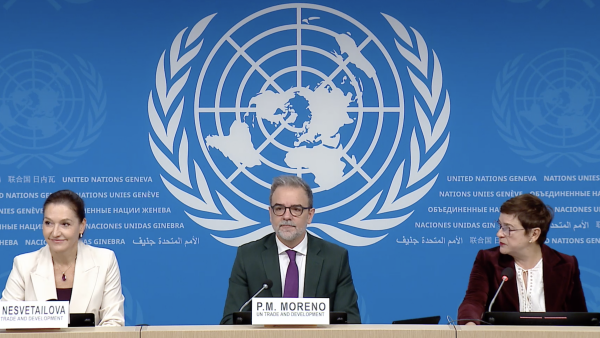
UNHCR – ExCom Meeting, UNICEF – Nepal Recovery, IFRC – Flash Floods, WHO – Mental Health, IOM – South Sudan Floods, OCHA – DRC Humanitarian aid, UNHCR – Sahel Displacement, UNICEF – Yemen Update, IOM – Gaza Shelter, UN Women – Gaza Women, OHCHR – Arrests and detentions of Syrians by Israeli force
2
1
2
Press Conferences | UNCTAD
Presentation of the Trade and Developement Report 2026
Embargoed until 9 October 2026 at 11 a.m. (Geneva Time)
UNCTAD: UNCTAD’s flagship report finds that governments increasingly use industrial, trade, financial and technology policies to pursue economic and national security objectives. Market access and the ability to move into higher-value activities now depend more heavily on technology, finance and geopolitics.
1
1
1
Press Conferences | UPU
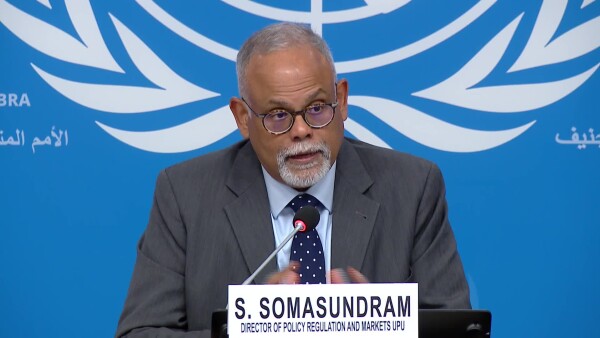
Release of the State of the Postal Sector Report 2026
1
1
1
Press Conferences | IOM , ITU , UNECE , UNICEF , WHO , WMO
UNICEF: Ebola, DRC - children orphans or separating them from parents and caregivers; IOM: Humanitarian needs in Djibouti amid arrivals from Yemen and increased migrant movements; WHO: Darfur, scale of health needs far exceeds available resources; WMO co-sponsored Global Heat Forum, Bangkok, monthly Global Seasonal Climate Update; UNECE: UN Forum of Mayors; ITU Plenipotentiary Conference 2026; WHO: child and adolescent obesity guidelines and new global roadmap to tackle pregnancy hypertension, a leading cause of maternal mortality