

The United Nations Office at Geneva
Multimedia Newsroom
Press Conferences | WHO , UNOG , UNITED NATIONS , WFP , UNCTAD , ILO , WMO , UNDP
Bi-Weekly Press Briefing 22 October 2021
Meeting of the COVID-19 IHR Emergency Committee
Tarik Jašarević, for the World Health Organization (WHO), informed that the ninth meeting of the Emergency Committee for COVID-19, convened by the WHO Director-General under the International Health Regulations (IHR), would be held today. A statement by the Committee was expected on 25 October and would be promptly shared with the media. Mr. Jašarević reminded that the IHR Emergency Committee for COVID-19 had held its first meeting on 22-23 January 2020, and on 30 January 2020, following its second meeting, the Director-General had accepted the Committee’s advice and declared a Public Health Emergency of International Concern. The Committee was continuing to meet every three months.
Responding to questions, Mr. Jašarević confirmed that the Committee would be looking into a number of issues on which it could pronounce itself. The Committee had thus far recommended not to have a proof of vaccination as a prerequisite for travel, primarily because of the unequal accessibility of the vaccines. He further explained that the WHO was in the process of establishing a Scientific Advisory Group for the Origins of Novel Pathogens (SAGO), a new permanent scientific body that would prepare a framework on how to look both into the origins of SARS-COV2 and other future outbreaks. Two weeks of public consultations on the proposed names were currently underway.
Regarding the Management Response Plan to address the findings of the Independent Commission on allegations of sexual abuse and exploitation during the response to the tenth Ebola outbreak in the Democratic Republic of the Congo, Mr. Jašarević stressed that the plan (announced in the press release the previous night) outlined short-term actions focusing on the most urgent recommendations of the report: supporting the survivors and their families; completing investigations; taking urgent managerial action and launching a series of internal reviews and audits; and reforming WHO structures and culture. WHO had terminated contracts of four people who had been identified as perpetrators and had been still employed. Mr. Jašarević also informed that the WHO had allocated an initial USD 7.6 million to strengthen its capacity to prevent, detect and respond to sexual abuse allegations in ten countries with the highest risk profile: Afghanistan, the Central African Republic, DRC, Ethiopia, Nigeria, Somalia, South Sudan, Sudan, Venezuela, and Yemen.
On another question, Mr. Jašarević said that at the moment, there were five confirmed cases of Ebola in the Kivu Province, DRC; three of them had died and two were being treated. Hundreds of contacts had been identified, most of whom were being currently monitored. Measures were being introduced into the WHO response to prevent future cases of sexual abuse. A dedicated focal point for preventing sexual abuse and exploitation had been deployed to Beni.
Answering a question, Alessandra Vellucci, for the UN Information Service, reminded that the Secretary-General had appointed the first UN System-wide Victims’ Rights Advocate, and significant steps had been taken to tackle the issue of sexual harassment and abuse throughout the UN system. There was a strict zero-tolerance policy across the Organization. Also answering a question, Ms. Vellucci confirmed that UN staff under investigation could be put on an administrative leave while the enquiry was ongoing.
COP 26
Sarah Bel, for the United Nations Development Programme (UNDP), informed that UNCTAD was organizing a pre-COP media briefer with Achim Steiner at 2:30 pm today to provide an overview of the reports and campaign UNDP would launch the following week and what are our expectations from COP 26.
The global campaign “Don’t choose extinction” to be launched on 27 October would focus on the hugely negative effects fossil fuel financing had on people and planet. There were two major elements of the campaign: one was a short, animated film in which a dinosaur went to the UN General Assembly and called on the world leaders to shift away from fossil fuel subsidies. UNDP would also release a study to put spotlight on the sheer amounts spent to support oil, electricity, gas, and coal and how that money disproportionately benefited the rich and entrenched inequality. The study brought policy recommendations for how this money could be better spent to support the most vulnerable whilst helping to limit global temperature rise. All interested could register for today’s briefing here.
Catherine Huissoud, for the United Nations Conference on Trade and Development (UNCTAD), informed that UNCTAD would release on 28 October the second part of its annual Trade and Development Report 2021. Ahead of the COP 26 climate summit, UNCTAD was calling in this report for a transformative approach to climate adaptation. Scaling up adaptation finance had to be on the table in Glasgow.
UNCTAD warned that current funding was less than a quarter of what is needed to reach the 2030 target and relying on private finance would not be sufficient for countries most in need.
UNCTAD saw green industrial policies as key if developing countries are to adapt to the stresses of a changing climate. UNCTAD proposed a 5-point plan to articulate a development led approach to climate adaptation and sees green industrial policies as key from a developing countries point of view. On 25 October at 2:30 pm, in a virtual press conference, the report would be presented by UNCTAD Secretary-General Rebeca Grynspan and Richard Kozul-Wright, Director of the division on Globalization and development strategies and main author of the report.
Other announcements
Alessandra Vellucci, for the UN Information Service (UNIS), informed that on 24 October, the UN would mark its seventy-sixth anniversary - 76 years since the UN Charter entered into force. In his message on this occasion, the Secretary-General stressed that the values that had powered the UN Charter for the last 76 years — peace, development, human rights, and opportunity for all — had no expiry date, and he called on everyone to unite behind those ideals, and live up to the full promise, potential and hope of the United Nations. On the occasion of the UN Day, today at 3:30 pm Geneva time, UN Geneva would launch a 45-minute long programme “The Choice Before Us: From Global Challenges to Stronger Multilateralism", which would be shown live at webtv.un.org.
She said that today at approximately 4:45 pm (exact time to be confirmed), there would be a hybrid press conference by the Office of the UN Special Envoy for Syria, following the conclusion of the sixth session of the Small Body of the Syrian Constitutional Committee. Speaker would be Geir O. Pedersen, the Special Envoy.
Ms. Vellucci also informed that from the following week press briefings would be held in Room B-128 in the Library Building.
Clare Nullis, for the World Meteorological Organization (WMO), informed that on 25 October at 11 am, the WMO would present the new Greenhouse Gas Bulletin, the annual report by the WMO on atmospheric concentrations of carbon dioxide and other major greenhouse gases. Speakers at the virtual press conference would be Petteri Taalas, WMO Secretary-General, and Oksana Tarasova, WMO Chief of Atmospheric and Environment Research Division.
Ms. Nullis also informed that the State of the Climate in Asia report would be released on 26 October, copies of which would be shared with the media the day before.
Rosalind Yarde, for the International Labour Organization (ILO), informed that at a virtual press conference on 27 October at 10 am the ILO would launch the eighth edition of the ILO Monitor on the impact of COVID-19 on labour markets. The report looked into how countries were grappling with the recovery, and also analyzed the impact of vaccination rates on labour markets around the world. The embargoed report and press release would be shared on 25 October. The speakers would be Guy Ryder, ILO Director-General, and Sangheon Lee, Director, ILO Employment Policy Department.
The Human Rights Committee would begin on 25 October at 3 pm its review of the report of Ukraine and would conclude it on 26 October morning.
The Committee on the Elimination of Discrimination against Women was reviewing today the report of Sweden.
Finally, on 24 October, at 11 am, at the Cinerama Empire, there would be a Ciné ONU event – screening of the documentary film “Les médias, le monde et moi”, followed by a discussion. The event, organized in the framework of the Global Media and Information Literacy Week, would be free of charge, on a first-come first-served basis.
Similar Stories
1
1
1
Press Conferences | UNHCR
End of UNHCR's 77th Annual Executive Committee (ExCom) meeting week
1
1
1
Press Conferences | UNICEF , IOM , UNHCR
UN Special Assistant to the Personal Envoy Office (SUDAN): Peace Initiatives and Efforts in Sudan; UNICEF: Dire situation of children in Gaza; IOM: Damaged Homes and Energy Attacks Risk Displacing Ukrainians for this winter; UNHCR: update on EXCOM week
1
1
1
Press Conferences | IOM , UNDRR
UN stresses importance of household preparedness for disaster risk reduction.
1
1
1
Statements , Press Conferences | OHCHR
1
1
1
Press Conferences | UNHCR , UNICEF , IFRC , OHCHR , UN WOMEN , IOM , OCHA , WHO
UNHCR – ExCom Meeting, UNICEF – Nepal Recovery, IFRC – Flash Floods, WHO – Mental Health, IOM – South Sudan Floods, OCHA – DRC Humanitarian aid, UNHCR – Sahel Displacement, UNICEF – Yemen Update, IOM – Gaza Shelter, UN Women – Gaza Women, OHCHR – Arrests and detentions of Syrians by Israeli force
2
1
2
Press Conferences | UNCTAD
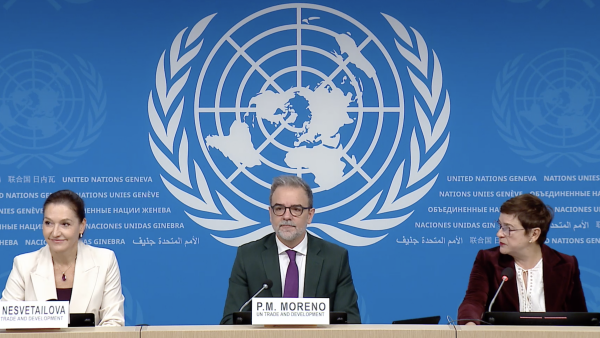
Presentation of the Trade and Developement Report 2026
Embargoed until 9 October 2026 at 11 a.m. (Geneva Time)
UNCTAD: UNCTAD’s flagship report finds that governments increasingly use industrial, trade, financial and technology policies to pursue economic and national security objectives. Market access and the ability to move into higher-value activities now depend more heavily on technology, finance and geopolitics.
1
1
1
Press Conferences | UPU
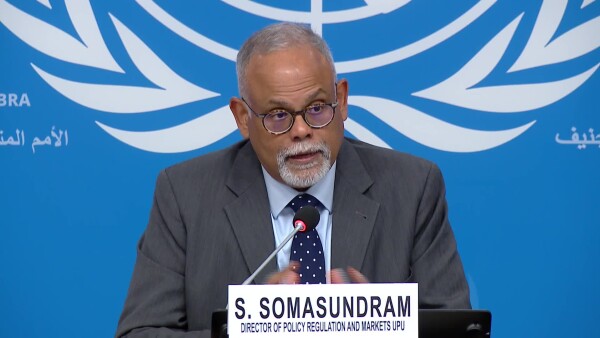
Release of the State of the Postal Sector Report 2026
1
1
1
Press Conferences | IOM , ITU , UNECE , UNICEF , WHO , WMO
UNICEF: Ebola, DRC - children orphans or separating them from parents and caregivers; IOM: Humanitarian needs in Djibouti amid arrivals from Yemen and increased migrant movements; WHO: Darfur, scale of health needs far exceeds available resources; WMO co-sponsored Global Heat Forum, Bangkok, monthly Global Seasonal Climate Update; UNECE: UN Forum of Mayors; ITU Plenipotentiary Conference 2026; WHO: child and adolescent obesity guidelines and new global roadmap to tackle pregnancy hypertension, a leading cause of maternal mortality
1
1
1
Press Conferences | OCHA , UN WOMEN , UNHCR , WFP , WHO , WTO , UNEP
OCHA – $160M CERF allocation to 12 underfunded crises; UNHCR – 5.8M refugee children remain out of school amid funding cuts; UN Women – Middle East escalation and food security among women/girls; WHO – Gaza supplies and overall situation; WFP – Yemen food insecurity and impact on global hunger ; UNEP - First International Conference of the Global Framework on Chemicals in Geneva | 16-20 November 2026
1
1
1
Press Conferences | UNHCR , WHO
Yemen's health system nears collapse amid conflict, causing rising casualties and medicine shortages.
1
1
1
Press Conferences | HRC
Update by the Expert Mechanism to Advance Racial Justice and Equality in Law Enforcement
1
1
1
Press Conferences | WIPO , WHO , UNICEF , UNHCR , IOM , WFP , FAO
WIPO Global Innovation Index 2026 launch and press conference, WHO Composition of influenza vaccines for the 2027 Southern Hemisphere flu season, UNICEF Yemen hunger and malnutrition; UNHCR Sudan displacement into Chad; IOM Ebola and population movements in DRC; WFP emergency food assistance in Nepal; and FAO food loss and waste.