

The United Nations Office at Geneva
Multimedia Newsroom
Edited News , Press Conferences | OHCHR , UNOG , UNITED NATIONS
Libya - Independent Fact-Finding Mission
Libya: War crimes likely committed since 2016, UN probe finds
War crimes and crimes against humanity have likely been committed in Libya by all parties to conflict since 2016 including by external actors, a Human Rights Council-appointed probe said on Monday.
From arbitrary detention to torture, the recruitment of child soldiers and mass killings, the Independent Fact-Finding Mission on Libya listed numerous grave rights violations which had impacted on the country’s people and which gave them “reasonable grounds” for the war crimes allegations.
Civilians were particularly at risk during the 2019-2020 fight for Tripoli, the Mission said, as well as during other violence in the country since 2016 which has been marked by attacks on hospitals, schools, migration detention centres and communities.
“Airstrikes have killed dozens of families. The destruction of health-related facilities has impacted access to health care, and anti-personnel mines left by mercenaries in residential areas have killed and maimed civilians,” said Mission chair, Mohamed Auajjar.
The investigators – whose Fact-Finding Mission was created by the Human Rights Council in June 2020 - published their findings after reviewing hundreds of documents and interviewing more than 150 individuals, alongside parallel research in Libya, Tunisia and Italy.
“Arbitrary detention in secret prisons and unbearable conditions of detention are widely used by the State or militias against anyone perceived to be a threat to their interests or views,” said the Mission’s Tracy Robinson speaking to journalists in Geneva. “Violence in Libyan prisons is committed on such a scale and with such a level of organisation that it may also amount to crimes against humanity.”
The UN-appointed independent investigators highlighted violence against migrants, refugees and other vulnerable minorities including LGBTQi individuals.
“Violations against migrants are committed on a widespread scale by State and non-State actors with a high level of organisation and with encouragement of the State. All of this is suggestive of crimes against humanity,” said Mission member Chaloka Beyani.
Mr. Beyani also pointed to worrying reports about the continued presence of foreign fighters in the country from the Syrian conflict and private mercenaries allegedly contracted by the Russia-based Wagner Group in the fight for the Libyan capital from 2019 to 2020, claims highlighted previously by the UN Working Group on the use of mercenaries.
“Our investigations have indicated that there are foreign fighters, there are mercenaries in Libya, and they have not yet left the territory of Libya as required,” he said.
Other likely violations of international law covered by the Mission included the recruitment of children to fight. “Our report also documents the recruitment and direct participation of children in hostilities, the enforced disappearance and extrajudicial killings of prominent women and continuing sexual and other forms of violence against vulnerable populations including LGBTQI persons,” said Ms. Robinson.
The Mission was also able to verify allegations of atrocity crimes committed in the town of Tarhuna, southeast of Tripoli, between 2016 and 2020, where mass graves containing the bodies of men, women and children have been found.
According to reports, the Kaniyat militia were responsible for killing perhaps hundreds of civilians in Tarhuna, their wounds indicating that they had been shot many times while blindfolded, handcuffed and with their legs tied.
Mission chair Mohamed Auajjar noted that the recently installed Government of National Unity has created the possibility of national dialogue and unification of State institutions.
The UN has been supporting peace efforts in Libya, which descended into chaos and conflict following the overthrow of President Muammar Gaddafi in 2011, resulting in the country being divided between the internationally recognized Government of National Accord (GNA) and the rival Libyan National Army (LNA).
In a statement, the Mission noted that it had identified “both Libyans and foreign actors who may bear responsibility for the violations, abuses and crimes committed in Libya since 2016”.
These names will remain on a confidential list “until the need arises for its publication or sharing with other accountability mechanisms”, the Mission continued, acknowledging the continuing work of the investigation opened in 2011 by the International Criminal Court (ICC) into alleged crimes against humanity and war crimes committed in Libya, at the request of the UN Security Council.
“As Libyans strive to secure peace, ensuring accountability for gross human rights violations and international crimes committed in the country is more necessary than ever to deter further violations and promote long-term peace and reconciliation,” said Mr. Auajjar. “We urge Libya to intensify its efforts to hold those responsible to account. It is also essential that the international community continues to provide support to the Libyan judicial authorities.”
ends
STORY: Independent Fact-Finding Mission on Libya
TRT: 2 mins 20s
SOURCE: UNTV CH
RESTRICTIONS: NONE
LANGUAGE: ENGLISH / NATS
ASPECT RATIO: 16:9
DATELINE: 04 Oct 2021 GENEVA, SWITZERLAND
SHOTLIST
- Exterior medium shot, United Nations flag flying.
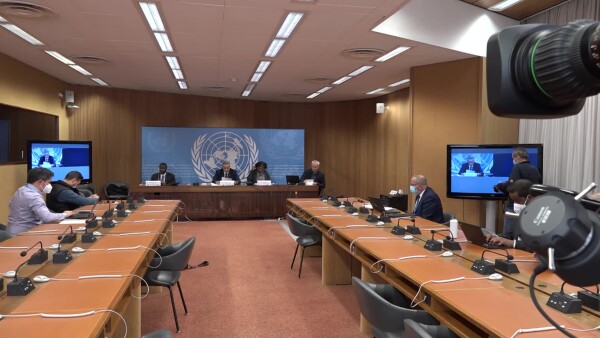
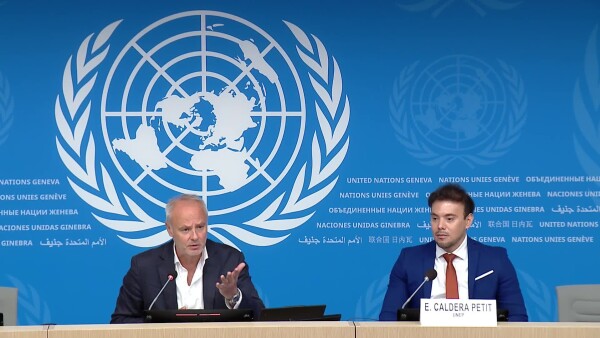
- Medium shot, inside the press conference room, showing speakers and participants.
- SOUNDBITE (English): Tracy Robinson, Member of the Independent Fact-Finding Mission on Libya: “Arbitrary detention in secret prisons and unbearable conditions of detention are widely used by the State and militias against anyone perceived to be a threat to their interests or views. Violence in Libyan prisons is committed on such a scale and with such a level of organization that it may also potentially amount to crimes against humanity.”
- Medium shot, TV camera operators filming the conference at the back of the room.
- SOUNDBITE (English): Tracy Robinson, Member of the Independent Fact-Finding Mission on Libya: “Our report also documents the recruitment and direct participation of children in hostilities, the enforced disappearance and extrajudicial killings of prominent women and continuing sexual and other forms of violence against vulnerable populations including LGBTQI persons.”
- Medium shot of the speakers and the press briefing broadcast on Zoom.
- SOUNDBITE (English): Tracy Robinson, Member of the Independent Fact-Finding Mission on Libya: “We paid particular attention to the allegations of atrocity crimes committed in the town of Tarhuna to the southeast of Tripoli between 2016 and 2020. We were able to document the existence of mass graves in Tarhuna.”
- Close shot, a photographer taking pictures of the press briefing broadcast on Zoom.
- SOUNDBITE (English): Chaloka Beyani, Member of the Independent Fact-Finding Mission on Libya: “Our investigations also indicated that migrants, asylum seekers and refugees are subjected to a litany of abuses at sea, in detention centres and at the hands of traffickers. Violations against migrants are committed on a widespread scale by State and non-State actors with a high-level organization and with encouragement of the state. All of this is suggestive of crimes against humanity.”
- Medium shot, inside the press conference room, showing participants attending the conference.
- SOUNDBITE (English): Chaloka Beyani, Member of the Independent Fact-Finding Mission on Libya: “Indeed our investigations have indicated that there are foreign fighters that are mercenaries in Libya and they have not yet Libya, and they have not yet left the territory of Libya as required.”
- Medium shot, cameramen filming the press conference.
- Medium shot, a participant attending the conference.
- Medium shot, a participant attending the conference.
Similar Stories
1
1
1
Press Conferences | IOM , UNDRR
UN stresses importance of household preparedness for disaster risk reduction.

1
1
1
Edited News | UNICEF , IFRC
Six weeks after Nepal’s deadly flooding disaster, communities are still struggling to rebuild their lives, but they will need sustained help as global warming increases the risk of another Himalayan catastrophe, the UN Children’s Fund (UNICEF) said on Friday.
1
1
1
Statements , Press Conferences | OHCHR
1
1
1
Press Conferences | UNHCR , UNICEF , IFRC , OHCHR , UN WOMEN , IOM , OCHA , WHO
UNHCR – ExCom Meeting, UNICEF – Nepal Recovery, IFRC – Flash Floods, WHO – Mental Health, IOM – South Sudan Floods, OCHA – DRC Humanitarian aid, UNHCR – Sahel Displacement, UNICEF – Yemen Update, IOM – Gaza Shelter, UN Women – Gaza Women, OHCHR – Arrests and detentions of Syrians by Israeli force
2
1
2
Press Conferences | UNCTAD
Presentation of the Trade and Developement Report 2026
Embargoed until 9 October 2026 at 11 a.m. (Geneva Time)
UNCTAD: UNCTAD’s flagship report finds that governments increasingly use industrial, trade, financial and technology policies to pursue economic and national security objectives. Market access and the ability to move into higher-value activities now depend more heavily on technology, finance and geopolitics.
1
1
1
Press Conferences | UPU
Release of the State of the Postal Sector Report 2026

1
1
1
Edited News | WHO
In suspected Russia plague death, testing and monitoring underway – WHO
The death of a lab worker in Russia’s Siberia region has sparked concerns about plague being the cause, the UN World Health Organization (WHO) said on Tuesday, adding that it was following the situation closely.
1
1
1
Press Conferences | IOM , ITU , UNECE , UNICEF , WHO , WMO
UNICEF: Ebola, DRC - children orphans or separating them from parents and caregivers; IOM: Humanitarian needs in Djibouti amid arrivals from Yemen and increased migrant movements; WHO: Darfur, scale of health needs far exceeds available resources; WMO co-sponsored Global Heat Forum, Bangkok, monthly Global Seasonal Climate Update; UNECE: UN Forum of Mayors; ITU Plenipotentiary Conference 2026; WHO: child and adolescent obesity guidelines and new global roadmap to tackle pregnancy hypertension, a leading cause of maternal mortality

1
1
Edited News | OHCHR , UNOG
UN Human Rights Chief Volker Türk on Friday provided and oral update to the 63rd session of the Human rights Council on Ukraine.

1
1
1
Edited News | OHCHR , UNOG
UN Human Rights Chief Volker Türk on Friday provided and oral update to the 63rd session of the Human rights Council on the human rights situation in Haiti.

1
1
1
Edited News | WHO
Repeated delays in bringing lifesaving medicines, prosthetics and more from Israel into Gaza risk having devastating consequences on Palestinians who urgently need them in the wartorn enclave, the UN World Health Organization (WHO) said on Friday. “A truck full of non-priority supplies or the right supplies arriving too late, doesn't save lives. That's the question that actually matters," said Dr Reinhilde Van De Weerdt, WHO Representative in the OPT.
1
1
1
Press Conferences | OCHA , UN WOMEN , UNHCR , WFP , WHO , WTO , UNEP
OCHA – $160M CERF allocation to 12 underfunded crises; UNHCR – 5.8M refugee children remain out of school amid funding cuts; UN Women – Middle East escalation and food security among women/girls; WHO – Gaza supplies and overall situation; WFP – Yemen food insecurity and impact on global hunger ; UNEP - First International Conference of the Global Framework on Chemicals in Geneva | 16-20 November 2026