

The United Nations Office at Geneva
Multimedia Newsroom
Talks on new Syrian Constitution restart in Geneva on Monday, as a “door opener for a broader political process” – says UN Special Envoy for Syria
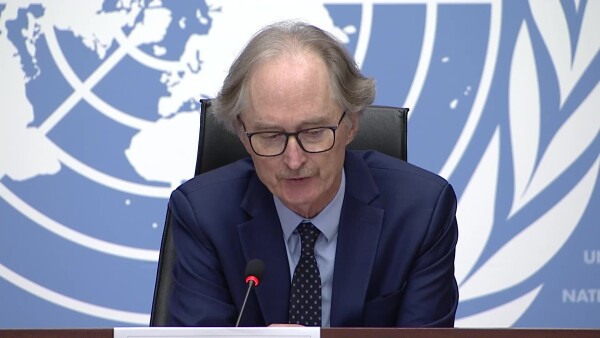
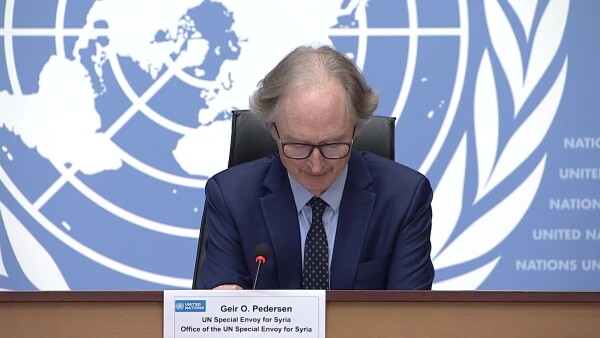
As another round of talks on Syria’s future constitution begins at United Nations premises in Switzerland on Monday, Geir Pedersen, the U.N. Special Envoy for Syria, expressed his hope that the co-chairs of the 45-member committee, known in diplomatic parlance as the Small Body, will agree on “work plans with clear agendas and topics and with an urgency in delivering progress in this process”.
The so-called Small Body refers to the 45 people (15 representatives from each of three groups: the Syrian government, the opposition and civil society) who undertake the talks in Geneva on Behalf of the larger Constitutional Committee (also known as the “Large Body”, comprising the same three group with 50 representatives each), who are charged with drafting a new constitution ahead of UN-supervised elections.
“My hope has been that the Constitutional Committee, you know, if it’s handled in the correct manner, that it could start to build trust and it could be a door opener for a broader political process,” Pedersen said. “But the Constitutional Committee cannot work in isolation from other factors. We need a political will from the different parties to be able to move forward, ” he added.
In his briefing last Wednesday to the UN Security Council, the Special Envoy described next week’s meeting as “very important”. Many topics on the agenda have been under discussion discussed for more than a year in the Constitutional Committee.
“The time has come for the co-chairs to establish what I call more effective and operational working methods, so that the meetings can be better organized and more focused. We need to ensure that the Committee begins to move from preparing a constitutional reform into actually drafting one“,Pedersen said.
Although the last 10 months have been the calmest in almost a decade of conflict in Syria, and frontlines have barely shifted, the situation could break down at any moment, Pedersen warned.
“This is a fragile calm”, he said. “All of these issues cannot be sorted out by the Syrians alone. It needs an international cooperation, and what I have said we need real negotiations, and for the different parties to sit down and have a real exchange of views on how to move this process forward. And if that political will is lacking it will be very very difficult to move this process forward”.
After nearly a decade of conflict, death, displacement, destructions, detention, millions of Syrians in the country and millions of refugees abroad are having to deal with deep trauma and a lack of hope for the future.
The UN’s Syria Envoy admitted that “the political process so far is not yet delivering real changes in Syrian’s lives nor a real vision for the future.” He said that a willingness to collaborate is essential to moving the peace process forward. “As I emphasized many times, it is now clear that no one actor or group of actors can impose their will on Syria or settle the conflict alone. They must work together,” he stated.
Pedersen said the Committee can start considering specific constitutional issues and draft provisions and agree on future meetings on specific topics. He appealed for “a more serious and cooperative international diplomacy,” saying that despite their differences key countries remain committed to the UN Security Council resolution that guides his work.
“I have called for a more serious and a cooperative international diplomacy and indeed that is needed,” Pedersen said. “It is not only needed. I strongly believe that it should be also possible. After all, despite the differences, key states are continuing to reaffirm their commitment to resolution 2254”.
Resolution 2254 was adopted by the UN Security Council in December 2015, and unanimously endorsed a road map to peace in Syria. Through this resolution, the Security Council endorsed the 30 June 2012 agreement known as the Geneva Communiqué, as the basis for a Syrian-led, Syrian-owned political transition to end the conflict.
Continuity: Audio CH1 (L) English / CH2 (R) Arabic
Edited story shotlist:
- Exterior wide shot, Palais des Nations, Flag alley, a cloudy day.
- Wide shot, press briefing room
- SOUNDBITE (English) — Geir Pedersen, U.N. Special Envoy for Syria: “This is a fragile calm. All of these issues cannot be sorted out by the Syrians alone. It needs an international cooperation, and what I have said we need real negotiations, and for the different parties to sit down and have a real exchange of views on how to move this process forward. And if that political will is lacking it will be very very difficult to move this process forward”.
- Medium shot, staff of the Office of the UN Envoy
- SOUNDBITE (English) - Geir Pedersen, U.N. Special Envoy for Syria: “The time has come for the co-chairs to establish what I call more effective and operational working methods, so that the meetings can be better organized and more focused. We need to ensure that the Committee begins to move from preparing a constitutional reform into actually drafting one. “
- Medium shot, Geir Pedersen and spokesperson
- SOUNDBITE (English) - Geir Pedersen, U.N. Special Envoy for Syria: “The political process so far is not yet delivering real changes in Syrian’s lives nor a real vision for the future. As I emphasized many times, it is now clear that no one actor or group of actors can impose their will on Syria or settle the conflict alone. They must work together”.
- Close up, journalist in press briefing room at the UN Palais
- SOUNDBITE (English) - Geir Pedersen, U.N. Special Envoy for Syria: “I have called for a more serious and a cooperative international diplomacy and indeed that is needed. It is not only needed. I strongly believe that it should be also possible. After all, despite the differences, key states are continuing to reaffirm their commitment to resolution 2254”.
- Medium shot, camera with view finder and Geir Pedersen on the podium in background
- SOUNDBITE (English) - Geir Pedersen, U.N. Special Envoy for Syria: “My hope has been that the Constitutional Committee, you know if it’s handled in the correct manner, that it could start to build trust and it could be a door opener for a broader political process. But the Constitutional Committee cannot work in isolation from other factors. We need a political will from the different parties to be able to move forward”.
- Medium shot, journalist with cell phone in press briefing room
- Wide shot, Geir Pedersen at podium
- Close up, Geir Pedersen at podium
Similar Stories

2
17
1
2
Edited News , Press Conferences | OCHA , WMO
Two UN agencies teamed up on Wednesday to issue an appeal for immediate assistance to help communities already being impacted by the strongest El Niño on record.

3
16
2
2
B-roll , Conferences , Edited News | UNITED NATIONS , UNOG
Sixth Consultative Meeting on Enhancing Coordination of Peace Initiatives and Efforts for Sudan

1
1
1
Edited News | UNICEF , WHO , UNHCR
Yemen war continues to force families from homes amid hunger and disease
More than 250,000 people have now fled renewed fighting in Yemen, the UN said on Tuesday, citing particular concern for those sheltering in the southwestern city of Taiz and the wider governorate, where access is “essentially blocked”.

1
1
1
Edited News | UNICEF
A little over one year since a ceasefire agreement was announced between Hamas fighters and Israel, more than 340 children have been reported killed and hundreds more injured, the UN Children’s Fund, UNICEF, said on Friday.

1
1
1
Edited News | UNICEF , IFRC
Six weeks after Nepal’s deadly flooding disaster, communities are still struggling to rebuild their lives, but they will need sustained help as global warming increases the risk of another Himalayan catastrophe, the UN Children’s Fund (UNICEF) said on Friday.

1
1
1
Edited News | WHO
In suspected Russia plague death, testing and monitoring underway – WHO
The death of a lab worker in Russia’s Siberia region has sparked concerns about plague being the cause, the UN World Health Organization (WHO) said on Tuesday, adding that it was following the situation closely.

1
1
Edited News | OHCHR , UNOG
UN Human Rights Chief Volker Türk on Friday provided and oral update to the 63rd session of the Human rights Council on Ukraine.

1
1
1
Edited News | OHCHR , UNOG
UN Human Rights Chief Volker Türk on Friday provided and oral update to the 63rd session of the Human rights Council on the human rights situation in Haiti.

1
1
1
Edited News | WHO
Repeated delays in bringing lifesaving medicines, prosthetics and more from Israel into Gaza risk having devastating consequences on Palestinians who urgently need them in the wartorn enclave, the UN World Health Organization (WHO) said on Friday. “A truck full of non-priority supplies or the right supplies arriving too late, doesn't save lives. That's the question that actually matters," said Dr Reinhilde Van De Weerdt, WHO Representative in the OPT.

1
1
1
Edited News | WHO
DRC: Early access to care and oxygen decisive for Ebola patients’ survival – WHO
In the Democratic Republic of the Congo (DRC), health workers fighting the country’s largest-ever Ebola outbreak are struggling to overcome critical challenges to patient care, the UN World Health Organization (WHO) warned on Tuesday.

1
1
1
Edited News | OCHA , UN
Civilians in Iran are continuing to feel the consequences of months of conflict and military escalation, the UN’s top official in the country has said, as loss of life, damage to civilian infrastructure and mounting economic pressures leave many facing continued uncertainty.
1
1
1
Edited News | WHO , UNICEF
Aid agencies in Yemen highlighted the growing hunger emergency sparked by renewed fighting between Houthi opposition forces and Government troops, after mobile health clinics reported that hundreds of children displaced by the violence are suffering from the most deadly form of malnutrition.