

The United Nations Office at Geneva
Multimedia Newsroom
Syrian Constitutional Committee should push for progress for war-weary Syrians, says UN negotiator
Work on drafting a new foundational text for war-torn Syria officially began at the UN in Geneva on Wednesday with representatives from the Government of Syria and the opposition sitting face to face and preparing to discuss the country’s future for the first time in the more than eight-year conflict.
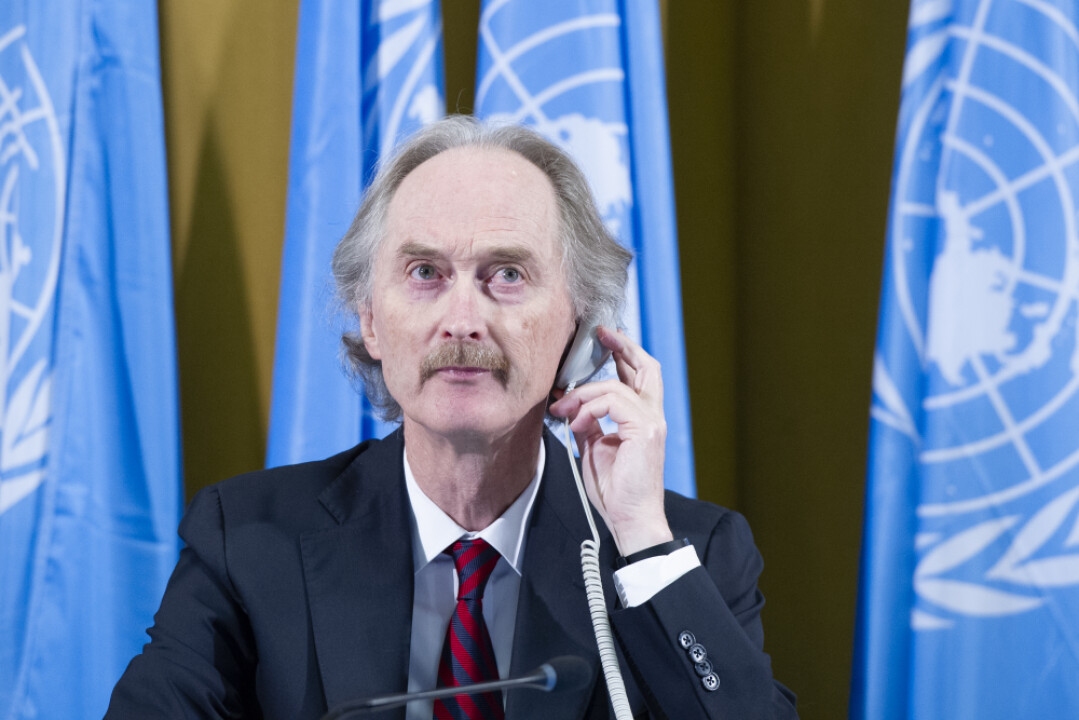
Addressing the delegations – as well as a third group representing Syrian civil society - UN Special Envoy Geir O. Pedersen urged them to seize the historic opportunity of working together, for the sake of the Syrian people.
“The future constitution belongs to Syrians, to the Syrian people and them alone,” he said, adding: “Today could become the beginning of something new, something meaningful for Syria and for Syrians everywhere. And this will be led by you, and you only as both Co-Chairs have emphasized. Together, we can make this come through, tomorrow, the hard work begins.”
According to the rules of procedure in these UN-facilitated discussions, meetings of the 150-member Committee will take place in parallel with a smaller “drafting group”, made up of 15 people from each of the three delegations.
It will be tasked with writing any new constitution, depending on what is voted on by the larger Committee.
Mr. Pedersen highlighted that the existing Syrian constitution could be re-examined, in line with UN Security Council resolution 2254, adopted unanimously on 18 December 2015 in New York.
“The Constitutional Committee may review the 2012 constitution including in the context of other Syrian constitutional experiences and amend the current constitution or draft a new constitution,” he said, adding that it was “the first political agreement between the Government and the Opposition to begin to implement a key aspect of Security Council resolution 2254, which called for setting a schedule and a process for drafting a new constitution.”
In addition to endorsing a road map for a negotiated peace between belligerents, the UN Security Council resolution also called for a nationwide ceasefire and free and fair elections, as part of a Syrian-led, Syrian-owned political transition.
Ahead of the official convening of the 150-member body at the UN’s European headquarters in Geneva, the organization’s Secretary-General, António Guterres, welcomed the fact that both the Government of Syria and the opposition Syrian Negotiations Commission “will sit together and take the first step on the political path out of the tragedy of the Syrian conflict”.
The UN chief also welcomed the fact that women’s representation on the committee was “very near 30 per cent”, a “minimum threshold” that the UN has long pushed for, in the interests of representing the widest possible number of Syrians affected by the conflict.
In his comments to the forum, the Government of Syria Co-Chair Ahmad Kuzbari expressed an openness to reviewing the country’s existing foundational text, the latest dating from 2012.
“It is a modern constitution,” he said, “but that does not prevent us Syrians from meeting for the purpose of considering any possible amendments to the current constitution or to consider a new constitution that would improve our reality and bring about a positive change that can be directly reflected in the lives of our people.”
And while Mr. Kuzbari underscored the fact that the Government was “committed to the success of this part of the political process”, he warned against “any occupying forces on our territory, the spoliation of the resources of our country and the continuing imposition of unilateral economic sanctions”.
These elements could threaten “the entire political process”, he said, insisting that they also breached the Charter of the United Nations and international legitimacy.
From the Opposition, Committee Co-Chair Hadi Albahra underscored his delegation’s desire for progress in negotiations, noting nonetheless that “the 150 people meeting today in this room have diverging opinions on many issues”.
Be that as it may, “after eight painful years of suffering in Syria, we came here determined to look for similarities and not differences”, Mr. Albahra said, highlighting that the conflict had claimed one million lives and displaced millions more. “We are fully aware of the aspirations of a whole nation that awaits salvation from unspeakable suffering.”
He also appealed for progress on other confidence-building measures on the ground in Syria, particularly the release of prisoners - or information about them.
“We must achieve the release of all detainees at the hands of all parties and to discover the fate of the missing and the forcibly displaced, we must respect the right of families to know the fate of their loved ones,” he said.
- Wide shot, exterior, Palais des Nations, Geneva.
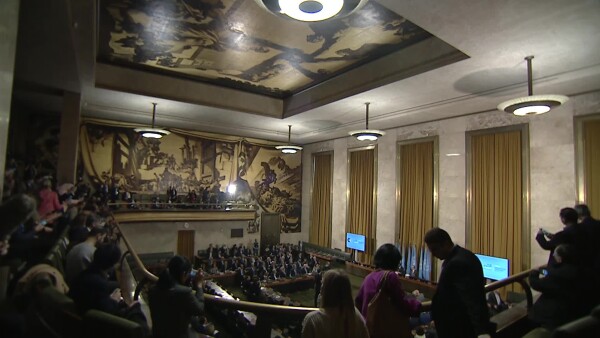
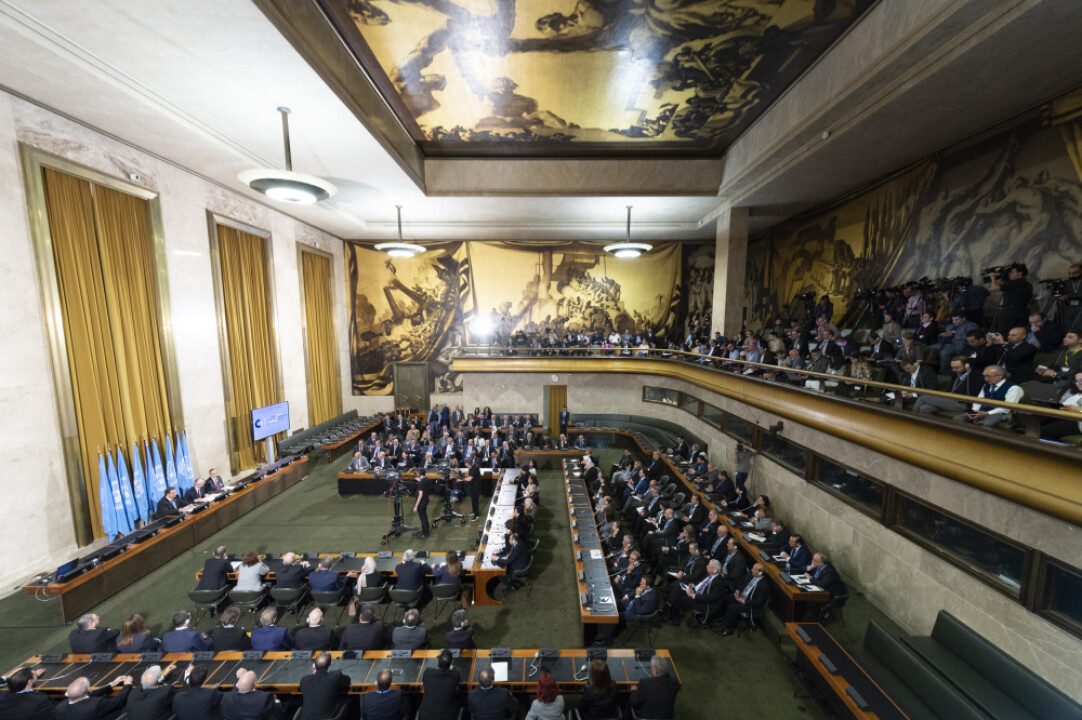
- Wide shot, journalists and members of the Syrian Constitutional Committee in the Council Chamber at United Nations Geneva.
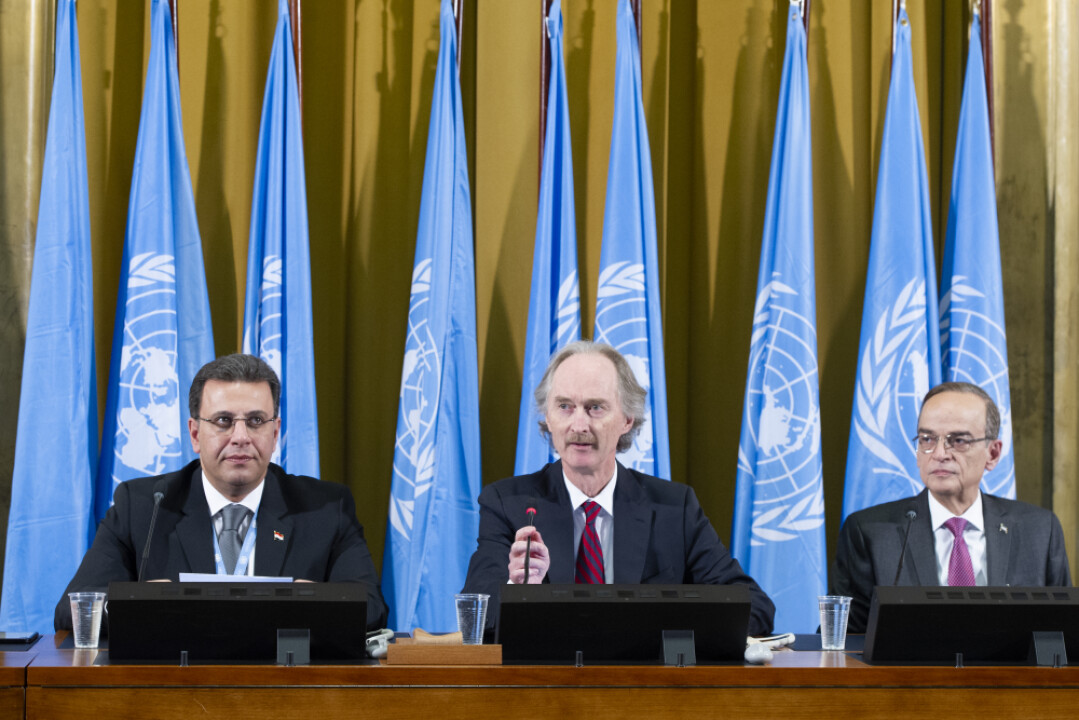
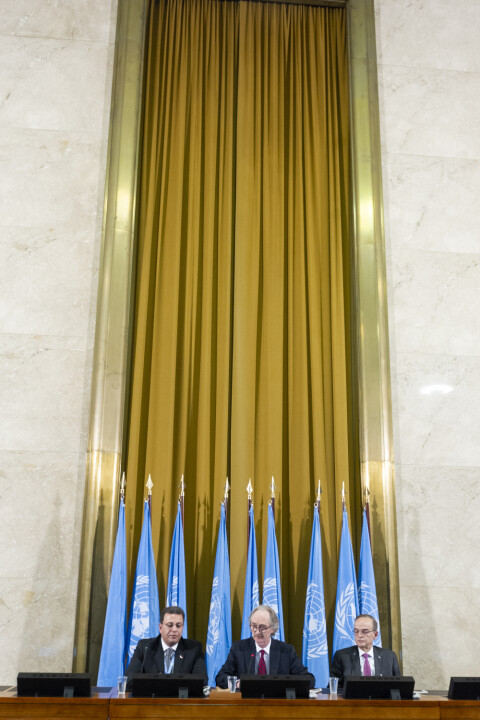
- Medium shot, Geir O. Pedersen, UN Special Envoy for Syria, and Syrian Constitutional Committee Co-Chairs Mr. Ahmad Kuzbari from the Government and Mr. Hadi Albahra from the opposition, Council Chamber.
- SOUNDBITE (English) — Geir O. Pedersen, UN Special Envoy for Syria: “Today could become the beginning of something new, something meaningful for Syria and for Syrians everywhere. And this will be led by you, and you only as both Co-Chairs have emphasized. Together, we can make this come through, tomorrow, the hard work begins.”
- Medium shot, Members of the Syrian Constitutional Committee, Council Chamber.
- SOUNDBITE (English) — Geir O. Pedersen, UN Special Envoy for Syria: “This is the first political agreement between the Government and the Opposition to begin to implement a key aspect of Security Council resolution 2254, which called for setting a schedule and a process for drafting a new constitution.”
- Medium shot, panning, Members of the Syrian Constitutional Committee, Council Chamber.
- SOUNDBITE (English)— Geir O. Pedersen, UN Special Envoy for Syria: “The Constitutional Committee may review the 2012 constitution including in the context of other Syrian constitutional experiences and amend the current constitution or draft a new constitution.”
- Medium shot, panning, Members of the Syrian Constitutional Committee, Council Chamber.
- SOUNDBITE (English) — Geir O. Pedersen, UN Special Envoy for Syria: “The future constitution belongs to Syrians, to the Syrian people and them alone.”
- Close up, large TV screen showing “Syrian Constitutional Committee UN Geneva”, Council Chamber.
- SOUNDBITE (English) — Ahmad Kuzbari, Co-Chair (Government of Syria): “It is a modern constitution but that does not prevent us Syrians from meeting for the purpose of considering any possible amendments to the current constitution or to consider a new constitution that would improve our reality and bring about a positive change that can be directly reflected in the lives of our people .”
- Medium shot, podium with speakers (Geir O. Pedersen, UN Special Envoy for Syria, and Syrian Constitutional Committee Co-Chairs Mr. Ahmad Kuzbari from the Government and Mr. Hadi Albahra from the Opposition), Council Chamber.
- SOUNDBITE (English) — Hadi Albahra, Co-Chair (opposition): “We must achieve the release of all detainees at the hands of all parties and to discover the fate of the missing and the forcibly displaced, we must respect the right of families to know the fate of their loved ones.”
- Medium shot, Members of the Committee with photographer passing in front, Council Chamber.
- SOUNDBITE (English) — Ahmad Kuzbari, Co-Chair (Government of Syria): “We are committed to the success of this part of the political process. At the same time, we affirm that the presence of any occupying forces on our territory, the spoliation of the resources of our country and the continuing imposition of unilateral economic sanctions threaten the entire political process, as well as being in contradiction with international legitimacy and breaching the Charter of the United Nations.”
- Medium shot, Members of the Committee, panning, Council Chamber.
- SOUNDBITE (English) — Hadi Albahra, Co-Chair (opposition): “We all know that the 150 people meeting today in this room have diverging opinions on many issues. Some of these are simple and some others are substantive, but after eight painful years of suffering in Syria, we came here determined to look for similarities and not differences; we are fully aware of the aspirations of a whole nation that awaits salvation from unspeakable suffering.”
- Wide shot, panning, Council Chamber gallery, journalists and TV crews.
- Medium shot, Members of the Committee, Council Chamber.
Similar Stories

1
1
1
Edited News | WHO
In suspected Russia plague death, testing and monitoring underway – WHO
The death of a lab worker in Russia’s Siberia region has sparked concerns about plague being the cause, the UN World Health Organization (WHO) said on Tuesday, adding that it was following the situation closely.

1
1
Edited News | OHCHR , UNOG
UN Human Rights Chief Volker Türk on Friday provided and oral update to the 63rd session of the Human rights Council on Ukraine.

1
1
1
Edited News | OHCHR , UNOG
UN Human Rights Chief Volker Türk on Friday provided and oral update to the 63rd session of the Human rights Council on the human rights situation in Haiti.

1
1
1
Edited News | WHO
Repeated delays in bringing lifesaving medicines, prosthetics and more from Israel into Gaza risk having devastating consequences on Palestinians who urgently need them in the wartorn enclave, the UN World Health Organization (WHO) said on Friday. “A truck full of non-priority supplies or the right supplies arriving too late, doesn't save lives. That's the question that actually matters," said Dr Reinhilde Van De Weerdt, WHO Representative in the OPT.

1
1
1
Edited News | WHO
DRC: Early access to care and oxygen decisive for Ebola patients’ survival – WHO
In the Democratic Republic of the Congo (DRC), health workers fighting the country’s largest-ever Ebola outbreak are struggling to overcome critical challenges to patient care, the UN World Health Organization (WHO) warned on Tuesday.

1
1
1
Edited News | OCHA , UN
Civilians in Iran are continuing to feel the consequences of months of conflict and military escalation, the UN’s top official in the country has said, as loss of life, damage to civilian infrastructure and mounting economic pressures leave many facing continued uncertainty.
1
1
1
Edited News | WHO , UNICEF
Aid agencies in Yemen highlighted the growing hunger emergency sparked by renewed fighting between Houthi opposition forces and Government troops, after mobile health clinics reported that hundreds of children displaced by the violence are suffering from the most deadly form of malnutrition.
1
1
1
Edited News | UNHCR
Displacement on the rise in Yemen as fighting continues - UNHCR
As hostilities worsen in Yemen, more people have been fleeing their homes, further intensifying the humanitarian crisis within the region, the UN Refugee Agency (UNHCR) warned on Tuesday.
1
1
1
Edited News | IOM , OHCHR , UNFPA , UNOG , UNHCR , WHO
Yemen’s humanitarian crisis growing by the hour amid spike in displacement
Yemenis displaced by renewed fighting have described fleeing for their lives amid shelling and gunfire, aid agencies reported on Friday, while highlighting the dramatic increase in humanitarian needs in the country and in Djibouti, where thousands have sought shelter.
1
1
1
Edited News | OHCHR , UNOG
The UN Human Rights Office issued on Friday a report documenting a shocking pattern of sexual violence amid Russia’s full-scale armed attack on Ukraine.
2
1
2
Edited News , Press Conferences | WMO
As world’s water reserves change, countries must prepare for a new reality: WMO
New data showing that rivers were at their lowest level for decades last year provides further evidence that the climate crisis is real and countries must act immediately to protect themselves from the increasing threat to communities and livelihoods, the UN World Meteorological Organization (WMO) said on Thursday.
The key findings from WMO’s State of Global Water Resources 2025 report covering the hydrological cycle and extreme events in the five-year period to last year:
- 2025 was one of driest years for river discharge in 35 years
- Past seven years have seen abnorfmal river flows
- Water storage on Earth’s land surface has decreased in past decade
- Widespread glacier loss across all regions for fourth consecutive year
- Asia and Africa are regions most affected by water-related disasters
- Water data availability has improved, but gaps remain in hard-hit areas
Highlighting the long-term decline in the Earth’s freshwater storage and glacier melt, WMO Secretary-General Celeste Saulo explained that the planet’s water reserves used to act as a planetary “savings account” that absorbed the occasional dry season, avoiding a water crisis. “One of the central stories of the 2025 report is what is happening to that savings account? And the simple answer is that we are depleting it,” she told journalists in Geneva.
Groundwater reserves are equally stretched and have been in decline since 2014, WMO’s report states, with nearly two-thirds of monitored wells worldwide showing levels lower than the historical norm and indicating a shift “further toward deficit…not recovery”.
“At the same time, we are seeing more water-related disasters,” Ms. Saulo said, while also stressing that the currently strengthening El Niño “will increase the risk of drought in some areas, and flooding in others”.
Glaciers disappearing
In 2025, for the fourth consecutive year, every major glaciated region on Earth lost ice mass, leading to short-term hazards including floods and long-term water insecurity, according to WMO.
Responding to a question about whether the changing global water cycle might have contributed to the deadly Nepal-China flooding disaster, Ms. Saulo explained that melting ice and rock was just one factor in the chain of events that ultimately sent a massive and deadly wall of water and debris downstream on 26 August, killing at least 1,367 people.
“You asked if it could happen again? Absolutely; the problem in this region is that there’s 63,700 glaciers at the last count,” she told a Press Conference in Geneva. “Even if you’re looking with remote sensing with satellites at these glaciers, you might see some faults, you might see some slight shifting, that does not mean necessarily catastrophic collapse. So, in order to plan for this, it’s very, very difficult. But the international community is looking very hard at ways in which we can bring people together to solve some of these monitoring issues.”
Data indicates that glaciers shrank between 2023 and 2025 with cumulative losses of 1,400 gigatonnes of water – or about one third of annual fresh water needs.
Every major glacier region on Earth lost ice for the fourth consecutive year.
“All 19 glacier regions around the globe lost ice; in Central Asia, Iceland, the Russian Arctic and western Canada and the United States, it was among the three worst years on record,” said Wayne Jenkinson, WMO’s Director of Hydrology and Cryosphere.
Some regions with smaller glaciers such as Central Europe, the Caucasus, the western Canada and the United States may already have reached “peak water”, Mr. Jenkinson warned.
“After this point, the glacier gives less meltwater each year simply because there is less ice left to melt. That matters for every community downstream that relies on water during hot, dry summers,” he explained.
Narelle van der Wel, WMO’s Head of Cryosphere Monitoring, Predictions and Services, stressed that while some further glacier loss is unavoidable, the eventual scale of the decline is not predetermined.
“Some glacier loss is inevitable, but total loss of glaciers is not yet inevitable,” she said, pointing to emissions reductions as central to limiting future losses.
Preparing for moving baselines
The report does not attribute every observed change to climate change alone. WMO says pressure on water resources and natural variability also contribute.
Mr. Jenkinson said governments need to prepare for “moving baselines” as historical patterns become less reliable.
“The situation 30 years ago is not where we are today,” he said. Countries, he added, need to prepare “for those changes that have really already arrived”.
ends
1
1
1
Edited News | OCHA , WHO
The deadly Ebola virus outbreak in DR Congo continues to spread across the vast country despite some success in containing it, aid officials said on Tuesday, in a renewed call for international support to help responders on the ground.