

The United Nations Office at Geneva
Multimedia Newsroom
Edited News | UNICEF , OCHA , WHO , UNHCR
Myanmar earthquake update UNICEF - OCHA - WHO - UNHCR
Myanmar earthquake latest: window for lifesaving support is closing, say UN humanitarians
As the death toll continues to rise in earthquake-struck Myanmar, UN humanitarians have been rushing to support severely deprived and traumatized victims, warning that the window for lifesaving response is closing.
Speaking to journalists from Yangon on Tuesday, Julia Rees, Deputy Representative of the UN Children’s Fund (UNICEF) in the country described seeing massive needs rising by the hour.
“Entire communities have been flattened,” she said, with children and families sleeping out in the open with no homes to return to.
“I met children who were in shock after witnessing their homes collapsed or the death of a family member… some have been separated from their parents and others are unaccounted for,” she explained.
Some 72 hours after the quake rocked Mandalay and Sagaing regions as well as Nay Pyi Taw and southern Shan state, the death toll has risen to around 2,000, according to the country’s military junta, with hundreds unaccounted for and thousands injured.
“The window for lifesaving response is closing,” Ms. Rees said, while across the affected areas, families face acute shortages of clean water, food and medical supplies.
The UN Office for the Coordination of Humanitarian Affairs (OCHA) said that local search and rescue teams, supported by international rescue units from a number of countries including China, India, Russia, Thailand and Bangladesh, have been “intensifying their efforts” particularly in central Myanmar, which has continued to experience aftershocks.
The UN’s top humanitarian official on the ground, Marcoluigi Corsi, freshly back from a visit to the country’s capital Nay Pyi Taw said that as the critical window for finding survivors under the rubble was narrowing, conditions in the affected areas continued to deteriorate.
“You have no electricity, you have no running water,” he said, while people were battling the summer heat. “Often there are aftershocks and people are scared to go inside their homes,” he added.
Dr. Fernando Thushara, the representative of the World Health Organization (WHO) in Myanmar, said that in Nay Pyi Taw, he saw hospitals “overwhelmed with patients”.
“The medical supplies were running dry. There were electricity disruptions in some hospitals… and shortages of running water,” he said, adding that in some cases power generators were not working and hospitals were short on fuel.
Dr. Thushara warned that a lack of fresh water and sanitation could fuel outbreaks of infectious diseases “unless we control them very quickly”.
He recalled that a few months back, several townships in Mandalay had been affected by cholera. About 800 cases of the water-borne disease had been reported until February across nine states and regions in Myanmar, while other infectious diseases such as dengue, hepatitis, malaria may spread further.
The dire health situation is not the only crisis confronting the people of Myanmar. UN refugee agency (UNHCR) spokesperson Babar Baloch stressed that the country is “reeling” from four years of conflict sparked by a military coup in 2021, while the UN’s Mr. Corsi said that in the past few years it has suffered a cyclone and massive flooding.
Mr. Baloch spoke of a “double tragedy” for the people of Myanmar, highlighting the fact that even before the devastating earthquake hit, all the affected areas already hosted 1.6 million displaced people.
Mr. Corsi stressed that the disaster-affected communities’ resilience is now highly compromised. Close to 20 million people across the country were already in need of humanitarian assistance before the earthquake hit and over 15 million were going hungry. Over three months into the year, the UN’s $1.1 billion humanitarian appeal for Myanmar remains only five per cent funded. “This is time…for the world to step up and support the people of Myanmar,” he concluded.
-Ends-
STORY: Myanmar earthquake update UNICEF - OCHA - WHO - UNHCR 1 April 2025
TRT: 2:16”
SOURCE: UNTV CH
RESTRICTIONS: NONE
LANGUAGE: ENGLISH/ NATS
ASPECT RATIO: 16:9
DATELINE: 1 APRIL 2025 GENEVA, SWITZERLAND
1. Exterior wide shot: Palais des Nations, Flag Alley.
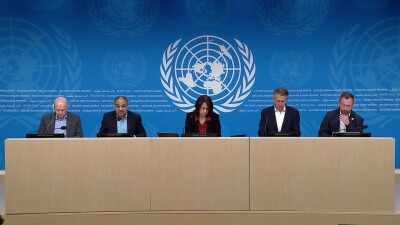
2. Wide shot: Speakers at the podium of the press conference; speaker on screens; journalists in the Press room.
3. SOUNDBITE (English) – Julia Rees, Deputy Representative in Myanmar, UN Children’s Fund (UNICEF): “What I saw was devastating. Entire communities have been flattened. Children and families are sleeping out in the open with no homes to return to. I met children who were in shock after witnessing their homes collapsed or the death of a family member, and some have been separated from their parents and others are unaccounted for.”
4. Wide shot: Speaker on screens; journalists in the Press room.
5. SOUNDBITE (English) – Julia Rees, Deputy Representative in Myanmar, UN Children’s Fund (UNICEF): “The needs are massive and they’re rising by the hour. The window for lifesaving response is closing. And across the affected areas, families are facing acute shortages of clean water, food and medical supplies.”
6. Wide shot: Speakers at the podium of the press conference from rear; speaker on screens; journalists in the Press room.
7. SOUNDBITE (English) – Marcoluigi Corsi, UN Resident and Humanitarian Coordinator a.i. in Myanmar: “You have no electricity, you have no running water. This is summertime, it’s very hot. And homes are being damaged or destroyed. And because of course, there are often, aftershocks and the people are indeed scared to go inside their homes.”
8. Wide shot: Speaker on screens; journalists in the Press room.
9. SOUNDBITE (English) – Dr. Fernando Thushara, Representative in Myanmar, World Health Organization (WHO): “I saw the influx of patients to the hospitals in Nay Pyi Taw. Hospitals were overwhelmed with patients. The medical supplies were running dry. There were electricity disruptions in some hospitals. The generators even were not working and shortages of running water. And they were low on fuel.”
10. Wide shot: Speaker on screens; journalists in the Press room.
11. SOUNDBITE (English) – Dr. Fernando Thushara, Representative in Myanmar, World Health Organization (WHO): “The hardships that some of them are facing today in terms of water, sanitation, etcetera, will turn into outbreaks of infectious diseases in the future, unless we control them very quickly.”
12. Wide shot: Speakers at the podium in the Press room.
13. SOUNDBITE (English) – Babar Baloch, spokesperson, UN Refugee Agency (UNHCR): “Even before this devastating earthquake that hit, all the affected areas were hosting 1.6 million people that were displaced.”
14. Various shots of speakers and journalists in the Press room.
B-roll available:
UNICEF: https://weshare.unicef.org/Package/2AM408M02Q3T
UNHCR: https://media.unhcr.org/asset-management/2CZ9LOYKN8SO?WS=SingleAsset_SharePublic
and photos from IFRC: https://shared.ifrc.org/collections/_QGw2Ax5d
Similar Stories

1
1
1
Edited News | UNICEF
A little over one year since a ceasefire agreement was announced between Hamas fighters and Israel, more than 340 children have been reported killed and hundreds more injured, the UN Children’s Fund, UNICEF, said on Friday.

1
1
1
Edited News | UNICEF , IFRC
Six weeks after Nepal’s deadly flooding disaster, communities are still struggling to rebuild their lives, but they will need sustained help as global warming increases the risk of another Himalayan catastrophe, the UN Children’s Fund (UNICEF) said on Friday.

1
1
1
Edited News | WHO
In suspected Russia plague death, testing and monitoring underway – WHO
The death of a lab worker in Russia’s Siberia region has sparked concerns about plague being the cause, the UN World Health Organization (WHO) said on Tuesday, adding that it was following the situation closely.

1
1
Edited News | OHCHR , UNOG
UN Human Rights Chief Volker Türk on Friday provided and oral update to the 63rd session of the Human rights Council on Ukraine.

1
1
1
Edited News | OHCHR , UNOG
UN Human Rights Chief Volker Türk on Friday provided and oral update to the 63rd session of the Human rights Council on the human rights situation in Haiti.

1
1
1
Edited News | WHO
Repeated delays in bringing lifesaving medicines, prosthetics and more from Israel into Gaza risk having devastating consequences on Palestinians who urgently need them in the wartorn enclave, the UN World Health Organization (WHO) said on Friday. “A truck full of non-priority supplies or the right supplies arriving too late, doesn't save lives. That's the question that actually matters," said Dr Reinhilde Van De Weerdt, WHO Representative in the OPT.

1
1
1
Edited News | WHO
DRC: Early access to care and oxygen decisive for Ebola patients’ survival – WHO
In the Democratic Republic of the Congo (DRC), health workers fighting the country’s largest-ever Ebola outbreak are struggling to overcome critical challenges to patient care, the UN World Health Organization (WHO) warned on Tuesday.

1
1
1
Edited News | OCHA , UN
Civilians in Iran are continuing to feel the consequences of months of conflict and military escalation, the UN’s top official in the country has said, as loss of life, damage to civilian infrastructure and mounting economic pressures leave many facing continued uncertainty.
1
1
1
Edited News | WHO , UNICEF
Aid agencies in Yemen highlighted the growing hunger emergency sparked by renewed fighting between Houthi opposition forces and Government troops, after mobile health clinics reported that hundreds of children displaced by the violence are suffering from the most deadly form of malnutrition.
1
1
1
Edited News | UNHCR
Displacement on the rise in Yemen as fighting continues - UNHCR
As hostilities worsen in Yemen, more people have been fleeing their homes, further intensifying the humanitarian crisis within the region, the UN Refugee Agency (UNHCR) warned on Tuesday.
1
1
1
Edited News | IOM , OHCHR , UNFPA , UNOG , UNHCR , WHO
Yemen’s humanitarian crisis growing by the hour amid spike in displacement
Yemenis displaced by renewed fighting have described fleeing for their lives amid shelling and gunfire, aid agencies reported on Friday, while highlighting the dramatic increase in humanitarian needs in the country and in Djibouti, where thousands have sought shelter.
1
1
1
Edited News | OHCHR , UNOG
The UN Human Rights Office issued on Friday a report documenting a shocking pattern of sexual violence amid Russia’s full-scale armed attack on Ukraine.