

The United Nations Office at Geneva
Multimedia Newsroom
Gaza: Acts of war bear hallmarks of atrocity crimes, warn UN humanitarians
According to local health authorities in Gaza, from 18 to 25 March, 830 people were killed, including 174 women and 322 children. A further 1,787 were injured.
“The acts of war that we see bear the hallmarks of atrocity crimes,” said Jens Laerke, spokesperson for the UN aid coordination office, OCHA. “Hundreds of children and other civilians have been killed in health and Israeli airstrikes. Intensely populated areas hospitals are once again battlegrounds; patients killed in their beds, ambulances shot at and first responders killed.”
It has been 10 days since Gazans woke up to renewed Israel bombing. “It has been 10 days of witnessing - because the UN remains on the ground in Gaza - a callous disregard for human life and dignity,” Mr. Laerke maintained.
Maryse Guimond, UN Women Representative for the OPT, relayed testimonies of Palestinians in Gaza who are refusing to heed new evacuation orders issued by the Israeli military on the grounds that “there are no safe places anyway”.
Speaking from Amman, she added: “It is a situation of pure survival and survival of their families because, as they say, there is simply nowhere to go. They are telling us they will not move again since no safe places anyway. As a woman recently said to us from Deir al Balah, ‘My mother says death is the same whether in Gaza City, or in Deir al Balah; we just want to return to Gaza.’”
Echoing those concerns, Dr Margaret Harris, spokesperson for the UN World Health Organization (WHO) said that the situation “is as bad as it ever was”. A new ceasefire is needed immediately for the sake of all Gazans, she insisted. “We knew it was bad before the ceasefire, when we were constantly begging to be allowed to do our job and just to help the ordinary people. No, they can't keep going and that's why we're saying…we need a ceasefire right now.”
Healthcare in the enclave is also suffering from the aid blockade, with supplies dwindling dangerously low since the cut-off began on 2 March. “The key supplies now for safe labour and delivery and deliveries of so-called supplies for maternal and child health will be running out soon,” said Dr Rik Peeperkorn, WHO representative in the OPT. A dozen ambulances have also been put out of action by a lack of fuel, the veteran humanitarian medic said, speaking from Jerusalem.
Sparked by Hamas-led terror attacks in Israel, the war in Gaza has devastated the enclave and prompted widespread international condemnation over its impact on civilians, who should be spared from violence in times of war.
“Nothing can justify the collective punishment of the Palestinian people,” OCHA’s Mr. Laerke insisted. “International law is clear, it prohibits indiscriminate attacks, obstruction of life saving aid, destruction of infrastructure indispensable for civilian survival and hostage-taking. The International Court of Justice’s provisional measures on the application of the Genocide Convention remain in place; yet the alerts that we issue in report after report reveal an utter lack of respect for the most basic principles of humanity.”
ends
STORY: Gaza Update – OCHA, WHO, UN Women
TRT: 03’27”
SOURCE: UNTV CH
RESTRICTIONS: NONE
LANGUAGE: ENGLISH / NATS
ASPECT RATIO: 16:9
DATELINE: 28 March 2025 GENEVA, SWITZERLAND
Speakers:
- Jens Laerke, spokesperson, OCHA
- Dr. Margaret Harris, spokesperson, WHO
- Dr Rik Peeperkorn, WHO representative in the OPT (from Jerusalem)
- Maryse Guimond, UN Women Representative for the OPT (from Amman)
SHOTLIST
- Exterior medium shot: Palais des Nations, Flag Alley
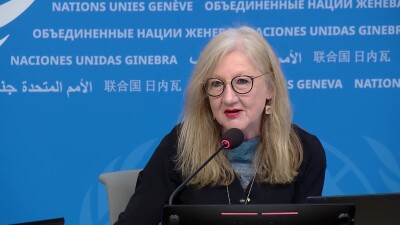
- Wide shot of podium with speakers.
- SOUNDBITE (English) – Jens Laerke, spokesperson, OCHA: “It is now day 10 of the return to full-scale war in Gaza after Israel decided to start bombing the enclave again. It has been 10 days of witnessing - because the UN remains on the ground in Gaza - a callous disregard for human life and dignity.”
- Wide shot, podium speakers, Press room.
- SOUNDBITE (English) – Jens Laerke, spokesperson, OCHA: “The acts of war that we see bear the hallmarks of atrocity crimes. Hundreds of children and other civilians have been killed in Israeli airstrikes in intensely populated areas. Hospitals are once again battlegrounds; patients killed in their beds, ambulances shot at and first responders killed.”
- Medium, journalists.
- SOUNDBITE (English) – Dr Margaret Harris, spokesperson, WHO: “We're looking at a situation right now that is as bad as it ever was. We knew it was bad before the ceasefire, when we were constantly begging to be allowed to do our job and just to help the ordinary people of Gzaa to live their lives. It is now worse because people have had a blockade of food but they’ve also got the ongoing fighting and supplies are running out. And they are exhausted. And this is on top of a situation where they were already very unwell. So no, they can’t keep going, and that why we’re saying we need this to be lifted right now. We need a ceasefire right now.”
- Medium-wide, TV screens showing speaker, journalists.
- SOUNDBITE (English) – Jens Laerke, spokesperson, OCHA: “We repeat: nothing can justify the collective punishment of the Palestinian people; international law is clear, it prohibits indiscriminate attacks, obstruction of life saving aid, destruction of infrastructure indispensable for civilian survival and hostage-taking. The International Court of Justice’s provisional measures on the application of the Genocide Convention remain in place; yet the alerts that we issue in report after report reveal an utter lack of respect for the most basic principles of humanity.”
- Medium, Press room, journalists.
- Dr Rik Peeperkorn, WHO representative in the OPT (from Jerusalem): “The key supplies now for safe labour and delivery and deliveries of so-called supplies for maternal and child health will be running out - soon. I mean, we were running out. Limited availability of benzene has put out a dozen of ambulances out of use.”
- Wide, Press room, TV journalist with camera.
- SOUNDBITE (English) – Maryse Guimond, UN Women Representative for the OPT (from Amman): “From 18 to 25 March in just eight days, 830 people have been killed, 174 women, 322 children with 1,787 injured.”
- Medium, journalist.
- SOUNDBITE (English) – Maryse Guimond, UN Women: “It is a situation of pure survival and survival of their families because, as they say, there is simply nowhere to go. They are telling us they will not move again since no safe places anyway. As a woman recently said to us from Deir al Balah, ‘My mother says death is the same whether in Gaza City, or Deir al Balah; we just want to return to Gaza.”
- Medium, journalist.
- Medium, TV journalist with camera.
Similar Stories

2
17
1
2
Edited News , Press Conferences | OCHA , WMO
Two UN agencies teamed up on Wednesday to issue an appeal for immediate assistance to help communities already being impacted by the strongest El Niño on record.

3
16
2
2
B-roll , Conferences , Edited News | UNITED NATIONS , UNOG
Sixth Consultative Meeting on Enhancing Coordination of Peace Initiatives and Efforts for Sudan

1
1
1
Edited News | UNICEF , WHO , UNHCR
Yemen war continues to force families from homes amid hunger and disease
More than 250,000 people have now fled renewed fighting in Yemen, the UN said on Tuesday, citing particular concern for those sheltering in the southwestern city of Taiz and the wider governorate, where access is “essentially blocked”.

1
1
1
Edited News | UNICEF
A little over one year since a ceasefire agreement was announced between Hamas fighters and Israel, more than 340 children have been reported killed and hundreds more injured, the UN Children’s Fund, UNICEF, said on Friday.

1
1
1
Edited News | UNICEF , IFRC
Six weeks after Nepal’s deadly flooding disaster, communities are still struggling to rebuild their lives, but they will need sustained help as global warming increases the risk of another Himalayan catastrophe, the UN Children’s Fund (UNICEF) said on Friday.

1
1
1
Edited News | WHO
In suspected Russia plague death, testing and monitoring underway – WHO
The death of a lab worker in Russia’s Siberia region has sparked concerns about plague being the cause, the UN World Health Organization (WHO) said on Tuesday, adding that it was following the situation closely.

1
1
Edited News | OHCHR , UNOG
UN Human Rights Chief Volker Türk on Friday provided and oral update to the 63rd session of the Human rights Council on Ukraine.

1
1
1
Edited News | OHCHR , UNOG
UN Human Rights Chief Volker Türk on Friday provided and oral update to the 63rd session of the Human rights Council on the human rights situation in Haiti.

1
1
1
Edited News | WHO
Repeated delays in bringing lifesaving medicines, prosthetics and more from Israel into Gaza risk having devastating consequences on Palestinians who urgently need them in the wartorn enclave, the UN World Health Organization (WHO) said on Friday. “A truck full of non-priority supplies or the right supplies arriving too late, doesn't save lives. That's the question that actually matters," said Dr Reinhilde Van De Weerdt, WHO Representative in the OPT.

1
1
1
Edited News | WHO
DRC: Early access to care and oxygen decisive for Ebola patients’ survival – WHO
In the Democratic Republic of the Congo (DRC), health workers fighting the country’s largest-ever Ebola outbreak are struggling to overcome critical challenges to patient care, the UN World Health Organization (WHO) warned on Tuesday.

1
1
1
Edited News | OCHA , UN
Civilians in Iran are continuing to feel the consequences of months of conflict and military escalation, the UN’s top official in the country has said, as loss of life, damage to civilian infrastructure and mounting economic pressures leave many facing continued uncertainty.
1
1
1
Edited News | WHO , UNICEF
Aid agencies in Yemen highlighted the growing hunger emergency sparked by renewed fighting between Houthi opposition forces and Government troops, after mobile health clinics reported that hundreds of children displaced by the violence are suffering from the most deadly form of malnutrition.