

The United Nations Office at Geneva
Multimedia Newsroom
Human Rights Council
Rolando Gomez, for the Human Rights Council (HRC), announced that the Commission of Inquiry on Syria would hold a virtual press conference at 2 p.m. today. The Commission’s report on the events in Idlib, which had been mandated by the Council, would be under embargo until the press conference.
Today at the Council, the dialogue with the working group on discrimination against women was continuing. The new rapporteur on extreme poverty, Olivier de Schutter, would then engage with the Council. A report on violence against women would also be presented, as well as a report on practices of conversion therapy. On 9 July, a report on targeted killings by drones would be presented by the Special Rapporteur on summary executions, Agnès Callamard, informed Mr. Gomez. Thursday, 9 July would also be the deadline for submission of draft resolutions to the Council.
More information on the forty-fourth session of the Council can be found here.
COVID-19: impact on food security in Kenya
Elisabeth Byrs, for the World Food Programme (WFP), stated that in late 2019, 1.3 million Kenyans had been severely food insecure and needed immediate assistance. That number was expected to rise to between 3 and 3.5 million in July when families ran out of food as the lean season between two harvests peaked. Complementing the Government’s COVID-19 response, WFP was providing cash assistance for three months to 279,000 people living in informal urban settlements in Nairobi. WFP’s assistance was reaching families who had already struggled daily to feed themselves before the pandemic had struck and had now lost incomes because of related restrictions.
WFP would provide USD 40 monthly through mobile transfers to each eligible household to cover up to half the food needs for an average family of four – in line with the Government’s own cash assistance programme. The urban poor spent about half of their income on food.
WFP had appealed for USD 44 million in April to meet new needs due to the pandemic, and with adequate funding, WFP could provide food assistance to 725,000 people in Nairobi’s informal settlements and other hotspots.
Responding to a question, Ms. Byrs said only a small fraction of the USD 962 million needed for the COVID-19 response had been received so far.
COVID-19: updates from the World Health Organization
Margaret Harris, for the World Health Organization (WHO), informed that WHO briefings on COVID-19 would from now on take place twice a week, instead of three times, as had been the case so far. The next briefing would be held at 5 p.m. today. A journalist recommended that WHO Geneva briefings not take place on Tuesday afternoons so not to overlap with PAHO press conferences.
Responding to a question on claims that COVID-19 could be airborne, Ms. Harris said the issue would be addressed at the presser this afternoon. Updated travel guidance was in the process of preparation, said Ms. Harris, who reiterated the importance of physical distancing and not touching one’s face with the hands. Travellers should also be informed about the current levels of transmission where they were going and the local requirements. Things could change very rapidly and one needed to stay alert, she stressed. Ms. Harris could not currently provide further details on the upcoming WHO mission to China. Temperatures seemed not to have any effect on the spread of COVID-19, said Ms. Harris.
Ms. Harris also informed that a press conference on HIV would take place after the COVID-19 press briefing this afternoon.
Congolese refugees in Uganda
Charlie Yaxley, for the United Nations Refugee Agency (UNHCR), stated that more than 3,000 refugees from the Democratic Republic of the Congo had arrived in Uganda between 1 and 3 July during a temporary opening of two border crossing points at Golajo and Mount Zeu, north-western Uganda. The new arrivals had been previously part of a larger group of some 45,000 people, according to local DRC authorities, who had attempted to flee towards the Ugandan border shortly after deadly clashes erupted between armed militia groups in the Ituri province on 17 and 18 May.
While some had been able to return to their areas of origin, others had remained close to the border, unable to cross for more than a month due to the closure of borders on the Uganda side to contain the spread of COVID-19. Sixty-five per cent of the new arrivals were children, said Mr. Yaxley. UNHCR had installed 318 family tents, as well as nine water tanks, health screening areas, toilets and hand-washing facilities. In addition, UNHCR and partners were providing food, water, medical checks and temporary shelter, and health teams and an ambulance were on stand-by in case anyone needed hospitalization. UNHCR welcomed the decision by the Government of Uganda to allow the group of refugees to enter the country and receive life-saving aid and protection. Mr. Yaxley said the UNHCR had received only 18 per cent of the USD 357 million required for its operation in Uganda in 2020.
Full press release is here.
Geneva announcements
Rosalind Yarde, for the International Labour Organization (ILO), spoke about the ILO Global Summit on COVID-19 and the World of Work, the second stage of which was opening today at noon Geneva time. ILO Director-General, Guy Ryder, would open the summit in a virtual conversation with the moderator, but he would not be making a formal statement. On 8 July, more than 50 Heads of State and Government would address the Summit via recorded video messages. On 9 July, government ministers, worker and employer leaders – the constituents of the ILO – would engage in discussions. The Summit could be followed on the ILO website.
Rhéal LeBlanc, for the UN Information Service (UNIS), informed that the 2020 High-level Political Forum on Sustainable Development (HLPF 2020) would hold its first meeting today. The theme was "Accelerated action and transformative pathways: realizing the decade of action and delivery for sustainable development". The HLPF annual meeting was the core United Nations platform for follow-up and review of the 2030 Agenda for Sustainable Development and its 17 Sustainable Development Goals. This year’s Sustainable Development Goals Report would be released today, confirming that the pandemic had reversed decades of progress, especially for the most vulnerable.
There was no plenary meeting of the Conference on Disarmament scheduled for this week, which was the last week of the second part of the 2020 session.
The Committee on the Elimination of Discrimination against Women, which had opened its seventy-sixth session the previous week, was holding this afternoon a public meeting devoted to an informal briefing for States Parties on the draft General recommendation on trafficking in women and girls in the context of global migration.
The Human Rights Committee, which had opened the previous week its one hundred and twenty-ninth session, would hold during this session several public meetings, all devoted to the review of its General Comment 37 on Article 21 of the Covenant on Civil and Political Rights (right to peaceful assembly).
Similar Stories
1
1
1
Press Conferences | UN WOMEN , WFP , WHO
UN WOMEN: Sudan Women and girls one year after the fall of El Fasher; increasing drone attacks across the country; WFP: DRC - Ebola spreads to eighth DRC province as WFP delivers food, builds treatment centres and keeps supplies moving; WHO - Update on Ebola (Bundibugyo Virus Disease)
1
12
1
1
Press Conferences , Images | UNOG
Closing Press Conference following the Sixth Consultative Meeting on Enhancing Coordination of Peace Initiatives and Efforts in Sudan

2
17
1
2
Edited News , Press Conferences , Images | OCHA , WMO
Two UN agencies teamed up on Wednesday to issue an appeal for immediate assistance to help communities already being impacted by the strongest El Niño on record.
1
1
1
Press Conferences | CITES
Wildlife trade and conservation policy discussions at the 81st meeting of the CITES Standing Committee (SC81)
1
1
1
Press Conferences | UNHCR , UNCTAD , WMO , OCHA , UNICEF , WHO
UNHCR Hungary’s 1956 Refugee Crisis: 70 Years On, UNCTAD World Investment Forum 2026, Doha, WMO Greenhouse Gas Bulletin and Climate Update for COP31, OCHA Afghanistan: Malnutrition, Girls’ Education and Recovery, UNICEF Yemen: Child Malnutrition and Unsafe Water in Taiz, WHO Inequalities in Noncommunicable Diseases and Risk Factors
1
1
1
Press Conferences | UNHCR
End of UNHCR's 77th Annual Executive Committee (ExCom) meeting week
1
1
1
Press Conferences | UNICEF , IOM , UNHCR
UN Special Assistant to the Personal Envoy Office (SUDAN): Peace Initiatives and Efforts in Sudan; UNICEF: Dire situation of children in Gaza; IOM: Damaged Homes and Energy Attacks Risk Displacing Ukrainians for this winter; UNHCR: update on EXCOM week
1
1
1
Press Conferences | IOM , UNDRR
UN stresses importance of household preparedness for disaster risk reduction.
1
1
1
Statements , Press Conferences | OHCHR
1
1
1
Press Conferences | UNHCR , UNICEF , IFRC , OHCHR , UN WOMEN , IOM , OCHA , WHO
UNHCR – ExCom Meeting, UNICEF – Nepal Recovery, IFRC – Flash Floods, WHO – Mental Health, IOM – South Sudan Floods, OCHA – DRC Humanitarian aid, UNHCR – Sahel Displacement, UNICEF – Yemen Update, IOM – Gaza Shelter, UN Women – Gaza Women, OHCHR – Arrests and detentions of Syrians by Israeli force
2
1
2
Press Conferences | UNCTAD
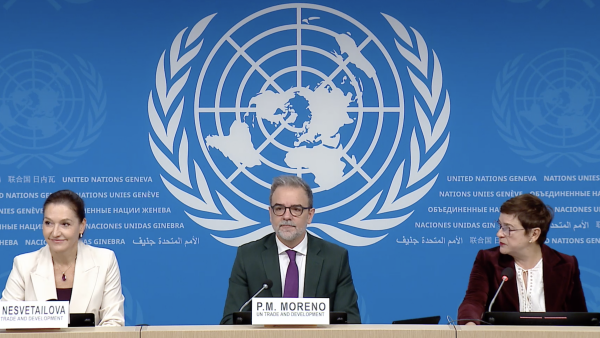
Presentation of the Trade and Developement Report 2026
Embargoed until 9 October 2026 at 11 a.m. (Geneva Time)
UNCTAD: UNCTAD’s flagship report finds that governments increasingly use industrial, trade, financial and technology policies to pursue economic and national security objectives. Market access and the ability to move into higher-value activities now depend more heavily on technology, finance and geopolitics.
1
1
1
Press Conferences | UPU
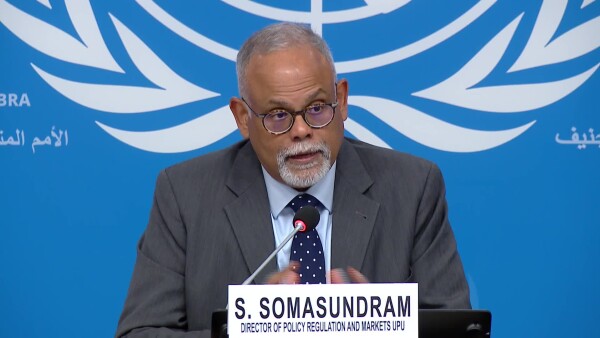
Release of the State of the Postal Sector Report 2026