

The United Nations Office at Geneva
Multimedia Newsroom
Sudan’s displaced endured ‘unimaginable suffering, brutal atrocities’: UNHCR
Sudan’s displaced have endured “unimaginable suffering” in their search for shelter from the country’s ongoing war, UN humanitarians warned on Friday.
Nineteen months since conflict erupted between rival militaries the Sudanese Armed Forces and the Rapid Support Forces over the transfer of power to civilian rule, the UN refugee agency (UNHCR) expressed deep concern that more than three million people have now been forced to flee the country in search of safety.
“It's been over a year and a half of unimaginable suffering, brutal atrocities and widespread human rights violations,” said Dominique Hyde, UNHCR Director of External Relations. “Every day of every minute, thousands of lives are shattered by war and violence away from the world's attention.”
Speaking in Geneva after visiting displaced communities sheltering in neighbouring Chad, Ms. Hyde described Chad as “a sanctuary, a lifeline” for 700,000 war refugees.
“I spoke to people who watched while their families were murdered,” she said. “People are targeted on the basis of their ethnicity. Men and boys are killed and their bodies are burned. Women raped while fleeing. People told me over and over again how they remember the bodies they saw abandoned by the road as they were fleeing.”
The UNHCR official explained that in the face of massive needs, the UN agency and partners had relocated more than 370,000 refugees in Chad “to six new-build settlements and 10 extensions of pre-existing settlements, all completed in record time. But tens of thousands of families are still waiting for that opportunity to start over”.
The exodus from Sudan has put pressure on surrounding countries to provide assistance to all those in need of shelter and basic services.
“Other countries neighbouring Sudan, South Sudan, Ethiopia, Egypt, Central African Republic have gone above and beyond their means, not only providing safety for people to flee, but extending a chance to refugees to start rebuilding their lives while in exile,” the UNHCR official said.
“Continuing bloodshed” in Sudan’s Darfurs and across the country has created the world's worst civilian protection crisis in decades but “the world is not paying any attention”, Ms. Hyde insisted.
The $1.5 billion Refugee Response Plan for Sudan’s displaced which aims to assist 2.7 million people in five neighbouring countries is only 29 per cent funded. “Chad and its people…have been more than generous, more than welcoming,” Ms. Hyde said. “I heard over and over again that they felt one with the Sudanese community. But we need that support. We need support now.”
Story: “Sudan crisis - UNHCR” – 08 November 2024
Speaker:
- Dominique Hyde, UNHCR Director of External Relations
TRT: 5’19”
SOURCE: UNTV CH footage in Geneva, UNHCR footage from Chad.
LANGUAGES: ENGLISH / ARABIC / NATS
ASPECT RATIO: 16:9
DATELINE: 08 November 2024 - GENEVA, SWITZERLAND + UNHCR footage filmed 28-29 October 2024 in Adre, Chad – details here: https://media.unhcr.org/Share/gb03u0dk5hnqrd746ce74016c3744n06
SHOTLIST
- Exterior medium shot: UN flag alley.
- Wide shot of podium with speakers at Press conference room.
- SOUNDBITE (English) Dominique Hyde, UNHCR Director of External Relations: “This week, we have reached a devastating milestone. Since the war broke out 19 months ago, over three million people have been forced to flee Sudan, seeking safety in neighbouring countries and further afield.”
- Wide, journalists, TV journalist, camera and control room.
- SOUNDBITE (English) Dominique Hyde, UNHCR Director of External Relations: “It's been over a year and a half of unimaginable suffering, brutal atrocities and widespread human rights violations. Every day of every minute, thousands of lives are shattered by war and violence away from the world's attention.”
- Medium shot: journalists.
- SOUNDBITE (English) Dominique Hyde, UNHCR Director of External Relations: “Chad has become what I would call a sanctuary, a lifeline for these refugees, the 700,000 Sudanese refugees who have fled since the beginning of the war in April of last year.”
- Medium shot, TV screens showing speaker lining walls of Press room, journalists.
- SOUNDBITE (English) Dominique Hyde, UNHCR Director of External Relations: “Since the start of the war, over 370,000 refugees have been relocated to six new-build settlements and 10 extensions of pre-existing settlements, all completed in record time. But tens of thousands of families are still waiting for that opportunity to start over."
- Medium-wide, journalists.
- SOUNDBITE (English) Dominique Hyde, UNHCR Director of External Relations: “Other countries neighbouring Sudan, South Sudan, Ethiopia, Egypt, Central African Republic have gone above and beyond their means, not only providing safety for people to flee, but extending a chance to refugees to start rebuilding their lives while in exile.”
- Medium, podium speakers.
- SOUNDBITE (English) Dominique Hyde, UNHCR Director of External Relations: “I spoke to people who watched while their families were murdered. People are targeted on the basis of their ethnicity. Men and boys are killed and their bodies are burned. Women raped while fleeing. People told me over and over again how they remember the bodies they saw abandoned by the road as they were fleeing.”
- Medium, podium speakers and journalists.
- Medium, journalists and TV camera.
- Medium, journalist listening amid array of microphones.
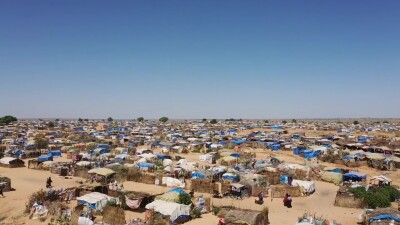
- Wide aerial shot of informal displacement shelters in Adre, Chad.
- Wide aerial shot of informal displacement shelters in Adre, Chad.
- Medium, people sheltering under open tent.
- Medium, people - mainly children - sheltering under open tent.
- Medium, children and women in open tent.
- Close, woman looking into distance.
- Medium, children and women in open tent.
- Close, woman looking at camera.
- Close, elderly woman with young girl walks in front of camera.
- Medium, UNHCR registration.
- Medium, UNHCR registration.
- Medium, women sitting on ground in shade of open tent.
- Medium, two women sitting on ground in shade of open tent.
- Aerial shot, Aboutengue site in Chad.
- Wide, shelters, a huge tree.
- Medium-wide, displaced people sheltering under the tree.
- Medium, displaced people sheltering under the tree.
- Medium, displaced woman.
- Medium, displaced woman.
- Medium-wide, displaced people registering for nutrition services.
- Medium, infant nutrition distribution point.
- Medium, woman walks around nutrition station.
- Medium, woman receives relief support.
- Medium, woman, girl and baby rest in the shade.
- Medium, women and children resting.
Similar Stories

1
1
1
Edited News | OCHA , UNICEF , WFP
Aid agencies warned on Friday of the fast-developing humanitarian emergency inside Taiz City in Yemen, which has been encircled by de facto Houthi forces fighting government troops along the country’s west coast.

2
17
1
2
Edited News , Press Conferences , Images | OCHA , WMO
Two UN agencies teamed up on Wednesday to issue an appeal for immediate assistance to help communities already being impacted by the strongest El Niño on record.

3
16
2
2
Edited News , B-roll , Conferences , Images | UNITED NATIONS , UNOG
Sixth Consultative Meeting on Enhancing Coordination of Peace Initiatives and Efforts for Sudan

1
1
1
Edited News | UNICEF , WHO , UNHCR
Yemen war continues to force families from homes amid hunger and disease
More than 250,000 people have now fled renewed fighting in Yemen, the UN said on Tuesday, citing particular concern for those sheltering in the southwestern city of Taiz and the wider governorate, where access is “essentially blocked”.

1
1
1
Edited News | UNICEF
A little over one year since a ceasefire agreement was announced between Hamas fighters and Israel, more than 340 children have been reported killed and hundreds more injured, the UN Children’s Fund, UNICEF, said on Friday.

1
1
1
Edited News | UNICEF , IFRC
Six weeks after Nepal’s deadly flooding disaster, communities are still struggling to rebuild their lives, but they will need sustained help as global warming increases the risk of another Himalayan catastrophe, the UN Children’s Fund (UNICEF) said on Friday.

1
1
1
Edited News | WHO
In suspected Russia plague death, testing and monitoring underway – WHO
The death of a lab worker in Russia’s Siberia region has sparked concerns about plague being the cause, the UN World Health Organization (WHO) said on Tuesday, adding that it was following the situation closely.

1
1
Edited News | OHCHR , UNOG
UN Human Rights Chief Volker Türk on Friday provided and oral update to the 63rd session of the Human rights Council on Ukraine.

1
1
1
Edited News | OHCHR , UNOG
UN Human Rights Chief Volker Türk on Friday provided and oral update to the 63rd session of the Human rights Council on the human rights situation in Haiti.

1
1
1
Edited News | WHO
Repeated delays in bringing lifesaving medicines, prosthetics and more from Israel into Gaza risk having devastating consequences on Palestinians who urgently need them in the wartorn enclave, the UN World Health Organization (WHO) said on Friday. “A truck full of non-priority supplies or the right supplies arriving too late, doesn't save lives. That's the question that actually matters," said Dr Reinhilde Van De Weerdt, WHO Representative in the OPT.

1
1
1
Edited News | WHO
DRC: Early access to care and oxygen decisive for Ebola patients’ survival – WHO
In the Democratic Republic of the Congo (DRC), health workers fighting the country’s largest-ever Ebola outbreak are struggling to overcome critical challenges to patient care, the UN World Health Organization (WHO) warned on Tuesday.

1
1
1
Edited News | OCHA , UN
Civilians in Iran are continuing to feel the consequences of months of conflict and military escalation, the UN’s top official in the country has said, as loss of life, damage to civilian infrastructure and mounting economic pressures leave many facing continued uncertainty.