

The United Nations Office at Geneva
Multimedia Newsroom
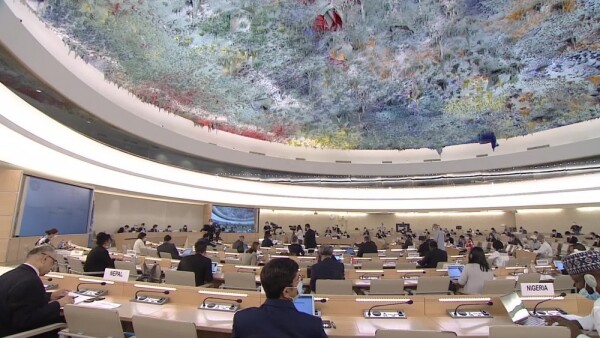
Human Rights Council unanimously calls on top UN rights official to take action on racist violence
The UN’s top rights official, Michelle Bachelet, is to spearhead efforts to address systemic racism on people of African descent by law enforcement agencies, the Human Rights Council decided on Friday.
The resolution – decided unanimously without a vote - follows a rare Urgent Debate in the Council earlier in the week, requested by the African group of nations, following the death of George Floyd.
His death on 25 May was captured on video while a police officer knelt on his neck for over eight minutes in Minneapolis, sparking worldwide protest.
During the debate on racism, alleged police brutality and violence against protesters that preceded the resolution’s adoption, no less than120 speakers took the floor.
Many expressed sympathy for the family of Mr. Floyd, whose brother also addressed Council members in Geneva, in a passionate pre-recorded video message in which he urged the United Nations to act.
Although some delegates had called for an international probe to investigate killings of black people in America, and violence against demonstrators, others maintained that the issue impacted on all nations, and required a broader approach.
In line with the final version of the resolution text, the High Commissioner should “prepare a report on systemic racism, violations of international human rights law against Africans and people of African descent by law enforcement agencies, especially those incidents that resulted in the death of George Floyd and other Africans and of people of African descent”.
The text also calls on Ms. Bachelet – assisted by UN appointed independent rights experts and committees “to examine government responses to anti-racism peaceful process peaceful protests, including the alleged use of excessive force against protesters, bystanders and journalists”.
Overseeing the resolution, Ambassador Elisabeth Tichy-Fisslberger (Austria), President of the Human Rights Council (14th cycle) announced that the text was ready for their consideration and asked whether a vote could be dispensed with, in light of the general consensus.
“Excellencies, ladies and gentlemen, I have been informed that a number of resolutions are ready for adoption during this meeting as shown on the screen…So, I would like to ask if there is a request from anybody for a vote…I see none, so may I take it that the draft proposal L50 as orally revised may be adopted without a vote? It is so decided.”
In his address to Member States as coordinator of the African Group, Dieudonné W. Désiré Sougouri, Permanent Representative of Burkina Faso to the United Nations Office, declared the Urgent Debate “an historic step” in the combat against racism of which the Human Rights Council could be “proud”.
“The international outrage caused by the tragic events that led to the death of George Floyd underlined the urgency and importance for the Human Rights Council to raise its voice against injustice and police brutality which African people and people of African descent are faced with every day in many regions of the world,” he said.
The Council also heard widespread declarations of support for an investigation into violence against protesters supporting the Black Lives Matter movement.
“The fight against all forms of racism and racial discrimination remains a priority for us,” said Michael Ungern-Sternberg, Permanent Representative of the Republic of Germany to the United Nations Office at Geneva. “The past weeks, many people around the world raised their voices and took to the streets to send a clear signal that racism and excessive use of force by law enforcement officials against minority populations cannot (any) longer be accepted.”
Other speakers insisted that the resolution was necessary and important in promoting awareness about systemic racism, and in continuing the work of implementing key pledges taken to combat the scourge in 2002 at the Durban World Conference Against Racism, Racial Discrimination, Xenophobia and Related Intolerance.
“Black lives matter,” said Ambassador Coly Seck, Permanent Representative of Senegal to the United Nations Office at Geneva: Racism continues to happen in many countries too, he said, noting that it was in “flagrant contradiction” to the UN Charter in which we place our aith in the basic rights of man and in the value of the human person”.
- Wide shot: exterior, flag alley, Palais des Nations, United Nations Geneva.
- Wide shot: UN Human Rights Council at UN Geneva.
- SOUNDBITE (EN) – Ambassador Elisabeth Tichy-Fisslberger (Austria), President of the Human Rights Council (14th cycle): “Excellencies, ladies and gentlemen, I have been informed that a number of resolutions are ready for adoption during this meeting as shown on the screen.”
- Medium shot: TV camera operators standing in front of big screen showing Ambassador Tichy-Fisslberger.
- SOUNDBITE (EN) – Ambassador Elisabeth Tichy-Fisslberger (Austria), President of the Human Rights Council (14th cycle): “So, I would like to ask if there is a request from anybody for a vote…(switches to wide shot of Council delegates)…I see none, so may I take it that the draft proposal L50 as orally revised may be adopted without a vote? It is so decided.”
- Medium shot: delegates sitting wide apart, Human Rights Council at UN Geneva.
- SOUNDBITE (FR) - Dieudonné W. Désiré Sougouri, Permanent Representative of Burkina Faso to the United Nations Office and other international organizations in Geneva (Coordinator of the African Group): “J’ai l’honneur de faire prononcer cette déclaration au nom du Groupe Africain. Le débat urgent qui vient de s’achever a été une étape historique dont le Conseil des droits de l’homme peut être fier. Le tollé international suscité par les évènements tragiques qui ont entraînés la mort de George Floyd a souligné l’urgence et l’importance pour le Conseil des droits de l’homme de donner de la voix contre l’injustice et la brutalité auxquels les personnes d’ascendance africaine sont confrontées quotidiennement dans de nombreuses régions du monde. »
- Close up: delegates in profile wearing facemasks, sitting some distance apart, Human Rights Council at UN Geneva.
- SOUNDBITE (EN) – Michael Ungern-Sternberg, Permanent Representative of the Republic of Germany to the United Nations Office at Geneva: “The fight against all forms of racism and racial discrimination remains a priority for us. The past weeks, many people around the world raised their voices and took to the streets to send a clear signal that racism and excessive use of force by law enforcement officials against minority populations cannot (any) longer be accepted.”
- Medium-wide shot: delegates wearing facemasks, TV camera in middle of room, Human Rights Council at UN Geneva.
- SOUNDBITE (FR) – Coly Seck, Permanent Representative of Senegal to the United Nations Office at Geneva: “La vie des noirs compte. Ainsi, le racisme continue de s’exprimer et d’être assume dans de nombreux pays. C’est en flagrant contradiction avec des engagements conseillés dans la Charte des Nations-Unies et par lesquels nous reaffirmons notre foi dans les droits fondamentaux de l’homme dans la dignité et la valeur de la personne humaine. »
- Medium shot: showing delegates wearing facemasks, listening to speaker (out of shot), Human Rights Council at UN Geneva.
- Medium shot: TV camera operators with cameras appearing to point at each other, Human Rights Council at UN Geneva.
- Medium shot: delegate wearing facemask and talking on mobile phone.
Similar Stories

1
1
1
Edited News | UNICEF , IFRC
Six weeks after Nepal’s deadly flooding disaster, communities are still struggling to rebuild their lives, but they will need sustained help as global warming increases the risk of another Himalayan catastrophe, the UN Children’s Fund (UNICEF) said on Friday.

1
1
1
Edited News | WHO
In suspected Russia plague death, testing and monitoring underway – WHO
The death of a lab worker in Russia’s Siberia region has sparked concerns about plague being the cause, the UN World Health Organization (WHO) said on Tuesday, adding that it was following the situation closely.

1
1
Edited News | OHCHR , UNOG
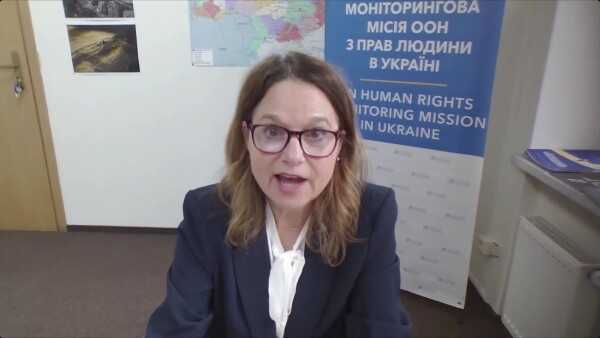
UN Human Rights Chief Volker Türk on Friday provided and oral update to the 63rd session of the Human rights Council on Ukraine.

1
1
1
Edited News | OHCHR , UNOG
UN Human Rights Chief Volker Türk on Friday provided and oral update to the 63rd session of the Human rights Council on the human rights situation in Haiti.

1
1
1
Edited News | WHO
Repeated delays in bringing lifesaving medicines, prosthetics and more from Israel into Gaza risk having devastating consequences on Palestinians who urgently need them in the wartorn enclave, the UN World Health Organization (WHO) said on Friday. “A truck full of non-priority supplies or the right supplies arriving too late, doesn't save lives. That's the question that actually matters," said Dr Reinhilde Van De Weerdt, WHO Representative in the OPT.

1
1
1
Edited News | WHO
DRC: Early access to care and oxygen decisive for Ebola patients’ survival – WHO
In the Democratic Republic of the Congo (DRC), health workers fighting the country’s largest-ever Ebola outbreak are struggling to overcome critical challenges to patient care, the UN World Health Organization (WHO) warned on Tuesday.

1
1
1
Edited News | OCHA , UN
Civilians in Iran are continuing to feel the consequences of months of conflict and military escalation, the UN’s top official in the country has said, as loss of life, damage to civilian infrastructure and mounting economic pressures leave many facing continued uncertainty.
1
1
1
Edited News | WHO , UNICEF
Aid agencies in Yemen highlighted the growing hunger emergency sparked by renewed fighting between Houthi opposition forces and Government troops, after mobile health clinics reported that hundreds of children displaced by the violence are suffering from the most deadly form of malnutrition.
1
1
1
Edited News | UNHCR
Displacement on the rise in Yemen as fighting continues - UNHCR
As hostilities worsen in Yemen, more people have been fleeing their homes, further intensifying the humanitarian crisis within the region, the UN Refugee Agency (UNHCR) warned on Tuesday.
1
1
1
Edited News | IOM , OHCHR , UNFPA , UNOG , UNHCR , WHO
Yemen’s humanitarian crisis growing by the hour amid spike in displacement
Yemenis displaced by renewed fighting have described fleeing for their lives amid shelling and gunfire, aid agencies reported on Friday, while highlighting the dramatic increase in humanitarian needs in the country and in Djibouti, where thousands have sought shelter.
1
1
1
Edited News | OHCHR , UNOG
The UN Human Rights Office issued on Friday a report documenting a shocking pattern of sexual violence amid Russia’s full-scale armed attack on Ukraine.
2
1
2
Edited News , Press Conferences | WMO
As world’s water reserves change, countries must prepare for a new reality: WMO
New data showing that rivers were at their lowest level for decades last year provides further evidence that the climate crisis is real and countries must act immediately to protect themselves from the increasing threat to communities and livelihoods, the UN World Meteorological Organization (WMO) said on Thursday.
The key findings from WMO’s State of Global Water Resources 2025 report covering the hydrological cycle and extreme events in the five-year period to last year:
- 2025 was one of driest years for river discharge in 35 years
- Past seven years have seen abnorfmal river flows
- Water storage on Earth’s land surface has decreased in past decade
- Widespread glacier loss across all regions for fourth consecutive year
- Asia and Africa are regions most affected by water-related disasters
- Water data availability has improved, but gaps remain in hard-hit areas
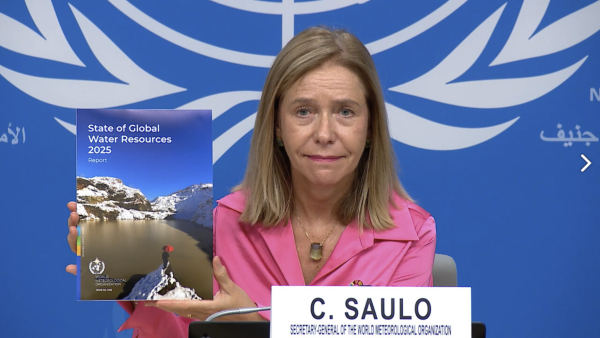
Highlighting the long-term decline in the Earth’s freshwater storage and glacier melt, WMO Secretary-General Celeste Saulo explained that the planet’s water reserves used to act as a planetary “savings account” that absorbed the occasional dry season, avoiding a water crisis. “One of the central stories of the 2025 report is what is happening to that savings account? And the simple answer is that we are depleting it,” she told journalists in Geneva.
Groundwater reserves are equally stretched and have been in decline since 2014, WMO’s report states, with nearly two-thirds of monitored wells worldwide showing levels lower than the historical norm and indicating a shift “further toward deficit…not recovery”.
“At the same time, we are seeing more water-related disasters,” Ms. Saulo said, while also stressing that the currently strengthening El Niño “will increase the risk of drought in some areas, and flooding in others”.
Glaciers disappearing
In 2025, for the fourth consecutive year, every major glaciated region on Earth lost ice mass, leading to short-term hazards including floods and long-term water insecurity, according to WMO.
Responding to a question about whether the changing global water cycle might have contributed to the deadly Nepal-China flooding disaster, Ms. Saulo explained that melting ice and rock was just one factor in the chain of events that ultimately sent a massive and deadly wall of water and debris downstream on 26 August, killing at least 1,367 people.
“You asked if it could happen again? Absolutely; the problem in this region is that there’s 63,700 glaciers at the last count,” she told a Press Conference in Geneva. “Even if you’re looking with remote sensing with satellites at these glaciers, you might see some faults, you might see some slight shifting, that does not mean necessarily catastrophic collapse. So, in order to plan for this, it’s very, very difficult. But the international community is looking very hard at ways in which we can bring people together to solve some of these monitoring issues.”
Data indicates that glaciers shrank between 2023 and 2025 with cumulative losses of 1,400 gigatonnes of water – or about one third of annual fresh water needs.
Every major glacier region on Earth lost ice for the fourth consecutive year.
“All 19 glacier regions around the globe lost ice; in Central Asia, Iceland, the Russian Arctic and western Canada and the United States, it was among the three worst years on record,” said Wayne Jenkinson, WMO’s Director of Hydrology and Cryosphere.
Some regions with smaller glaciers such as Central Europe, the Caucasus, the western Canada and the United States may already have reached “peak water”, Mr. Jenkinson warned.
“After this point, the glacier gives less meltwater each year simply because there is less ice left to melt. That matters for every community downstream that relies on water during hot, dry summers,” he explained.
Narelle van der Wel, WMO’s Head of Cryosphere Monitoring, Predictions and Services, stressed that while some further glacier loss is unavoidable, the eventual scale of the decline is not predetermined.
“Some glacier loss is inevitable, but total loss of glaciers is not yet inevitable,” she said, pointing to emissions reductions as central to limiting future losses.
Preparing for moving baselines
The report does not attribute every observed change to climate change alone. WMO says pressure on water resources and natural variability also contribute.
Mr. Jenkinson said governments need to prepare for “moving baselines” as historical patterns become less reliable.
“The situation 30 years ago is not where we are today,” he said. Countries, he added, need to prepare “for those changes that have really already arrived”.
ends