

The United Nations Office at Geneva
Multimedia Newsroom
UN GENEVA PRESS BRIEFING
12 March 2024
Secretary-General’s Envoy on Technology
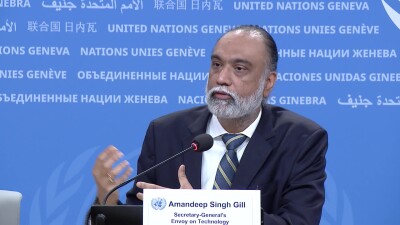
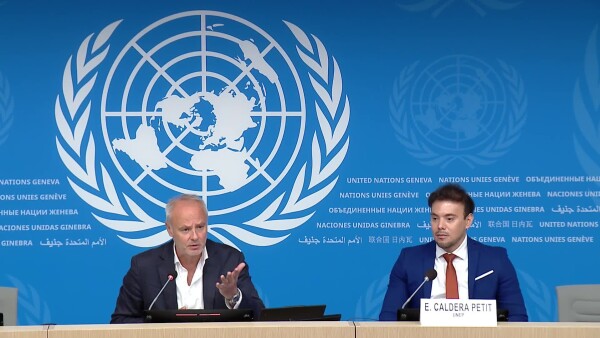
Amandeep Singh Gill, Secretary-General's Envoy on Technology, stated that he was in Geneva for a meeting of the 39-member Advisory Board on Artificial Intelligence, which was now meeting in person for the second time. An interim report had been presented at the end of 2023, and the current meeting allowed the Advisory Body to deepen its considerations and analysis of the AI risks and challenges, and also to discuss what kind of international governance was needed to address the challenges and seize the opportunities. In the interim report, the Advisory Board had presented some guiding principles for international governance, in which it had emphasized the importance of inclusion and public interest. The report had also stressed the significance on building upon the UN Charter and other shared international norms rather than starting from scratch. AI governance ought to perform several functions, including horizon scanning, building consensus, interoperability, and mediating standards. Mr. Gill informed that this week the Advisory Board was meeting with specialized UN agencies, including the ILO and the WHO.
Replying to questions from the media, Mr. Gill said that the Board had members from all over the world who were steeped into the issue. In a short span of time of only 2.5 months, the members had achieved an agreement on several important issues, as presented in the interim report. Everyone agreed that AI was a powerful technology, and continuing business as usual was not an option. In the context of the Summit of the Future, a global digital compact was being negotiated, reminded Mr. Gill. The notion of privacy ought to extend to mental privacy, he said in a response to another question. Private sector, which was leading innovation in this area, had to be brought on board. Mr. Gill said that monitoring and analysis had to continue on a regular basis, given the constantly evolving nature of AI. On the issue of language barriers and the predominance of English, Mr. Gill said that indeed most AI models were based on the English language and acknowledged the challenge of maintaining linguistic and cultural diversity. In the Advisory Body, there was a lot of emphasis on capacity building, and it was hoped that there would be concrete recommendations to help prevent the expansion of the existing digital divide. Answering a final question on the composition of the Advisory Body, Mr. Gill said that 1,800 candidates had applied to be on the Body, of whom 39 had been selected from 33 countries and five regions of the world. The Body included both industry representatives and human rights experts. A consultative network of more than 120 experts had also been created, he informed; they should help address any gaps that might exist within the Advisory Body.
Human Rights Council
Pascal Sim, for the Human Rights Council (HRC), informed that this morning the Council was holding its first dialogue with Ben Saul, new Special Rapporteur on the promotion and protection of human rights and fundamental freedoms while countering terrorism. In the afternoon, the Council would hold an interactive dialogue with Mary Lawlor, Special Rapporteur on the situation of human rights defenders, and an interactive dialogue with Ana Brian Nougrères, Special Rapporteur on the right to privacy. The following day, the focus would be on children’s rights, specifically violence against children and children in armed conflict. At 5 pm, the High Commissioner would present his report on the impact of climate change on the realization of human rights. On 14 March, the Council would hold a full-day panel discussion on rights of the child.
Humanitarian aid for Gaza
Responding to questions, Jens Laerke, for the Office for the Coordination of Humanitarian Affairs (OCHA), said that the UN had not been involved in the planning of organizing the ship which had departed from Larnaca, Cyprus, to Gaza. Any food and other aid that would come into Gaza were desperately needed, and all efforts were appreciated. However, stressed Mr. Laerke, neither sea nor air deliveries could make up for overland access and safe, secure, and regular deliveries. Any and all entry points into Gaza should be looked at. While the UN had a large, coordinated operation in and around Gaza, there were other humanitarian actors, acknowledged Mr. Laerke.
Announcements
Thomas Croll-Knight, for the United Nations Economic Commission for Europe (UNECE), reminded that the Regional Forum on Sustainable Development would take place at the Palais des Nations on 13 and 14 March. The objective was to take stock on the progress made towards SDGs in the UNECE region. The Forum would be informed by the 2024 status report on SDGs progress in Europe, North America & Central Asia which warned that sustainable development is slowing (only 20 of 117 measurable SDG targets were on track) and in preparation for the Summit of the Future
He also informed that the next Global Methane Forum would bring together over 1,000 global thought and industry leaders in Geneva from 18 to 21 March to promote replicable methane mitigation successes and mobilize action to continue making progress toward addressing methane. The Forum would be hosted by the Global Methane Initiative and UNECE in partnership with the Global Methane Hub and the Climate and Clean Air Coalition. Actions to cut emissions now would pay off in mid-term; half of those actions were in the fossil fuel sector, reminded Mr. Croll-Knight. Targeted measures included venting and flaring in gas and oil operations. Methane had been responsible for 30 percent of warming since the Industrial Revolution, just after CO2.
Zeina Awad, for the International Labour Organization (ILO), informed about ILO’s upcoming report on stolen wages due to illegal forced labour. The report is “Profits and Poverty: The Economics of Forced Labour” would be presented on 19 March, during a press briefing that day. Presenters would be Federico Blanco, ILO Senior Researcher, and Zeina Awad, Chief of News and Multimedia. The report would be available under embargo as of 15 March. This global report would reveal the latest figures for forced labour and forced sexual exploitation, including estimated value of stolen wages due to forced labour.
Rolando Gómez, for the for the United Nations Information Service, said that on 19 March at 2 pm, the World Meteorological Organization (WMO) would present its State of Global Climate 2023 report at a press conference. Speakers would be Celeste Saulo, WMO Secretary-General, and Omar Baddour, Chief of Climate Monitoring.
Today at 1 pm, Ben Saul, Special Rapporteur on the promotion and protection of human rights and fundamental freedoms while countering terrorism, would present his vision and priorities at a press conference.
On 15 March at 9 am, the Independent International Commission of Inquiry on Ukraine would hold a press conference, before presenting its comprehensive report to the Council.
On 18 March at 1 pm, the Independent International Fact-Finding Mission on the Islamic Republic of Iran would present its findings at a press conference.
The Human Rights Committee would this morning conclude its consideration of the second periodic report of Indonesia. This afternoon, it would start its review of the eighth periodic report of the United Kingdom.
The Committee on the Rights of Persons with Disabilities would this morning conclude its consideration of the combined second and third periodic report of Sweden. This afternoon, it would start its review of the combined second and third periodic report of Azerbaijan.
The Conference on Disarmament was convening a plenary meeting this morning.
Similar Stories
1
1
1
Press Conferences | UNHCR
End of UNHCR's 77th Annual Executive Committee (ExCom) meeting week
1
1
1
Press Conferences | UNICEF , IOM , UNHCR
UN Special Assistant to the Personal Envoy Office (SUDAN): Peace Initiatives and Efforts in Sudan; UNICEF: Dire situation of children in Gaza; IOM: Damaged Homes and Energy Attacks Risk Displacing Ukrainians for this winter; UNHCR: update on EXCOM week

1
1
1
Press Conferences | IOM , UNDRR
UN stresses importance of household preparedness for disaster risk reduction.

1
1
1
Statements , Press Conferences | OHCHR

1
1
1
Press Conferences | UNHCR , UNICEF , IFRC , OHCHR , UN WOMEN , IOM , OCHA , WHO
UNHCR – ExCom Meeting, UNICEF – Nepal Recovery, IFRC – Flash Floods, WHO – Mental Health, IOM – South Sudan Floods, OCHA – DRC Humanitarian aid, UNHCR – Sahel Displacement, UNICEF – Yemen Update, IOM – Gaza Shelter, UN Women – Gaza Women, OHCHR – Arrests and detentions of Syrians by Israeli force

2
1
2
Press Conferences | UNCTAD
Presentation of the Trade and Developement Report 2026
Embargoed until 9 October 2026 at 11 a.m. (Geneva Time)
UNCTAD: UNCTAD’s flagship report finds that governments increasingly use industrial, trade, financial and technology policies to pursue economic and national security objectives. Market access and the ability to move into higher-value activities now depend more heavily on technology, finance and geopolitics.

1
1
1
Press Conferences | UPU
Release of the State of the Postal Sector Report 2026
1
1
1
Press Conferences | IOM , ITU , UNECE , UNICEF , WHO , WMO
UNICEF: Ebola, DRC - children orphans or separating them from parents and caregivers; IOM: Humanitarian needs in Djibouti amid arrivals from Yemen and increased migrant movements; WHO: Darfur, scale of health needs far exceeds available resources; WMO co-sponsored Global Heat Forum, Bangkok, monthly Global Seasonal Climate Update; UNECE: UN Forum of Mayors; ITU Plenipotentiary Conference 2026; WHO: child and adolescent obesity guidelines and new global roadmap to tackle pregnancy hypertension, a leading cause of maternal mortality
1
1
1
Press Conferences | OCHA , UN WOMEN , UNHCR , WFP , WHO , WTO , UNEP
OCHA – $160M CERF allocation to 12 underfunded crises; UNHCR – 5.8M refugee children remain out of school amid funding cuts; UN Women – Middle East escalation and food security among women/girls; WHO – Gaza supplies and overall situation; WFP – Yemen food insecurity and impact on global hunger ; UNEP - First International Conference of the Global Framework on Chemicals in Geneva | 16-20 November 2026
1
1
1
Press Conferences | UNHCR , WHO
Yemen's health system nears collapse amid conflict, causing rising casualties and medicine shortages.
1
1
1
Press Conferences | HRC
Update by the Expert Mechanism to Advance Racial Justice and Equality in Law Enforcement
1
1
1
Press Conferences | WIPO , WHO , UNICEF , UNHCR , IOM , WFP , FAO
WIPO Global Innovation Index 2026 launch and press conference, WHO Composition of influenza vaccines for the 2027 Southern Hemisphere flu season, UNICEF Yemen hunger and malnutrition; UNHCR Sudan displacement into Chad; IOM Ebola and population movements in DRC; WFP emergency food assistance in Nepal; and FAO food loss and waste.