

The United Nations Office at Geneva
Multimedia Newsroom
Press Conferences | OHCHR , UNCTAD , UNICEF , WHO
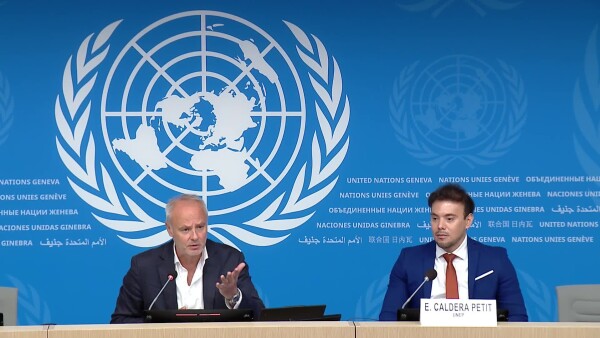
UN Geneva press briefing - 09 February 2024
UN GENEVA PRESS BRIEFING
9 February 2024
Rolando Gómez, Chief of the Press and External Relations Section at the United Nations Information Service in Geneva, chaired a hybrid briefing, which was attended by spokespersons and representatives of the World Health Organization, the Office of the High Commissioner for Human Rights, the United Nations Children’s Fund, the Office for the Coordination of Humanitarian Affairs, and the United Nations Conference on Trade and Development.
Displacement of children and rises in grave violations and malnutrition in Sudan
James Elder, for the United Nations Children’s Fund (UNICEF), said that 300 days ago to this day, the conflict had begun in Sudan, unleashing a wave of atrocities against the country’s children. The fighting had led to the displacement of four million children. More than 700,000 children were likely to suffer from the deadliest levels of malnutrition in 2024. There had been a five-fold increase in cases of recruitment, rape, and killing of children, compared to just a year before. Some two-thirds of the population did not have access to health care, which was also killing people, stressed Mr. Elder.
This war was destroying opportunities and would have adverse effects on Sudan’s future for many years to come. Mr. Elder spoke of having met youths whose dreams had been shattered. Many of Sudan’s brightest young minds had to abandon their studies and their hopes were being tarnished. In the absence of a ceasefire, the focus ought to be on safe, sustained, and unimpeded humanitarian access across conflict lines and across borders; and international support to help sustain the essential services that children relied on to survive. In 2024, UNICEF was appealing for USD 840 million to reach 7.6 million of the most vulnerable children in Sudan with humanitarian assistance. Mr. Elder reminded that most health workers had not been paid at all since the beginning of the war 300 days earlier, so they were coming to work to volunteer and help their own communities survive. The people of Sudan were feeling increasingly abandoned by the world. “Where is our collective humanity if we allow this situation to continue,” conclude Mr. Elder.
Rolando Gómez, for the United Nations Information Service, informed that in a press conference the previous day, the UN Secretary-General stated that what was happening was horrible, it needed to stop, and we needed to mobilize the whole of the international community, the neighbors, the countries that have influence on both parties to do everything possible to stop the atrocities. There was no military solution for Sudan, and a ceasefire was needed.
Responding to questions from the media, Mr. Elder, for UNICEF, explained that he had been in the far east of Chad, speaking to people in refugee camps. He would make day trips to west Darfur, where UN workers were not allowed to stay overnight. Bureaucratic obstacles to aid were very real and cost lives. For example, UNICEF had 27 trucks of mixed supplies ready, but they were blocked because of the fighting and lack of permits to move. Mr. Elder said, that, very worryingly, 700,000 children were expected to suffer severe acute malnutrition this year. Cholera cases had doubled over the past month; the health system was on its knees, stressed Mr. Elder.
Tarik Jašarević, for the World Health Organization (WHO), replying to a question on the health situation, said that Sudan’s health crisis was made worse by food insecurity. The latest reports on the deteriorating situation indicated that nearly 18 million people – 37 percent of the population – were food insecure, including 4.9 million people who already faced emergency levels of food insecurity. He explained that access to critical health services was severely limited, with 70–80 percent of health facilities in conflict-affected areas either inaccessible or nonfunctional. He stressed that getting funding was of critical importance. Access to healthcare was severely reduced, hospitals in many places were inaccessible and preventing delivery of aid. More details from the WHO are available here.
Mr. Gómez, for UNIS, quoted the Secretary-General, who had stated that the UN was working with the Intergovernmental Authority on Development and with the African Union and the Arab League. The Secretary-General hoped that he would have a chance to meet with all of them again at the African Union Summit the following week to see how we can converge our efforts to bring the two generals to the table, to have a ceasefire.
Jens Laerke, for the Office for the Coordination of Humanitarian Affairs (OCHA), said that the 2024 humanitarian response plan for Sudan was currently four percent funded. Aid access discussions could be held with the two generals’ “empowered representatives”, as the UN Humanitarian Coordinator had explained.
Record gang violence in Haiti
Marta Hurtado, for the Office of the High Commissioner for Human Rights (OHCHR), informed that the UN High Commissioner for Human Rights, Volker Türk, today issued an urgent warning about the deepening human rights catastrophe in Haiti, after figures showed that January was the most violent month in more than two years.
The already dire human rights situation had deteriorated even further, amid unrelenting and expanding gang violence, with disastrous consequences for Haitians. At least 806 people, not involved in the violent exchanges taking place, had been killed, injured, or kidnapped in January 2024; of them, 547 had been killed. In addition, some 300 gang members had been killed or injured. Gang violence was affecting all communes in the Port-au-Prince metropolitan area, as gang members continued to clash for control of territory and had escalated their activities in areas outside the capital. The intensity of clashes might indicate that some gangs had recently received new ammunition.
“Every day that passes, more casualties are being recorded. Now, more than ever, Haitian lives depend on the deployment, with no further delay, of the Multinational Security Support Mission in Haiti, to support the National Police and bring security to the Haitian population, under conditions that comply with international human rights norms and standards,” said the High Commissioner. “While improvement of the security situation is the prerequisite to breaking the cycle of crises in Haiti, long-term stability will only be achieved through tackling the root causes of poverty, social and economic discrimination and corruption.”
Full statement is here.
Update on the global dengue situation
Dr. Raman Velayudhan, Unit Head, Global Neglected Tropical Diseases Programme, at the World Health Organization (WHO), explained that dengue was the most common viral infection transmitted to humans through the bite of infected mosquitoes and was mostly found in urban areas within tropical and sub-tropical climates worldwide. Majority of dengue cases were mild and did not have symptoms, but for those who did, the most common symptoms were high fever, headache, body aches, nausea, and rash. There was currently no specific treatment for dengue or severe dengue, so early detection and access to proper medical care would lower the probability of dying due to severe dengue. In 2023, there had been over 5.5 million cases and 5,000 reported deaths worldwide.
The dengue season was now peaking in the southern hemisphere, especially in the Americas.
In the first four weeks of 2024, the Americas had reported 373,709 total dengue cases, of which 132,558 confirmed, 258 severe cases and 57 deaths. Brazil had the highest reported numbers, but it also had one of the strongest surveillance systems in the region. Brazil was also one of two countries in the Americas (along with Argentina) that was introducing the new dengue vaccine in its routine schedule for children 10-14 years old, targeting some 2.5 million children. Dr. Velayudhan informed that the WHO was currently actively supporting the countries to plan and implement priority multisectoral interventions to control the spread of dengue such as strengthening surveillance and conducting risk stratification of countries to prioritize actions; updating guidance and training for clinical management; and strengthening mosquito surveillance and control to guide vector control activities including community participation.
More information on dengue from the WHO can be found here.
Answering questions, Mr. Velayudhan said that the situation in Mexico at the moment was not alarming, and the country had a good monitoring system in place. The situation in Ecuador was not alarmin either, he explained. On another question, Dr. Velayudhan said that the WHO recommendation was to vaccinate children 6-16 years of age in high transmission areas, but it was up to countries to decide how exactly to conduct their vaccination drives. He reiterated that now was the dengue season in the southern hemisphere, and it was too early to know whether there would be a steep increase in the coming weeks and months. The trend in Brazil was somewhat alarming, and the Government had declared an emergency. Regarding the carnival, which was just about to start in Brazil, the WHO recommended primarily using mosquito repellents and wearing long sleeves when possible. There were several vaccines under testing around the world right now, explained Dr. Velayudhan. He said that it was very difficult to find one vaccine to address all different four serotypes of the dengue virus. In the first four weeks of 2024, Brazil, which had done commendably well in many years, had recorded 262,247 cases. Globally, the number for January stood at around 500,000. Regularly updated statistics from WHO/PAHO in the Latin American region can be found here.
Criminalization of homosexuality in Iraq
Marta Hurtado, for the Office of the High Commissioner for Human Rights (OHCHR), said that the OHCHR was troubled by proposed amendments to legislation in Iraq which, if approved, would impose the death penalty or life imprisonment for engaging in consensual same-sex relations, as well as for certain forms of adultery. OHCHR called on the members of Parliament to ensure that any legislation be fully in line with Iraq’s human rights obligations. OHCHR also called on the Government to halt all planned executions and establish a moratorium on any imposition of capital punishment, with a view to its abolition.
Full press release is available here.
Situation in the Occupied Palestinian Territory
Responding to questions from the media on the IDF raid on a hospital in Jenin on 30 January, Marta Hurtado, for the Office of the High Commissioner for Human Rights (OHCHR), said that international humanitarian law extended special protection to medical units, which should be respected and protected at all times. They could lose such special protection only if they were used outside of their humanitarian function, which did not seem to have been the case in Jenin. OHCHR could not comment on this specific case in more detail, as it had no more information than was captured in the video from the hospital. However, she pointed out that the day of the event the Office issued a statement in which it was stressed that the killing of the three men looked like a seemingly planned extrajudicial execution. She also pointed out that the statement called on the Israeli authorities to immediately end the unlawful killing of Palestinian in the occupied West Bank. Accountability was needed for all unlawful use of force, stressed Ms. Hurtado. Israel, as the occupying power, had the obligation to conduct an investigation, she explained.
Tarik Jašarević, for the World Health Organization (WHO), said that people should always feel safe in hospitals, where they should be receiving medical care in peace. If people were afraid of requesting health care, that would further limit access to hospitals. Health workers, hospitals, and patients should never be a target and should always be protected, stressed Mr. Jašarević. WHO had documented 721 attacks on health care in the OPT since 7 October; of those, 357 attacks in Gaza had resulted in 645 fatalities.
Replying to another question, Ms. Hurtado reminded that the OHCHR had not received an authorization to renew visas for international staff in the Occupied Palestinian Territory, so there were currently no international staff in the OPT.
She said that the previous day, the High Commissioner had stated that Article 53 of the Fourth Geneva Convention prohibited destruction by the Occupying Power of property belonging to private persons “except where such destruction is rendered absolutely necessary by military operations”. Destructions carried out to create a “buffer zone” for general security purposes do not appear consistent with the narrow “military operations” exception set out in international humanitarian law. Further, extensive destruction of property, not justified by military necessity and carried out unlawfully and wantonly, amounts to a grave breach of the Fourth Geneva Convention, and a war crime.
Global Supply Chain Forum
Catherine Huissoud, for the United Nations Conference on Trade and Development (UNCTAD), informed that UNCTAD and the Government of Barbados would organize the first Global Supply Chain Forum in Barbados from 21 to 24 May 2024. At the Forum, policymakers, industry leaders and practitioners would discuss innovative solutions to tackle transport and logistics challenges and harness opportunities for sustainable, inclusive, and resilient supply chains. That would be done through innovative solutions, international collaboration, public-private partnerships and sharing of best practices. Global supply chains help deliver not only goods globally but also the UN Sustainable Development Goals. The forum would focus on the policy actions required to better prepare countries to cope with future shocks to global supply chains. On 13 February at 4 pm, there would be a press conference on this topic with Matthew Wilson, Ambassador of Barbados to the UN in Geneva; Pedro Manuel Moreno, UNCTAD Deputy Secretary General; and Kerrie Symmonds, Minister of Foreign Affairs and Foreign Trade of Barbados. Further information on the Global Supply Chain Forum is available here.
Announcements
Rolando Gómez, for the United Nations Information Service, informed that the Committee on the Elimination of Discrimination against Women was reviewing the report of the Central African Republic today.
The Committee on Economic, Social and Cultural Rights would open on 12 February its 75th session, during which it would review the reports of Romania, Mauritania, Ireland, Iraq, Indonesia, and Sweden.
Finally, Mr. Gómez informed that Lunar New Year would start on 10 February, on which occasion the Secretary-General had issued a video message. On 11 February, it would be the International Day of Women and Girls in Science.
Not available
10 February
International Day of the Arabian Leopard
World Pulses Day
11 February
International Day of Women and Girls in Science
12 February
International Day for the Prevention of Violent Extremism as and when Conducive to Terrorism
Similar Stories
2
17
1
2
Edited News , Press Conferences | OCHA , WMO
WMO and OCHA urge early action as unprecedented El Niño is set to hit fragile communities hard
1
1
1
Press Conferences | CITES
Wildlife trade and conservation policy discussions at the 81st meeting of the CITES Standing Committee (SC81)
1
1
1
Press Conferences | UNHCR , UNCTAD , WMO , OCHA , UNICEF , WHO
UNHCR Hungary’s 1956 Refugee Crisis: 70 Years On, UNCTAD World Investment Forum 2026, Doha, WMO Greenhouse Gas Bulletin and Climate Update for COP31, OCHA Afghanistan: Malnutrition, Girls’ Education and Recovery, UNICEF Yemen: Child Malnutrition and Unsafe Water in Taiz, WHO Inequalities in Noncommunicable Diseases and Risk Factors
1
1
1
Press Conferences | UNHCR
End of UNHCR's 77th Annual Executive Committee (ExCom) meeting week
1
1
1
Press Conferences | UNICEF , IOM , UNHCR
UN Special Assistant to the Personal Envoy Office (SUDAN): Peace Initiatives and Efforts in Sudan; UNICEF: Dire situation of children in Gaza; IOM: Damaged Homes and Energy Attacks Risk Displacing Ukrainians for this winter; UNHCR: update on EXCOM week
1
1
1
Press Conferences | IOM , UNDRR
UN stresses importance of household preparedness for disaster risk reduction.
1
1
1
Statements , Press Conferences | OHCHR
1
1
1
Press Conferences | UNHCR , UNICEF , IFRC , OHCHR , UN WOMEN , IOM , OCHA , WHO
UNHCR – ExCom Meeting, UNICEF – Nepal Recovery, IFRC – Flash Floods, WHO – Mental Health, IOM – South Sudan Floods, OCHA – DRC Humanitarian aid, UNHCR – Sahel Displacement, UNICEF – Yemen Update, IOM – Gaza Shelter, UN Women – Gaza Women, OHCHR – Arrests and detentions of Syrians by Israeli force
2
1
2
Press Conferences | UNCTAD
Presentation of the Trade and Developement Report 2026
Embargoed until 9 October 2026 at 11 a.m. (Geneva Time)
UNCTAD: UNCTAD’s flagship report finds that governments increasingly use industrial, trade, financial and technology policies to pursue economic and national security objectives. Market access and the ability to move into higher-value activities now depend more heavily on technology, finance and geopolitics.
1
1
1
Press Conferences | UPU
Release of the State of the Postal Sector Report 2026
1
1
1
Press Conferences | IOM , ITU , UNECE , UNICEF , WHO , WMO
UNICEF: Ebola, DRC - children orphans or separating them from parents and caregivers; IOM: Humanitarian needs in Djibouti amid arrivals from Yemen and increased migrant movements; WHO: Darfur, scale of health needs far exceeds available resources; WMO co-sponsored Global Heat Forum, Bangkok, monthly Global Seasonal Climate Update; UNECE: UN Forum of Mayors; ITU Plenipotentiary Conference 2026; WHO: child and adolescent obesity guidelines and new global roadmap to tackle pregnancy hypertension, a leading cause of maternal mortality
1
1
1
Press Conferences | OCHA , UN WOMEN , UNHCR , WFP , WHO , WTO , UNEP
OCHA – $160M CERF allocation to 12 underfunded crises; UNHCR – 5.8M refugee children remain out of school amid funding cuts; UN Women – Middle East escalation and food security among women/girls; WHO – Gaza supplies and overall situation; WFP – Yemen food insecurity and impact on global hunger ; UNEP - First International Conference of the Global Framework on Chemicals in Geneva | 16-20 November 2026