

The United Nations Office at Geneva
Multimedia Newsroom
PRESS BRIEFING BY THE UNITED NATIONS INFORMATION SERVICE
16 January 2024
New Secretary-General of the World Meteorological Organization
Celeste Saulo, who had assumed her duty as the Secretary-General of the World Meteorological Organization (WMO) this month, stated that one of the most complex challenges faced by humanity was climate change, and it was her wish that the global community would come together to address this challenge. Support to regions and countries ought to be intensified, especially to those which were grappling with developmental challenges. This support should help nations become key players and shape the climate agenda at all levels. The Sustainable Development Goals were the guiding star, as inequalities intersected with climate change. WMO would work to make sure that those members with lower levels of development would receive particular attention. Ms. Saulo stressed that adapting to climate change was not a choice but a necessity and spoke about the importance of building resilient communities and early warning systems. Under her leadership, early warning systems would be fortified, and science and life-saving information would be made accessible to all. She stressed that every person on the planet should have access to life-saving information in real time.
Speaking of mitigation, SG Saulo said that WMO’s Global Greenhouse Gas Watch aimed at providing a comprehensive and accurate overview of greenhouse gas emissions worldwide. In the pursuit of common objectives, international cooperation, accessible financial mechanisms, collaboration between science and education, public-private partnerships, inter-institutional agendas and other processes were not simply beneficial, but truly essential, she said. The World Economic Forum’s latest risk report highlighted the severity of extreme weather events as the second biggest threat, closely interlinked with other risks. To address the existing massive challenges, media support and professionalism were needed so that people around the world could understand what was at stake, and in order to help tackle misinformation and fake news. The road ahead would not be easy, but with determination progress was possible.
Responding to numerous questions from the media, SG Saulo said that the WMO needed to offer stronger support to its members on how they communicate on climate action. She hoped that she could work together with the press corps to produce clear, robust, authoritative communication, based on science, to reach people around the world with facts. Speaking on early warning systems, SG Saulo said that the Early Warnings for All initiative had thus far identified 30 countries who were mostly prone to hazards and less developed, where coordination had commenced at the national level. National meetings had begun to identify what the exact needs were and how each agency would attend to those priorities. By the end of 2024, concrete results were expected to be seen in these 30 countries (which included Mauritius, Haiti, Guyana), but activities were also underway in other countries.
SG Saulo emphasized that her priorities would be early warnings and greenhouse emissions monitoring, with the emphasis on helping regions and countries. While campaigning for this position, she had spoken to representatives of 168 countries in order to identify what their needs were. Implementation was a crucial aspect of everything the WMO did, she said. She explained that the world was already close to 1.5 degrees Celsius over the preindustrial temperatures. During 2024, it was expected that this threshold would be passed, especially as it was a El Niño year. The worrying trend was there, confirmed by the atmospheric data, and not enough action had been taken so far. Communication was at the heart of everything the WMO did, said Ms. Saulo, who was planning to have a series of meetings with a wide range of stakeholders, including donors and partners. Resource mobilization had to speed up, as many development actors were still way too bureaucratic, while there was no time to waste.
Responding to another question, SG Saulo underscored that women brought diversity and a different way of thinking to the WMO and other organizations. For her, family was a source of inspiration as she wanted to do her best to leave the best world possible to future generations. She also emphasized the importance of diversity, inclusivity, and openness. Finally, SG Saulo said that climate change could not be considered without considering inequalities; for example, Africa had contributed the least to global warming, but was suffering from many of its consequences. She hoped that, during her mandate, concrete results would be achieved for the most vulnerable countries and regions.
WHO global report on trends in prevalence of tobacco use 2000-2030
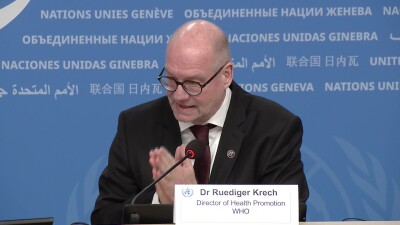
Dr. Ruediger Krech, Director of Health Promotion at the World Health Organization (WHO), stated that globally there were 1.25 billion adult tobacco users worldwide, which was good news as the number was 19 million lower than two years before. This was a first such decline, made even more important by the growth of the global population, which added some 149 million adults over the same period.
In total, 150 countries were now on a downward trend in tobacco use, with 56 among them already tracking towards the global target of a 30 percent reduction by 2025. Regulating tobacco sales, including tobacco taxes, worked well, along with measuring who exactly smoked in every country and helping those people quit. An average person tried to quit smoking ten times before succeeding, he said. While countries set themselves the ambitious voluntary target of a 30 percent reduction in tobacco use prevalence by 2025, the report showed that the world collectively would only make a 25 percent relative reduction in tobacco use unless more concerted efforts were made to adopt stronger tobacco control measures.
Currently the fastest decreases in tobacco use were happening in the lower middle-income group of countries, which showed that tobacco control could be done regardless of a country’s economic status. The European Region remained a challenge, where rates among women were more than double the global average for women and were reducing much slower than all other regions. The WHO region which currently had the lowest tobacco use prevalence was Africa, where the smoking population had already decreased from an average of 18 percent in 2000 to under 10 percent in 2022. Yet, due to population growth, there was likely to be more tobacco users in the African region come 2030 than there were now.
WHO urged countries to continue putting in place tobacco control policies and continue to fight against tobacco industry interference. The minute a government thought they were winning the fight against tobacco, the tobacco industry seized the opportunity to manipulate health policies to keep selling their deadly products. The ”Global Tobacco Industry Interference Index 2023”, published by STOP and the Global Center for Good Governance in Tobacco Control, showed that efforts to protect health policy from increased tobacco industry interference had deteriorated around the world.
Dr. Krech informed that tobacco control was as much about protecting future generations as helping existing users to quit, and that the WHO would dedicate this year’s World No Tobacco Day to protecting children from tobacco industry interference. In February, countries were set to meet in Panama for the 10th Session of WHO Framework Convention on Tobacco Control (FCTC) Conference of Parties where the tobacco industry would try to influence global health policies by offering financial and in-kind incentives interfering with countries rights to protect the health of their populations. Strengthening the WHO FCTC was a global health priority outlined in the sustainable development goals. WHO stood ready to support countries in defending evidence-based tobacco control measures in the face of industry interference.
Answering questions from the press corps, Dr. Krech said that there was a lot of room for improvement for Switzerland, which hosted several major tobacco corporations and grew tobacco. In certain countries in Europe, smoking among women was increasing, partly because of the absence of regulation on advertisements and product placements. The tobacco industry presented women smoking as self-fulfillment and liberation, which could not be further from the truth. A large majority of women smokers would like to quit smoking, but nicotine, as it was known, was highly addictive.
Dr. Krech gave a concrete example of the Big Tobacco’s putting pressure on individual countries by purchasing first-class air tickets for their health delegations. He said that there was an unprecedented, stronger-than-ever push by the tobacco industry against the WHO and tobacco control efforts. If a country had not been banned e-cigarettes, at least strong regulatory measures had to be taken to ensure that children had no access to e-cigarettes, which could be very well concealed. E-cigarettes were hooking children to nicotine, which was highly addictive, and there were double-digit increases in certain countries with lax measures. There were thousands of flavors in the market, including vanilla ice cream and gummy bears, most of them attractive to children. All flavors ought to be banned.
On another question, Dr. Krech explained that the tobacco industry targeted Africa the most because the prevalence there was the lowest and people were young and would be smoking for a long time. He also pointed out that most studies showing that e-cigarettes were less harmful were funded by the tobacco industry. The industry was swamping markets with hundreds of new products and thousands of flavors, which were hard to all analyze and regulate. This had to be counteracted and the trend had to be reversed. E-cigarettes were not consumer goods and had to be regulated, stressed Dr. Krech. Finally, he informed that cigarette butts were the single most used plastic in the world; billions of those ended up in the oceans and ended up being eaten by the fish.
Execution by nitrogen asphyxiation in the US state of Alabama
Ravina Shamdasani, for the Office of the High Commissioner for Human Rights (OHCHR), said that the OHCHR was alarmed by the imminent execution, in Alabama, United States of America, of prisoner Kenneth Eugene Smith, through the use of a novel and untested method – suffocation by nitrogen gas, which could amount to torture or other cruel, inhuman or degrading treatment or punishment under international human rights law.
The UN Human Rights Office called on Alabama state authorities to halt Mr. Smith’s execution, scheduled for 25 January, and to refrain from taking steps towards any other executions in this manner. Alabama had already sought to execute Mr. Smith unsuccessfully by lethal injection in 2022. Mr. Smith also had ongoing proceedings in federal courts against his upcoming execution which had not been finally resolved.
Nitrogen gas has never been used in the United States to execute human beings. The American Veterinary Medical Association recommended giving even large animals a sedative when being euthanized in this manner, while Alabama’s protocol for execution by nitrogen asphyxiation made no provision for sedation of human beings prior to execution. Ms. Shamdasani reiterated that the death penalty was inconsistent with the fundamental right to life. There was an absence of proof that it deterred crime, while it created an unacceptable risk of executing innocent people.
Full statement can be found here.
Answering questions from the media, Ms. Shamdasani said that Mr. Smith had been found guilty for capital murder. There had already been one botched execution attempt with a lethal injection. On another question, she said that there had been difficulties to access lethal drugs in the USA, which was why Alabama had opted for this untested method. The OHCHR had raised the issue with the federal authorities of the United States but acknowledged the federal-state division of judicial responsibilities in the country. In the USA, 37 states had either abolished the death penalty or had not carried out one in more than a decade, which was a welcome development. Several other states had worryingly approved of this untested method of execution. Mr. Smith had a pending appeal in the federal court, informed Ms. Shamdasani. She said that this method had never been used in the United States but could not state definitely if it had been used anywhere else in the world.
Conflict in Sudan
Responding to a question, Ravina Shamdasani, for the Office of the High Commissioner for Human Rights (OHCHR), said that the conflict in Sudan was now in its ninth month, and the High Commissioner for Human Rights had repeatedly appealed for the respect of the rules of war and protection of civilians. Alessandra Vellucci, for the United Nations Information Service (UNIS) said that the Emergency Relief Coordinator had allocated USD 10 million from the Central Emergency Relief Fund to support those fleeing the country. Some 60,000 people had fled from Sudan into South Sudan over the past month only.
Announcements
Alessandra Vellucci, for the United Nations Information Service, informed that the Committee on the Rights of the Child had opened its 95th session on 15 January, and was concluding this morning its review of the report of Republic of Congo. The Committee would also review Bulgaria, Senegal, Russia, Lithuania, and South Africa.
Similar Stories
1
1
1
Press Conferences | UN WOMEN , WFP , WHO
UN WOMEN: Sudan Women and girls one year after the fall of El Fasher; increasing drone attacks across the country; WFP: DRC - Ebola spreads to eighth DRC province as WFP delivers food, builds treatment centres and keeps supplies moving; WHO - Update on Ebola (Bundibugyo Virus Disease)
1
12
1
1
Press Conferences , Images | UNOG
Closing Press Conference following the Sixth Consultative Meeting on Enhancing Coordination of Peace Initiatives and Efforts in Sudan

2
17
1
2
Edited News , Press Conferences , Images | OCHA , WMO
Two UN agencies teamed up on Wednesday to issue an appeal for immediate assistance to help communities already being impacted by the strongest El Niño on record.
1
1
1
Press Conferences | CITES
Wildlife trade and conservation policy discussions at the 81st meeting of the CITES Standing Committee (SC81)
1
1
1
Press Conferences | UNHCR , UNCTAD , WMO , OCHA , UNICEF , WHO
UNHCR Hungary’s 1956 Refugee Crisis: 70 Years On, UNCTAD World Investment Forum 2026, Doha, WMO Greenhouse Gas Bulletin and Climate Update for COP31, OCHA Afghanistan: Malnutrition, Girls’ Education and Recovery, UNICEF Yemen: Child Malnutrition and Unsafe Water in Taiz, WHO Inequalities in Noncommunicable Diseases and Risk Factors
1
1
1
Press Conferences | UNHCR
End of UNHCR's 77th Annual Executive Committee (ExCom) meeting week
1
1
1
Press Conferences | UNICEF , IOM , UNHCR
UN Special Assistant to the Personal Envoy Office (SUDAN): Peace Initiatives and Efforts in Sudan; UNICEF: Dire situation of children in Gaza; IOM: Damaged Homes and Energy Attacks Risk Displacing Ukrainians for this winter; UNHCR: update on EXCOM week

1
1
1
Press Conferences | IOM , UNDRR
UN stresses importance of household preparedness for disaster risk reduction.

1
1
1
Statements , Press Conferences | OHCHR

1
1
1
Press Conferences | UNHCR , UNICEF , IFRC , OHCHR , UN WOMEN , IOM , OCHA , WHO
UNHCR – ExCom Meeting, UNICEF – Nepal Recovery, IFRC – Flash Floods, WHO – Mental Health, IOM – South Sudan Floods, OCHA – DRC Humanitarian aid, UNHCR – Sahel Displacement, UNICEF – Yemen Update, IOM – Gaza Shelter, UN Women – Gaza Women, OHCHR – Arrests and detentions of Syrians by Israeli force

2
1
2
Press Conferences | UNCTAD
Presentation of the Trade and Developement Report 2026
Embargoed until 9 October 2026 at 11 a.m. (Geneva Time)
UNCTAD: UNCTAD’s flagship report finds that governments increasingly use industrial, trade, financial and technology policies to pursue economic and national security objectives. Market access and the ability to move into higher-value activities now depend more heavily on technology, finance and geopolitics.

1
1
1
Press Conferences | UPU
Release of the State of the Postal Sector Report 2026