

The United Nations Office at Geneva
Multimedia Newsroom
Edited News | HRC
Myanmar: intensified war crimes and crimes against humanity committed, says top rights panel
Myanmar: Intensified war crimes and crimes against humanity committed, says top rights panel
Serious international crimes continue to be inflicted against the people in Myanmar by the country’s military junta and affiliate militias, while armed conflict has intensified substantially, top UN-appointed independent rights experts maintained at the UN Human Rights Council on Monday.
“Tragically, the frequency and intensity of war crimes and crimes against humanity has only increased in recent months,” said Nicholas Koumjian, head of the Independent Investigative Mechanism for Myanmar (IIMM).
Presenting the panel’s fifth annual report to the forum in Geneva, Mr. Koumjian noted that the past year had seen “more brazen aerial bombings and indiscriminate shelling, resulting in the deaths of innocent civilians including children”.
The report covers the activities carried out by the Mechanism between 1 July 2022 and July 2023. It notes a rise in the number of arrests without due process. The mechanism also has gathered credible evidence that some detainees have been subjected to torture, sexual violence, and other severe mistreatments.
“We have collected compelling evidence of the widespread burning of Rohingya villages and the assaults and killings of civilians. I have been particularly horrified by the numerous accounts of sexual crimes that we have collected,” said Mr. Koumjian, in reference to one of Myanmar’s ethnic minorities who were forced to flee a military crackdown in their hundreds of thousands in 2017.
Established by the Human Rights Council on 27 September 2018, the Independent Investigative Mechanism for Myanmar (IIMM)’s role is to collect, consolidate, preserve and analyse evidence of the most serious international crimes and violations of international law committed in Myanmar since 2011.
Six years since the mass exodus of Rohingya from Myanmar to Bangladesh, the Muslim ethnic minority group is considered to be the world’s largest stateless population that has been denied citizenship rights under the 1982 Citizenship Law in Buddhist-majority Myanmar.
According to the UN Refugee Agency (UNHCR), more than 960,000 mainly Rohingya people now shelter in Bangladesh with a majority living in the Cox Bazar’s region - home to one of the world’s largest refugee camps.
“The quantity of evidence and information we have been able to collect in the past year from individuals and organizations is unprecedented and frankly, unanticipated,” said the IIMM head.
Although the investigators’ repeated requests for information and access have been ignored by the military authorities, cutting-edge technology has been employed to analyse and verify large quantities of material, such as videos, photographs and other information posted on social media. The investigators are also using geospatial imagery to determine damage to villages before and after attacks.
“We have also begun a dedicated inquiry into financial information related to entities and individuals that have contributed to, or benefitted from, the serious international crimes committed in Myanmar,” said Mr. Koumjian. “We are looking at weapon supply chains, and the dispossession of land, homes, and businesses, particularly during the clearance operations in Rakhine State.”
The Human Rights Council-appointed mechanism intends to use the evidence to facilitate justice and accountability in courts and tribunals that are willing and able to prosecute these cases. “We are currently sharing information and evidence with three ongoing proceedings focused on crimes committed against the Rohingya at the International Court of Justice, the International Criminal Court and in courts in Argentina,” said Mr. Koumjian.
The estimated 600,000 Rohingya who remain in Rakhine State are subject to persecution and violence, confined to camps and villages without freedom of movement, and cut off from access to adequate food, health care, education, and livelihoods.
Volker Türk, the UN High Commissioner for Human Rights, told the Council that “human rights are, and must be, politically neutral. All States have accepted their responsibility to realise all rights and my mandate and ambition are to help every country advance and uphold the full range of human rights – without distinction as to their political system, alliances or stage of development.”
Mr Türk reiterated that “the human rights cause in all its facets has the potential to unify us, at a time when we urgently need to come together to confront the existential challenges that face humanity. This is ultimately about building trust and restoring hope, including through the work of this Council. All of us need to play our part.”
Amid ongoing violence in Myanmar more than 18 months since the country’s military seized power, the UN Children’s Fund (UNICEF) warned that youngsters have been impacted worst. “Myanmar is contaminated with landmines and unexploded ordnance. In the first six months of 2023, 556 casualties were reported nationwide due to landmines and explosive remnants of war,” said Anne Grandjean, UNICEF’s human rights specialist. “This is 143 per cent of the total casualties reported last year. Children make up 20 per cent of these casualties.”
Lotte Knudsen, head of the EU delegation to the UN in Geneva, emphasized that the bloc “calls on the Myanmar armed forces to immediately hold the use of violences against civilians, create the conditions for safe and dignified return of Rohingya to Myanmar, facilitate the unhindered delivery of humanitarian aid, adopt a moratorium on the death penalty, release political detainees and allow the population to exercise their rights including their freedom of expression and assembly.”
From the Bangladesh delegation, Mohammad Sufiur Rahman, Permanent Representative of Bangladesh to the UN in Geneva, noted that his country appreciated the Mechanism’s close engagement to the ICJ, ICC and the court in Argentina to facilitate justice for the Rohingyas” and expressed willingness to continue to cooperate with the IIMM. “The Mechanism’s success in Myanmar is important for the on-the-ground investigations. We ask Myanmar to fully cooperate with IIMM.”
-ends-
STORY: Myanmar report: Special Rapporteur and Human Rights Chief, HRC54 - 11 September 2023
DURATION (TRT): 4:13"
SOURCE: UNTV CH
LANGUAGE: ENGLISH/NATS
ASPECT RATIO: 16/9
DATELINE: 8 September 2023, GENEVA SWITZERLAND
FORMAT: HYBRID PRESS BRIEFING
- Exterior medium shot: UN flag alley, UN Geneva
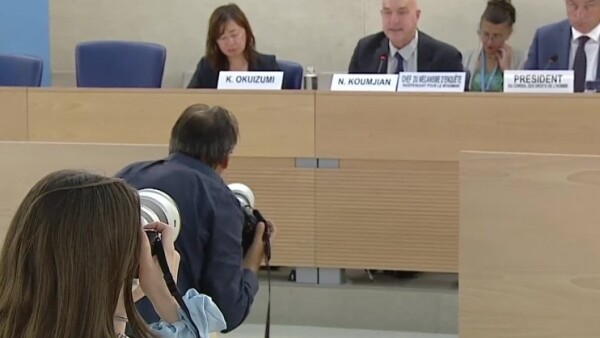
- Medium shot: delegates in the Human Rights Council room
- SOUNDBITE (English) – Nicholas Koumjian, Head of the Independent Investigative Mechanism for Myanmar: “Tragically, the frequency and intensity of war crimes and crimes against humanity has only increased in recent months. In the past year, we have seen more brazen aerial bombings and indiscriminate shelling, resulting in the deaths of innocent civilians including children. We have also seen increased executions of captured combatants and civilians and intentional burnings of homes and villages.”
- Medium shot: speakers at podium and photographers in the Human Rights Council room
- SOUNDBITE (English) – Nicholas Koumjian, Head of the Independent Investigative Mechanism for Myanmar: “We have collected compelling evidence of the widespread burning of Rohingya villages and the assaults and killing of civilians. I have been particularly horrified by the numerous accounts of sexual crimes that we have collected.”
- Medium shot: delegates in the Human Rights Council room
- SOUNDBITE (English) – Nicholas Koumjian, Head of the Independent Investigative Mechanism for Myanmar: “We have also begun a dedicated inquiry into financial information related to entities and individuals that have contributed to, or benefitted from, the serious international crimes committed in Myanmar. We are looking at weapon supply chains, and the dispossession of land, homes, and businesses, particularly during the clearance operations in Rakhine State.”
- Medium shot: speakers at podium in the Human Rights Council room
- SOUNDBITE (English) – Nicholas Koumjian, Head of the Independent Investigative Mechanism for Myanmar: “We are currently sharing information and evidence with three ongoing proceedings focused on crimes committed against the Rohingya at the International Court of Justice, the International Criminal Court and in courts in Argentina.”
- Medium shot: speakers at podium in the Human Rights Council room
- SOUNDBITE (English) – Volker Türk, United Nations High Commissioner for Human Rights: “Human rights are and must be politically neutral. All states have accepted their responsibility to realize all rights and my mandate and ambition are to help every country advance and uphold the full range of human rights without distinction as to their political system, alliances or stage of development.”
- Medium shot: delegates and photographers in the Human Rights Council room
- SOUNDBITE (English) – Volker Türk, United Nations High Commissioner for Human Rights: “The human rights calls in all its facets, has the potential to unify us at the time when we urgently need to come together to confront the existential challenges that we face. This is ultimately about building trust and restoring hope through the work of this Council and all of us need to play our part.”
- Medium shot: delegates in the Human Rights Council room
- SOUNDBITE (English) – Anne Grandjean, Human Rights Specialist at UNICEF: “Myanmar is contaminated with landmines and unexploded ordnance. In the first six months of 2023, 556 casualties were reported nationwide due to landmines and explosive remnants of war. This is 143 per cent of the total casualties reported last year. Children make up 20 per cent of these casualties.”
- Medium shot: cameraman and screen with delegates in the Human Rights Council room
- SOUNDBITE (English) – Lotte Knudsen, Head of the EU delegation to the UN in Geneva; “The EU calls on the Myanmar armed forces to immediately hold the use of violences against civilians, create the conditions for safe and dignified return of Rohingya to Myanmar, facilitate the unhindered delivery of humanitarian aid, adopt a moratorium on the death penalty, release political detainees and allow the population to exercise their rights including their freedom of expression and assembly.”
- Medium shot: delegates in the Human Rights Council room
- SOUNDBITE (English) – Mohammad Sufiur Rahman, Permanent Representative of Bangladesh to the UN in Geneva: “We appreciate the Mechanism’s close engagement to the ICJ, ICC and the court in Argentina to facilitate justice for the Rohingyas. We are pleased to host IIMM successive missions to Bangladesh and committed to cooperate further with the Mechanism. The Mechanism’s success in Myanmar is important for the on-the-ground investigations. We ask Myanmar to fully cooperate with IIMM.”
- Medium shot: delegates in the Human Rights Council room
- Close shot: delegates in the Human Rights Council room
- Close shot: camerawoman in the Human Rights Council room
Similar Stories

2
17
1
2
Edited News , Press Conferences | OCHA , WMO
Two UN agencies teamed up on Wednesday to issue an appeal for immediate assistance to help communities already being impacted by the strongest El Niño on record.

3
16
2
2
B-roll , Conferences , Edited News | UNITED NATIONS , UNOG
Sixth Consultative Meeting on Enhancing Coordination of Peace Initiatives and Efforts for Sudan

1
1
1
Edited News | UNICEF , WHO , UNHCR
Yemen war continues to force families from homes amid hunger and disease
More than 250,000 people have now fled renewed fighting in Yemen, the UN said on Tuesday, citing particular concern for those sheltering in the southwestern city of Taiz and the wider governorate, where access is “essentially blocked”.

1
1
1
Edited News | UNICEF
A little over one year since a ceasefire agreement was announced between Hamas fighters and Israel, more than 340 children have been reported killed and hundreds more injured, the UN Children’s Fund, UNICEF, said on Friday.

1
1
1
Edited News | UNICEF , IFRC
Six weeks after Nepal’s deadly flooding disaster, communities are still struggling to rebuild their lives, but they will need sustained help as global warming increases the risk of another Himalayan catastrophe, the UN Children’s Fund (UNICEF) said on Friday.

1
1
1
Edited News | WHO
In suspected Russia plague death, testing and monitoring underway – WHO
The death of a lab worker in Russia’s Siberia region has sparked concerns about plague being the cause, the UN World Health Organization (WHO) said on Tuesday, adding that it was following the situation closely.

1
1
Edited News | OHCHR , UNOG
UN Human Rights Chief Volker Türk on Friday provided and oral update to the 63rd session of the Human rights Council on Ukraine.

1
1
1
Edited News | OHCHR , UNOG
UN Human Rights Chief Volker Türk on Friday provided and oral update to the 63rd session of the Human rights Council on the human rights situation in Haiti.

1
1
1
Edited News | WHO
Repeated delays in bringing lifesaving medicines, prosthetics and more from Israel into Gaza risk having devastating consequences on Palestinians who urgently need them in the wartorn enclave, the UN World Health Organization (WHO) said on Friday. “A truck full of non-priority supplies or the right supplies arriving too late, doesn't save lives. That's the question that actually matters," said Dr Reinhilde Van De Weerdt, WHO Representative in the OPT.

1
1
1
Edited News | WHO
DRC: Early access to care and oxygen decisive for Ebola patients’ survival – WHO
In the Democratic Republic of the Congo (DRC), health workers fighting the country’s largest-ever Ebola outbreak are struggling to overcome critical challenges to patient care, the UN World Health Organization (WHO) warned on Tuesday.

1
1
1
Edited News | OCHA , UN
Civilians in Iran are continuing to feel the consequences of months of conflict and military escalation, the UN’s top official in the country has said, as loss of life, damage to civilian infrastructure and mounting economic pressures leave many facing continued uncertainty.
1
1
1
Edited News | WHO , UNICEF
Aid agencies in Yemen highlighted the growing hunger emergency sparked by renewed fighting between Houthi opposition forces and Government troops, after mobile health clinics reported that hundreds of children displaced by the violence are suffering from the most deadly form of malnutrition.