

The United Nations Office at Geneva
Multimedia Newsroom
UN relief teams warn of record levels of hunger in Sudan amid ongoing conflict
With conflict and economic decline continuing across Sudan, UN humanitarians on Friday dubbed the country “one of the most food-insecure…on the planet”.
More than 20.3 million people – at least 42 per cent of the population – now experience high levels of acute food insecurity, according to the latest Integrated Food Security Phase (IPC) projections.
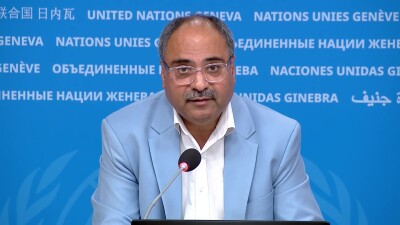
“The situation is critical” and families are encountering “unimaginable suffering”, said Adam Yao, Deputy UN Food and Agriculture Organization (FAO) Representative in Sudan.
Speaking from Port Sudan via Zoom to journalists in Geneva, Mr; Yao said that compared to the results from the last IPC analysis conducted in May 2022, the number of highly food-insecure people will nearly double between July and September 2023.
Some 14 million people are facing “Crisis” levels of hunger (IPC Phase 3) and nearly 6.2 million people face “Emergency” levels of acute hunger (IPC Phase 4), Mr. Yao said.
The states most severely affected are those grappling with active conflict, including Khartoum, South and West Kordofan, along with Central, East, South and West Darfur, where “over half of the population is facing acute hunger”.
Latest displacement data indicates that some four million people have been displaced from Sudan in a little over 100 days, since fighting erupted between the Sudanese Army and the paramilitary Rapid Support Forces (RSF), with Khartoum State remaining the epicentre of the conflict.
The UN agency said that critical infrastructure, including healthcare facilities, power sources and telecommunications had suffered significant damage, further exacerbating food insecurity and malnutrition. Market disruptions and soaring food prices have compounded the population's struggle to access essential goods and services.
Echoing the FAO concerns, Eddie Rowe, World Food Programme (WFP) Country Director for Sudan, pointed out that in the nearly four months since the conflict started, their “grim prediction” had come true, that hunger would rise to engulf more than 19 million people. Mr. Rowe described the operating environment in Sudan as “the most challenging that I have experienced in my career”, with the need to gain access to people in need of life-saving food assistance becoming “more challenging and increasingly urgent”.
On a positive note, the WFP spokesperson said that there was a major breakthrough last week when, for the first time, the agency delivered food assistance in West Darfur State. He explained that “a convoy of five trucks transporting 125 metric tonnes of food commodities travelled from eastern Chad to West Darfur where we were able to assist about 15,400 people in three villages”.
Mr. Rowe said that he hoped that the route from Chad will become “a regular humanitarian corridor to reach these families in West Darfur, especially in Geneina – the capital of West Darfur - but more importantly inwards into Zalingei in central Darfur, where lives have been torn apart by the violence”.
Mr. Yao also explained that the FAO has managed to procure 8,840 tonnes of cereal (sorghum and millet) and okra seed, despite the complex security conditions. These have reached more than half a million farming households across the country. The FAO aims to reach up to one million farmers in time for the planting season, in order to produce enough cereal to cover the needs of up to 19 million people for a year. The spokesperson pointed out that FAO became “the first UN agency to reach West Kordofan and East Darfur since the conflict began and has managed to distribute the seed to farmers through its local partners”. He explained that this milestone has facilitated access to North and South Darfur, allowing FAO to broaden its assistance to vulnerable communities.
Mr Yao. added that the success of the campaign is a reminder of “the importance of agriculture as a cost-efficient front-line humanitarian intervention to reduce vulnerability and strengthen food and nutrition security.”
ENDS
STORY: Steps away from famine in Sudan - FAO - WFP
TRT: 03’35”
SOURCE: UNTV CH
RESTRICTIONS: NONE
LANGUAGE: ENGLISH /NATS
ASPECT RATIO: 16:9
DATELINE: 11 AUGUST 2023, GENEVA, SWITZERLAND
SHOTLIST
- Exterior wide shot, United Nations flag flying.
- Wide shot, panel at briefing.
- SOUNDBITE: (ENGLISH) Adam Yao, Deputy FAO Representative in Sudan:
- “The food security situation in the country is deeply alarming. According to the latest IPC report, the July to September 2023 projection is nearly double the number of food-insecure people compared to the last IPC analysis conducted in May 2022.”
- Mid shot, attendees at briefing.
- SOUNDBITE: (ENGLISH) Adam Yao, Deputy FAO Representative in Sudan: “20.3 million people across Sudan, over 42 per cent of the population now face high level of acute food insecurity, making this one of the most food-insecure countries on the planet. More than 6.2 million people are categorized at emergency level IPC phase four - steps away from famine.”
- Close of journalists typing.
- SOUNDBITE: (ENGLISH) Adam Yao, Deputy FAO Representative in Sudan: “The situation is critical. A state like Khartoum, South and West Kordofan and parts of Darfur are the hardest hit, with over half the population facing acute hunger. Families are facing unimaginable suffering. And I've seen the impact of this conflict with my very eyes.”
- Mid-side view of attendees at briefing.
- SOUNDBITE: (ENGLISH) Adam Yao, Deputy FAO Representative in Sudan: “FAO was the first UN agency to reach West Kordofan and East Darfur since the conflict began and has managed to distribute the seed to farmers through its local partners. This milestone has facilitated access to North and South Darfur, allowing FAO to broader its assistance to vulnerable communities.”
- Mid of attendee at briefing.
- SOUNDBITE: (ENGLISH) Adam Yao, Deputy FAO Representative in Sudan: “The success of the campaign is a reminder of the importance of agriculture as a cost-efficient front-line humanitarian intervention to reduce vulnerability and strengthen food and nutrition security.”
- Mid-side view of journalists with screen in background.
- SOUNDBITE: (ENGLISH) Eddie Rowe, WFP Country Director for Sudan: “ Last week, we had a major breakthrough: for the first time WFP was able to deliver food assistance in West Darfur State. We had a convoy of about five trucks that transported 125 metric tons of food commodities from eastern Chad to west Darfur, where we were able to assist about 15,400 people in three villages.”
- Mid of panel at the briefing.
- SOUNDBITE: (ENGLISH) Eddie Rowe, WFP Country Director for Sudan: “We do hope that this route from Chad will become a regular humanitarian corridor to allow us to reach these families in Western Darfur, who particularly in Geneina, the capital of West Darfur, but more importantly inwards into Zalingei in central Darfur, where lives have been torn apart by violence.”
- Close of attendee at briefing.
- Mid-side view of attendees at briefing.
- Mid-side view of laptop screen.

Similar Stories

1
1
1
Edited News | UNICEF , WHO , UNHCR
Yemen war continues to force families from homes amid hunger and disease
More than 250,000 people have now fled renewed fighting in Yemen, the UN said on Tuesday, citing particular concern for those sheltering in the southwestern city of Taiz and the wider governorate, where access is “essentially blocked”.

1
1
1
Edited News | UNICEF
A little over one year since a ceasefire agreement was announced between Hamas fighters and Israel, more than 340 children have been reported killed and hundreds more injured, the UN Children’s Fund, UNICEF, said on Friday.

1
1
1
Edited News | UNICEF , IFRC
Six weeks after Nepal’s deadly flooding disaster, communities are still struggling to rebuild their lives, but they will need sustained help as global warming increases the risk of another Himalayan catastrophe, the UN Children’s Fund (UNICEF) said on Friday.

1
1
1
Edited News | WHO
In suspected Russia plague death, testing and monitoring underway – WHO
The death of a lab worker in Russia’s Siberia region has sparked concerns about plague being the cause, the UN World Health Organization (WHO) said on Tuesday, adding that it was following the situation closely.

1
1
Edited News | OHCHR , UNOG
UN Human Rights Chief Volker Türk on Friday provided and oral update to the 63rd session of the Human rights Council on Ukraine.

1
1
1
Edited News | OHCHR , UNOG
UN Human Rights Chief Volker Türk on Friday provided and oral update to the 63rd session of the Human rights Council on the human rights situation in Haiti.

1
1
1
Edited News | WHO
Repeated delays in bringing lifesaving medicines, prosthetics and more from Israel into Gaza risk having devastating consequences on Palestinians who urgently need them in the wartorn enclave, the UN World Health Organization (WHO) said on Friday. “A truck full of non-priority supplies or the right supplies arriving too late, doesn't save lives. That's the question that actually matters," said Dr Reinhilde Van De Weerdt, WHO Representative in the OPT.

1
1
1
Edited News | WHO
DRC: Early access to care and oxygen decisive for Ebola patients’ survival – WHO
In the Democratic Republic of the Congo (DRC), health workers fighting the country’s largest-ever Ebola outbreak are struggling to overcome critical challenges to patient care, the UN World Health Organization (WHO) warned on Tuesday.

1
1
1
Edited News | OCHA , UN
Civilians in Iran are continuing to feel the consequences of months of conflict and military escalation, the UN’s top official in the country has said, as loss of life, damage to civilian infrastructure and mounting economic pressures leave many facing continued uncertainty.

1
1
1
Edited News | WHO , UNICEF
Aid agencies in Yemen highlighted the growing hunger emergency sparked by renewed fighting between Houthi opposition forces and Government troops, after mobile health clinics reported that hundreds of children displaced by the violence are suffering from the most deadly form of malnutrition.
1
1
1
Edited News | UNHCR
Displacement on the rise in Yemen as fighting continues - UNHCR
As hostilities worsen in Yemen, more people have been fleeing their homes, further intensifying the humanitarian crisis within the region, the UN Refugee Agency (UNHCR) warned on Tuesday.
1
1
1
Edited News | IOM , OHCHR , UNFPA , UNOG , UNHCR , WHO
Yemen’s humanitarian crisis growing by the hour amid spike in displacement
Yemenis displaced by renewed fighting have described fleeing for their lives amid shelling and gunfire, aid agencies reported on Friday, while highlighting the dramatic increase in humanitarian needs in the country and in Djibouti, where thousands have sought shelter.