

The United Nations Office at Geneva
Multimedia Newsroom
The global average temperature for July 2023 was the highest on record and likely for at least 120,000 years, the UN weather agency WMO and partners said on Tuesday.
“The global average temperature for July 2023 is confirmed to be the highest on record for any month,” said Samantha Burgess, Deputy Director at the European Commission’s Copernicus Climate Change Service. “The month is estimated to have been around 1.5C warmer than the average for 1815 to 1900, so the average for pre-industrial times.”
Briefing journalists in Geneva, Ms. Burgess noted that July had been marked by heatwaves “in multiple regions around the world”.
Based on data analysis known as proxy records, which include cave deposits, calcifying organisms, coral and shells, the Copernicus scientist added that it “has not been this warm for the last 120,000 years”.
Records were also broken for global sea surface temperatures, after "unusually high" temperatures this April that led to the ocean surface warming in July to some 0.51C above the 1991-2020 average.
From the UN World Meteorological Organization (WMO), Chris Hewitt, Director of Climate Services, pointed to the agency’s prediction in May that there was a “ 98 per cent likelihood” that one of the next five years will be one of the warmest on record. He also reiterated that while there was a 66 per cent chance that the 1.5C threshold above the pre-industrial value will be exceeded in this timeframe, this will likely be a “temporary” change.
Temporary or not, any such increase will have “dire consequences for both people and the planet exposed to ever more frequent and intense extreme events”, Ms. Burgess warned. “It shows the urgency for ambitious efforts to reduce global greenhouse gas emissions, which are the main driver behind these records.”
WMO’s Mr. Hewitt said that it was also important to note that 2015 to 2022 were the “eight warmest years” according to readings going back at least 170 years, despite prevailing La Niña conditions in the Pacific ocean that “tend to reign in the global average temperature and suppress them slightly”.
The WMO added that “the long-term warming trend is driven by continued increases in concentrations of greenhouse gases in the atmosphere” which have all reached record observed highs.
“The warmest year on record so far was 2016 and that particular year was associated with a very strong El Niño event on top of the long-term warming of the climate system,” he explained.
ENDS
1. Exterior wide shot, United Nations flag flying.
2. Wide shot, panel at briefing.
3. SOUNDBITE: (ENGLISH) Samantha Burgess, Deputy Director Copernicus Climate Change Service/ECMWF: “The global average temperature for July 2023 is confirmed to be the highest on record for any month. The month is estimated to have been around 1.5 degrees warmer than the average for 1815 to 1900, so the average for pre-industrial times. Heatwaves were experienced throughout July in multiple regions around the world. Moving on from air temperatures to sea surface temperatures, the global average sea surface temperatures continued to rise after a long period of unusually high temperatures since April 2023, reaching record-high levels in July.”
4. Medium: speaker on podium.
5. SOUNDBITE: (ENGLISH) Chris Hewitt, WMO Director of Climate Services: “2015 to 2022 were the eight warmest years in the instrumental record going back at least 170 years and it’s important to note this is despite persistent La Niña conditions that we had over the last three years and the relevance of that is La Niña conditions tend to rein in the global average temperatures and suppress them slightly.”
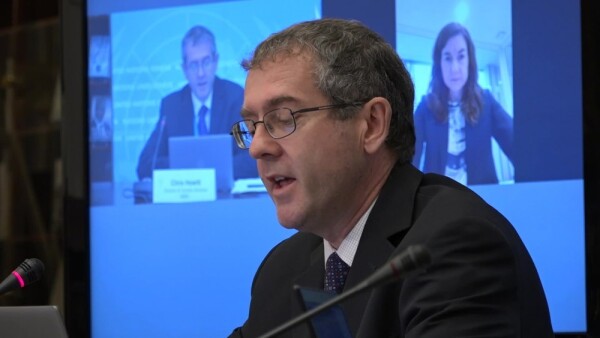
6. Medium of speaker and screen.
7. SOUNDBITE: (ENGLISH) Chris Hewitt, WMO Director of Climate Services: “This long-term warming trend, it’s driven by continued increases in concentrations of greenhouse gasses in the atmosphere so the three main gases carbon dioxide, methane and nitrous oxide, they all reached record observed highs. The warmest year on record so far was 2016 and that particular year is associated with a combination of a very strong El Niño event at that time on top of the long-term warming of the climate system.”
8. Close up, Zoom speaker on laptop.
9. SOUNDBITE: (ENGLISH) Samantha Burgess, Deputy Director Copernicus Climate Change Service/ECMWF: “What we can say is from the IPCC Sixth Assessment Report it has not been this warm, combining observational records and paleoclimate records, for the last 120 thousand years.”
10.Medium side view of speaker and screen.
11. SOUNDBITE: (ENGLISH) Chris Hewitt, WMO Director of Climate Services: “We predicted back in May I think it was, a press briefing again, it's very likely, 98 per cent likelihood, that one of the next five years will be one of the warmest on record and a 66 per cent chance - so more likely than not - that we will temporarily exceed 1.5 degrees above the pre-industrial value, so the Paris Agreement, so temporarily exceed 1.5 degrees for at least one of the next five years.”
12. Mid of attendee at briefing.
13. Mid of attendees at briefing.
14. Mid of attendee at briefing.
Similar Stories

1
1
1
Edited News | OCHA , UNICEF , WFP
Aid agencies warned on Friday of the fast-developing humanitarian emergency inside Taiz City in Yemen, which has been encircled by de facto Houthi forces fighting government troops along the country’s west coast.

2
17
1
2
Edited News , Press Conferences , Images | OCHA , WMO
Two UN agencies teamed up on Wednesday to issue an appeal for immediate assistance to help communities already being impacted by the strongest El Niño on record.

3
16
2
2
Edited News , B-roll , Conferences , Images | UNITED NATIONS , UNOG
Sixth Consultative Meeting on Enhancing Coordination of Peace Initiatives and Efforts for Sudan

1
1
1
Edited News | UNICEF , WHO , UNHCR
Yemen war continues to force families from homes amid hunger and disease
More than 250,000 people have now fled renewed fighting in Yemen, the UN said on Tuesday, citing particular concern for those sheltering in the southwestern city of Taiz and the wider governorate, where access is “essentially blocked”.

1
1
1
Edited News | UNICEF
A little over one year since a ceasefire agreement was announced between Hamas fighters and Israel, more than 340 children have been reported killed and hundreds more injured, the UN Children’s Fund, UNICEF, said on Friday.

1
1
1
Edited News | UNICEF , IFRC
Six weeks after Nepal’s deadly flooding disaster, communities are still struggling to rebuild their lives, but they will need sustained help as global warming increases the risk of another Himalayan catastrophe, the UN Children’s Fund (UNICEF) said on Friday.

1
1
1
Edited News | WHO
In suspected Russia plague death, testing and monitoring underway – WHO
The death of a lab worker in Russia’s Siberia region has sparked concerns about plague being the cause, the UN World Health Organization (WHO) said on Tuesday, adding that it was following the situation closely.

1
1
Edited News | OHCHR , UNOG
UN Human Rights Chief Volker Türk on Friday provided and oral update to the 63rd session of the Human rights Council on Ukraine.

1
1
1
Edited News | OHCHR , UNOG
UN Human Rights Chief Volker Türk on Friday provided and oral update to the 63rd session of the Human rights Council on the human rights situation in Haiti.

1
1
1
Edited News | WHO
Repeated delays in bringing lifesaving medicines, prosthetics and more from Israel into Gaza risk having devastating consequences on Palestinians who urgently need them in the wartorn enclave, the UN World Health Organization (WHO) said on Friday. “A truck full of non-priority supplies or the right supplies arriving too late, doesn't save lives. That's the question that actually matters," said Dr Reinhilde Van De Weerdt, WHO Representative in the OPT.

1
1
1
Edited News | WHO
DRC: Early access to care and oxygen decisive for Ebola patients’ survival – WHO
In the Democratic Republic of the Congo (DRC), health workers fighting the country’s largest-ever Ebola outbreak are struggling to overcome critical challenges to patient care, the UN World Health Organization (WHO) warned on Tuesday.

1
1
1
Edited News | OCHA , UN
Civilians in Iran are continuing to feel the consequences of months of conflict and military escalation, the UN’s top official in the country has said, as loss of life, damage to civilian infrastructure and mounting economic pressures leave many facing continued uncertainty.