

The United Nations Office at Geneva
Multimedia Newsroom
Edited News | OHCHR , UNOG
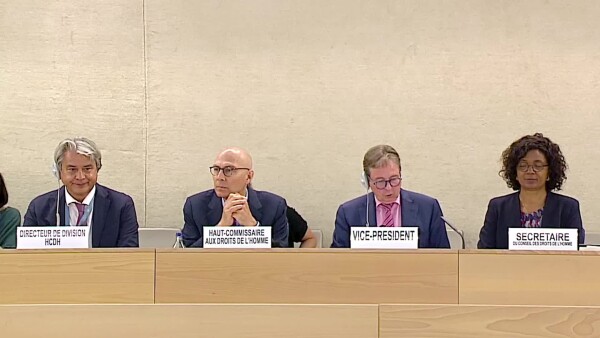
Statement by Volker Türk, UN High Commissioner for Human Rights at the UN Human Rights Council Interactive Dialogue on Ukraine-_1
“The Russian Federation’s senseless war on Ukraine continues to generate severe and far-reaching violations of human rights,” said UN human rights chief Volker Türk on Wednesday, during a UN Human Rights Council Interactive Dialogue on Ukraine.
“Last Friday, on the 500th day of this conflict, our Human Rights Monitoring Mission outlined the horrendous civilian cost of the war in Ukraine. More than 9,000 civilians, including over 500 children, have been killed since the war began on 24 February of last year. The real figures are likely to be much higher,” Türk added.
The report (A/HRC/53/CRP.3) presented to the Human Rights Council, examines the situation of civilians who have been detained in the context of the conflict. Its sources include 274 site visits by the Office’s staff, including 70 visits to official detention facilities, and interviews with 1,136 people. The High Commissioner wished to underline that the monitoring work of UN Human Rights Office – which is core to their mandate - follows the highest standards of impartiality, professionalism, objectivity and non-selectivity. These principles have guided the collection of the data set out in this report, as in all other reports produced by the UN Human Rights Office.
“It is through rigour and painstaking care in the collection of data and analysis of evidence that we make the strongest case for truth, and for accountability. In the report before you, we have documented the arbitrary detention of more than 900 individual civilians, including eight children, between 24 February 2022 and 23 May 2023,” the High Commissioner said.
“The Russian Federation gave no access to places of detention, which leads inevitably to undercounting. Even so, we were able to interview 178 detainees who had been held by the Russian Federation, after their release. In total, 864 of the cases that we documented were perpetrated by the Russian Federation. Many of them were incommunicado detentions, tantamount to enforced disappearances,” he stated.
The report also documented the summary execution of 77 civilians while they were arbitrarily detained by the Russian Federation. Over 90 per cent of detainees held by the Russian Federation that the UN Human rights office was able to interview said they had been subjected to torture and ill-treatment -- including sexual violence, in some cases -- by Russian security personnel.
The civilians detained by the Russian Federation that were also interviewed included local public officials, humanitarian volunteers, former soldiers, perceived political opponents, priests and teachers. In 26 per cent of cases, they were transferred to other locations in occupied Ukraine or the Russian Federation, without information provided to their families. The report also documented several cases that suggest detained civilians have been used by Russian armed forces as “human shields” in order to render certain areas immune from military attacks.
“These findings are shocking. They call for concrete measures by the Russian Federation to instruct and ensure their Russian personnel comply with international human rights and humanitarian law,” Türk said.
- The UN Human Rights Office was given extensive and unimpeded access to places of detention under the control of the Ukrainian authorities. The High Commissioner acknowledges and thanks the Government for this cooperation, occurring in a context of national crisis and survival. The report documented 75 cases of arbitrary detention. Most of them were people suspected of criminal offences related to the conflict, and many arbitrary detentions arose from excessively broad amendments to criminal legislation under martial law. The report also found that Ukrainian personnel in unofficial places of detention or – to a much lesser extent – in official pre-trial detention facilities, engaged in torture or ill-treatment, including sexual violence, mostly involving threats.
- The High Commissioner was concerned that the so-called “law on collaboration activities” adopted in March 2022 criminalizes a wide range of conduct, including conduct that may be permitted under international humanitarian law, and has led to cases of arbitrary detention.
The Secretary-General’s report A/HRC/53/64 outlines human rights violations in the temporarily occupied Autonomous Republic of Crimea and the city of Sevastopol, as well as Russian-occupied areas of Kherson, Zaporizhzhia, Donetsk and Luhansk regions of Ukraine.
From 1 July to 31 December 2022, the UN Human Rights Office has documented 60 arbitrary arrests in these areas by Russian security personnel, as well as enforced disappearances and torture.
Regarding forced conscription, Russian officials have announced that 2,500 men from Crimea were conscripted during the reporting period, and the Office has documented 112 criminal prosecutions for so-called draft evasion in 2022.
The High Commissioner was also deeply concerned about population transfers of civilians. During the reporting period, the UN Human Rights Office collected information about 23 residents who were arrested by Russian security forces and transferred across the Administrative Boundary Line to Crimea, reportedly handcuffed and blindfolded. In parallel, the Russian authorities have continued transferring Ukrainian citizens whom they consider “foreigners” out of Crimea.
- In Crimea and occupied areas of Ukraine, the report has documented extensive violations of the rights to freedom of opinion, expression, peaceful assembly and association, including new sanctions for publicly voicing opinions that “discredit” the Russian armed forces, and a further deterioration of the operating environment for human rights defenders. Teachers were pressured to actively endorse the Russian invasion and encourage a positive attitude towards it among children. Denial of the rights to due process and fair trial remain a systemic issue in Crimea. The UN Human Rights Office verified 16 cases where courts convicted Ukrainian citizens following proceedings that disregarded fair trial guarantees.
- “Accountability for the violations and abuses committed in this conflict continues to be conspicuous by its absence. I am aware of no ongoing investigations by the Russian Federation in relation to arbitrary detention, enforced disappearance, torture or ill-treatment perpetrated by its forces in Ukraine against civilians,” he said.
- The High Commissioner was deeply concerned that the Parliament of the Russian Federation recently adopted a federal law that would potentially exempt from criminal liability the perpetrators of international criminal offences committed in occupied regions of Ukraine. International law prohibits the granting of such amnesty in relation to serious violations of international humanitarian law or gross violations of international human rights law.
- In Ukraine, while numerous proceedings have been initiated, there are no completed criminal investigations of Ukrainian personnel for arbitrary detention, enforced disappearance or torture against civilians. The High Commissioner welcomes that Ukraine has created a mechanism to compensate victims of conflict-related arbitrary detention and enforced disappearance.
- “The issues outlined in our reports are profoundly harmful to the human rights of Ukrainians and must be addressed with urgency. I also sympathise deeply with all those affected by last month’s destruction of the dam at the Kakhovka Hydroelectric Power Plant, in occupied Kherson region, whose rights will be affected long into the future by this cruel act of war. The environmental damage more generally is one of the horrific by-products of this war which will have grave repercussions for generations to come. I continue to be deeply disturbed by the potentially enormous human rights implications of the precarious situation at Zaporizhzhia and other nuclear plants,” Türk said.
ENDS
For more information and media requests, please contact:
Ravina Shamdasani - + 41 22 917 9169 / ravina.shamdasani@un.org or
Liz Throssell + 41 22 917 9296 / elizabeth.throssell@un.org or
Jeremy Laurence + +41 22 917 9383 / jeremy.laurence@un.org or
Marta Hurtado - + 41 22 917 9466 / marta.hurtadogomez@un.org
Tag and share
Twitter @UNHumanRights
Facebook unitednationshumanrights
Instagram @unitednationshumanrights
Tag and share - Twitter: @UNHumanRights and Facebook: unitednationshumanrights
- Exterior shot: Palais des Nations, Geneva.
- Wide shot: wide shot room 20
- Soundbite (English)— Volker Türk, UN High Commissioner for Human Rights, (OHCHR): “The Russian Federation’s senseless war on Ukraine continues to generate severe and far-reaching violations of human rights.”
- Cut away: Room 20
- Soundbite (English)— Volker Türk, UN High Commissioner for Human Rights, (OHCHR): “Last Friday, on the 500th day of this conflict, our Human Rights Monitoring Mission outlined the horrendous civilian cost of the war in Ukraine. More than 9,000 civilians, including over 500 children, have been killed since the war began on 24 February of last year. The real figures are likely to be much higher.”
- Cut away: Room 20
- Soundbite (English)— Volker Türk, UN High Commissioner for Human Rights, (OHCHR):“It is through rigour and painstaking care in the collection of data and analysis of evidence that we make the strongest case for truth, and for accountability. In the report before you, we have documented the arbitrary detention of more than 900 individual civilians, including eight children, between 24 February 2022 and 23 May 2023.”
- Cut away: Room 20
- Soundbite (English)— Volker Türk, UN High Commissioner for Human Rights, (OHCHR): “The Russian Federation gave no access to places of detention, which leads inevitably to undercounting. Even so, we were able to interview 178 detainees who had been held by the Russian Federation, after their release. In total, 864 of the cases that we documented were perpetrated by the Russian Federation. Many of them were incommunicado detentions, tantamount to enforced disappearances.”
- Cut away: Room 20
- Soundbite (English)— Volker Türk, UN High Commissioner for Human Rights, (OHCHR):“These findings are shocking. They call for concrete measures by the Russian Federation to instruct and ensure their Russian personnel comply with international human rights and humanitarian law.”
- Cut away: Room 20
- Soundbite (English)— Volker Türk, UN High Commissioner for Human Rights, (OHCHR):“Accountability for the violations and abuses committed in this conflict continues to be conspicuous by its absence. I am aware of no ongoing investigations by the Russian Federation in relation to arbitrary detention, enforced disappearance, torture or ill-treatment perpetrated by its forces in Ukraine against civilians.”
- Cut away: Room 20
- Soundbite (English)— Volker Türk, UN High Commissioner for Human Rights, (OHCHR): “The issues outlined in our reports are profoundly harmful to the human rights of Ukrainians and must be addressed with urgency. I also sympathise deeply with all those affected by last month’s destruction of the dam at the Kakhovka Hydroelectric Power Plant, in occupied Kherson region, whose rights will be affected long into the future by this cruel act of war. The environmental damage more generally is one of the horrific by-products of this war which will have grave repercussions for generations to come. I continue to be deeply disturbed by the potentially enormous human rights implications of the precarious situation at Zaporizhzhia and other nuclear plants.”
Similar Stories

2
17
1
2
Edited News , Press Conferences | OCHA , WMO
Two UN agencies teamed up on Wednesday to issue an appeal for immediate assistance to help communities already being impacted by the strongest El Niño on record.

3
16
2
2
B-roll , Conferences , Edited News | UNITED NATIONS , UNOG
Sixth Consultative Meeting on Enhancing Coordination of Peace Initiatives and Efforts for Sudan

1
1
1
Edited News | UNICEF , WHO , UNHCR
Yemen war continues to force families from homes amid hunger and disease
More than 250,000 people have now fled renewed fighting in Yemen, the UN said on Tuesday, citing particular concern for those sheltering in the southwestern city of Taiz and the wider governorate, where access is “essentially blocked”.

1
1
1
Edited News | UNICEF
A little over one year since a ceasefire agreement was announced between Hamas fighters and Israel, more than 340 children have been reported killed and hundreds more injured, the UN Children’s Fund, UNICEF, said on Friday.

1
1
1
Edited News | UNICEF , IFRC
Six weeks after Nepal’s deadly flooding disaster, communities are still struggling to rebuild their lives, but they will need sustained help as global warming increases the risk of another Himalayan catastrophe, the UN Children’s Fund (UNICEF) said on Friday.

1
1
1
Edited News | WHO
In suspected Russia plague death, testing and monitoring underway – WHO
The death of a lab worker in Russia’s Siberia region has sparked concerns about plague being the cause, the UN World Health Organization (WHO) said on Tuesday, adding that it was following the situation closely.

1
1
Edited News | OHCHR , UNOG
UN Human Rights Chief Volker Türk on Friday provided and oral update to the 63rd session of the Human rights Council on Ukraine.

1
1
1
Edited News | OHCHR , UNOG
UN Human Rights Chief Volker Türk on Friday provided and oral update to the 63rd session of the Human rights Council on the human rights situation in Haiti.

1
1
1
Edited News | WHO
Repeated delays in bringing lifesaving medicines, prosthetics and more from Israel into Gaza risk having devastating consequences on Palestinians who urgently need them in the wartorn enclave, the UN World Health Organization (WHO) said on Friday. “A truck full of non-priority supplies or the right supplies arriving too late, doesn't save lives. That's the question that actually matters," said Dr Reinhilde Van De Weerdt, WHO Representative in the OPT.

1
1
1
Edited News | WHO
DRC: Early access to care and oxygen decisive for Ebola patients’ survival – WHO
In the Democratic Republic of the Congo (DRC), health workers fighting the country’s largest-ever Ebola outbreak are struggling to overcome critical challenges to patient care, the UN World Health Organization (WHO) warned on Tuesday.

1
1
1
Edited News | OCHA , UN
Civilians in Iran are continuing to feel the consequences of months of conflict and military escalation, the UN’s top official in the country has said, as loss of life, damage to civilian infrastructure and mounting economic pressures leave many facing continued uncertainty.
1
1
1
Edited News | WHO , UNICEF
Aid agencies in Yemen highlighted the growing hunger emergency sparked by renewed fighting between Houthi opposition forces and Government troops, after mobile health clinics reported that hundreds of children displaced by the violence are suffering from the most deadly form of malnutrition.