

The United Nations Office at Geneva
Multimedia Newsroom
“This Council has heard report after report on the human rights situation in Myanmar. With each successive update, it is almost impossible to imagine that the people of Myanmar can endure more suffering. Yet the country continues its deadly freefall into even deeper violence and heartbreak. -A regime imposed by generals for the last two and a half years has snatched away the optimism that Myanmar’s people once held for peace, democracy, and a more prosperous future,” Türk said.
The High Commissioner described the regime imposed by generals for the last two and a half years as having snatched away the optimism that Myanmar’s people once held for peace, democracy, and a more prosperous future.
“Civilians live at the whim of a reckless military authority that relies on systematic control tactics, fear and terror in the hope of enforcing its ever-diminishing control. Civilians also bear the devastating brunt of the grotesque violence, including against older people, people with disabilities and infants. The situation has become untenable,” he said.
The High Commissioner spoke of brutal attacks by the military in border regions, with increasing numbers of people crossing international frontiers in search of safety and protection. More than one million Rohingya remain in neighboring Bangladesh where they live in the world’s largest refugee camp in deplorable conditions. The conditions for their return to Myanmar are still non-existent. And the military continues to carry out atrocities in their home state of Rakhine, where they are denied citizenship.
Credible sources indicate that as of yesterday, 3,744 individuals have died at the hands of the military since they took power, and 23,670 have been arrested. These figures represent the minimum that can be documented and verified - the true number of casualties is likely to be far higher.
“Every day, the military’s ruthless so-called “four cuts” strategy continues to wreak destruction. Entire villages are razed and burned to the ground, collectively punishing civilians, by depriving them of shelter, food, water, and life-saving aid. Since the coup began, the military has scorched at least 70,000 homes across the country, 70 percent of which were in Sagaing region. Over 1.5 million people have been forcibly displaced with minimal access to humanitarian aid,” Türk said.
Incessant airstrikes and artillery shelling are destroying homes and stealing lives. In the first six months of this year, my Office reported a 33 percent increase in indiscriminate airstrikes compared to the first half of last year, with rising attacks on civilian targets, including villages, schools, hospitals and places of worship.
Artillery attacks have also dramatically increased, with over 563 this year, representing already 80 percent of the total attacks last year. My Office also continues to document repeated violations of the most brutal forms: sexual violence, mass killings, extra-judicial executions, beheadings, dismemberments, and mutilations.
The High Commissioner also appealed to all countries to cease and prevent the supply of arms to the military and to take targeted measures to limit access by generals to foreign currency, aviation fuel and other means that enable attacks on Myanmar’s people.
“The report I present to the Council today focuses on the systematic denial by the military of life-saving humanitarian aid for civilians. They have put in place a raft of legal, financial, and bureaucratic barriers to ensure people in need do not receive and cannot access assistance.
This obstruction of life-saving aid is deliberate and targeted, a calculated denial of fundamental rights and freedoms for large swathes of the population,” Türk said.
In mid-May, when Cyclone Mocha made landfall with devastating effect in Rakhine, Chin, Magway and Sagaing, the military actively prevented independent needs assessments, and obstructed access to information. They suspended all travel authorisations in Rakhine State, eventually allowing distribution of aid to resume if it was not cyclone-related.
“I deplore the direct attacks on humanitarian staff. Local organizations, which provide the vast majority of humanitarian aid, face the greatest risks in carrying out their work. Up to 40 humanitarian workers have been killed and over 200 arrested since the coup,” he said.
The High Commissioner also appealed to all countries to cease and prevent the supply of arms to the military and to take targeted measures to limit access by generals to foreign currency, aviation fuel and other means that enable attacks on Myanmar’s people.
“This Council needs to consider how to bring to light the business interests that support the military and keep them afloat,” the High Commissioner stated.
The High Commissioner said the path out of this crisis must be anchored in accountability for the grave human rights violations and other violations of international law that are occurring. He urged the Security Council to refer the situation to the International Criminal Court.
“It is of the utmost urgency that we restore all conditions necessary for Myanmar’s people to find a way out of the heartache, and to live their lives in freedom and safety,” he said in conclusion.
ENDS
For more information and media requests, please contact:
Ravina Shamdasani - + 41 22 917 9169 / ravina.shamdasani@un.org or Marta Hurtado - + 41 22 917 9466 / marta.hurtadogomez@un.org or Jeremy Laurence + +41 22 917 9383 / jeremy.laurence@un.org
Tag and share
Twitter @UNHumanRights
Facebook unitednationshumanrights
Instagram @unitednationshumanrights
Tag and share - Twitter: @UNHumanRights and Facebook: unitednationshumanrights
- Exterior shot: Palais des Nations, Geneva.
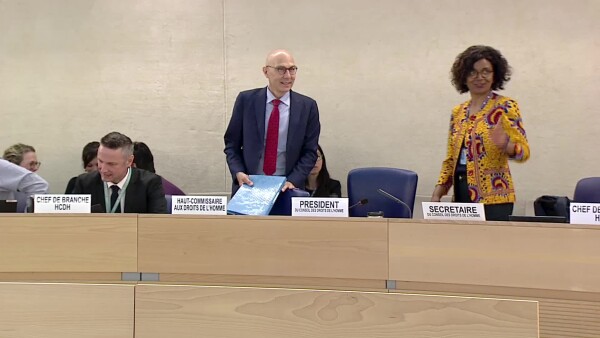
- Wide shot: wide shot room 20
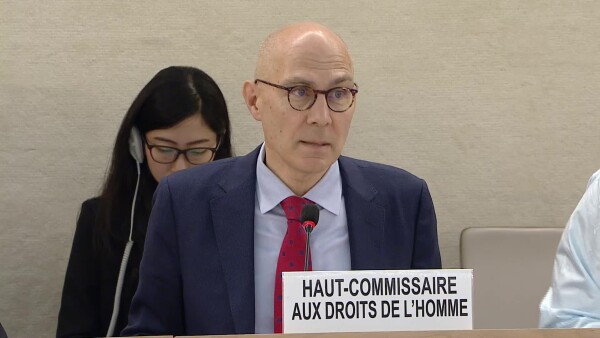
- Soundbite (English)— Volker Türk, UN High Commissioner for Human Rights, (OHCHR): “This Council has heard report after report on the human rights situation in Myanmar. With each successive update, it is almost impossible to imagine that the people of Myanmar can endure more suffering. Yet the country continues its deadly freefall into even deeper violence and heartbreak. -A regime imposed by generals for the last two and a half years has snatched away the optimism that Myanmar’s people once held for peace, democracy, and a more prosperous future,”
- Cut away: Room 20
- Soundbite (English)— Volker Türk, UN High Commissioner for Human Rights, (OHCHR):“Civilians live at the whim of a reckless military authority that relies on systematic control tactics, fear and terror in the hope of enforcing its ever-diminishing control. Civilians also bear the devastating brunt of the grotesque violence, including against older people, people with disabilities and infants. The situation has become untenable.”
- Cut away: Room 20
- Soundbite (English)— Volker Türk, UN High Commissioner for Human Rights, (OHCHR): “Every day, the military’s ruthless so-called “four cuts” strategy continues to wreak destruction. Entire villages are razed and burned to the ground, collectively punishing civilians, by depriving them of shelter, food, water, and life-saving aid. Since the coup began, the military has scorched at least 70,000 homes across the country, 70 percent of which were in Sagaing region. Over 1.5 million people have been forcibly displaced with minimal access to humanitarian aid.”
- Cut away: Room 20
- Soundbite (English)— Volker Türk, UN High Commissioner for Human Rights, (OHCHR): “The report I present to the Council today focuses on the systematic denial by the military of life-saving humanitarian aid for civilians. They have put in place a raft of legal, financial, and bureaucratic barriers to ensure people in need do not receive and cannot access assistance.”
- Cut away: Room 20
- Soundbite (English)— Volker Türk, UN High Commissioner for Human Rights, (OHCHR):” This obstruction of life-saving aid is deliberate and targeted, a calculated denial of fundamental rights and freedoms for large swathes of the population.”
- Cut away: Room 20
- Soundbite (English)— Volker Türk, UN High Commissioner for Human Rights, (OHCHR): “I deplore the direct attacks on humanitarian staff. Local organizations, which provide the vast majority of humanitarian aid, face the greatest risks in carrying out their work. Up to 40 humanitarian workers have been killed and over 200 arrested since the coup.”
- Cut away: Room 20
- Soundbite (English)— Volker Türk, UN High Commissioner for Human Rights, (OHCHR): “This Council needs to consider how to bring to light the business interests that support the military and keep them afloat.”
- Cut away: Room 20
- Soundbite (English)— Volker Türk, UN High Commissioner for Human Rights, (OHCHR): “It is of the utmost urgency that we restore all conditions necessary for Myanmar’s people to find a way out of the heartache, and to live their lives in freedom and safety.”
Similar Stories
1
1
1
Edited News | OCHA , UNICEF , WFP
Aid agencies warned on Friday of the fast-developing humanitarian emergency inside Taiz City in Yemen, which has been encircled by de facto Houthi forces fighting government troops along the country’s west coast.

2
17
1
2
Edited News , Press Conferences , Images | OCHA , WMO
Two UN agencies teamed up on Wednesday to issue an appeal for immediate assistance to help communities already being impacted by the strongest El Niño on record.
3
16
2
2
Edited News , B-roll , Conferences , Images | UNITED NATIONS , UNOG
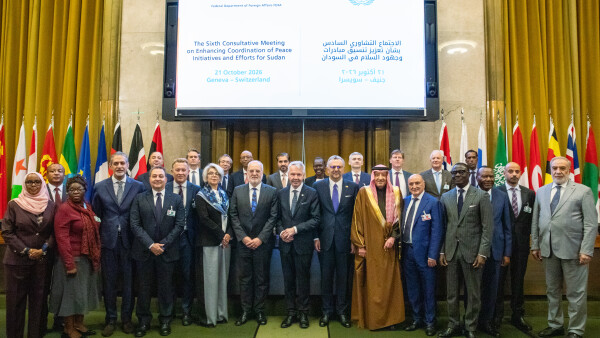
Sixth Consultative Meeting on Enhancing Coordination of Peace Initiatives and Efforts for Sudan

1
1
1
Edited News | UNICEF , WHO , UNHCR
Yemen war continues to force families from homes amid hunger and disease
More than 250,000 people have now fled renewed fighting in Yemen, the UN said on Tuesday, citing particular concern for those sheltering in the southwestern city of Taiz and the wider governorate, where access is “essentially blocked”.

1
1
1
Edited News | UNICEF
A little over one year since a ceasefire agreement was announced between Hamas fighters and Israel, more than 340 children have been reported killed and hundreds more injured, the UN Children’s Fund, UNICEF, said on Friday.

1
1
1
Edited News | UNICEF , IFRC
Six weeks after Nepal’s deadly flooding disaster, communities are still struggling to rebuild their lives, but they will need sustained help as global warming increases the risk of another Himalayan catastrophe, the UN Children’s Fund (UNICEF) said on Friday.

1
1
1
Edited News | WHO
In suspected Russia plague death, testing and monitoring underway – WHO
The death of a lab worker in Russia’s Siberia region has sparked concerns about plague being the cause, the UN World Health Organization (WHO) said on Tuesday, adding that it was following the situation closely.

1
1
Edited News | OHCHR , UNOG
UN Human Rights Chief Volker Türk on Friday provided and oral update to the 63rd session of the Human rights Council on Ukraine.

1
1
1
Edited News | OHCHR , UNOG
UN Human Rights Chief Volker Türk on Friday provided and oral update to the 63rd session of the Human rights Council on the human rights situation in Haiti.

1
1
1
Edited News | WHO
Repeated delays in bringing lifesaving medicines, prosthetics and more from Israel into Gaza risk having devastating consequences on Palestinians who urgently need them in the wartorn enclave, the UN World Health Organization (WHO) said on Friday. “A truck full of non-priority supplies or the right supplies arriving too late, doesn't save lives. That's the question that actually matters," said Dr Reinhilde Van De Weerdt, WHO Representative in the OPT.

1
1
1
Edited News | WHO
DRC: Early access to care and oxygen decisive for Ebola patients’ survival – WHO
In the Democratic Republic of the Congo (DRC), health workers fighting the country’s largest-ever Ebola outbreak are struggling to overcome critical challenges to patient care, the UN World Health Organization (WHO) warned on Tuesday.

1
1
1
Edited News | OCHA , UN
Civilians in Iran are continuing to feel the consequences of months of conflict and military escalation, the UN’s top official in the country has said, as loss of life, damage to civilian infrastructure and mounting economic pressures leave many facing continued uncertainty.