

The United Nations Office at Geneva
Multimedia Newsroom
Edited News , Statements | OHCHR , UNOG
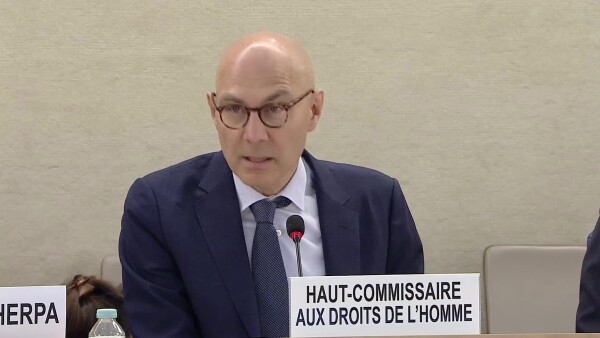
Volker Türk address the 53rd HRC on the adverse impact of climate change.
At 53rd session of the Human Rights Council Statement by Volker Türk, UN High Commissioner for Human Rights, on Adverse impact of climate change on the full realization of the right to food.
“Our environment is burning. Melting. Flooding. Depleting. Drying. Dying,” Türk said.
“The predictable, regular swing of the seasons is wildly off course. Cyclones of unprecedented proportions whip up lethal storm surges. A heatwave pulsates across the ocean, threatening marine life, fisheries and coral. And inland seas and lakes, which have nourished generation upon generation of farmers, are turning into dust bowls,” he said.
“Yet still we are not acting with the urgency and determination that is required. Leaders perform the choreography of deciding to act and promising to act and then get stuck in the short term,” the High Commissioner said.
“On our current course, the average temperature increase by the end of this century will be 3° Celsius, and our ecosystems – our air, our food, our water, and human life itself – would be unrecognizable,” Türk said.
“Vast territories would disappear under rising oceans, or become effectively uninhabitable, due to heat and lack of water. Last August, the temperature in Basrah, in southern Iraq, rose to 52.6°C. I will be travelling to Iraq later this year, in part to highlight the risks of this dystopian future,” he said.
“Our topic this morning is the right to food, and clearly this is comprehensively threatened by climate change. Extreme weather events, and both sudden and gradual disasters caused by climate change, wipe out crops, herds, fisheries and entire ecosystems. Their repetition makes it impossible for communities to rebuild and support themselves,” Türk said.
Globally, there has been a 134% increase in climate-fueled, flood-related disasters between 2000-2023.
More than 828 million people faced hunger in 2021. And climate change is projected to place up to 80 million more people at risk of hunger by the middle of this century – creating a truly terrifying scale of desperation and need.
Already, according to the Intergovernmental Panel on Climate Change, weather extremes related to climate change have damaged the productivity of all agricultural and fishery sectors, with negative consequences for people’s food security and livelihoods. Currently, this impact is worst for small-scale farmers, and for people in Africa below the Sahara; across Asia, in small island States, and in Central and South America.
“But as global heating accelerates, these repercussions will grow more widespread and more intense. No country will be spared. But the worst hit will be people in countries where there is already food insecurity, and where protection systems are not sufficiently robust to respond effectively to climate shocks,” he said.
“Often, these are countries that benefitted little from industrial development, and contributed next to nothing to the industrial processes which are killing our environment and violating rights. If this is not a human rights issue, what is?” Türk stated.
“We must not deliver this future of hunger and suffering to our children, and their children. And we don't have to. We, the generation with the most powerful technological tools in history, have the capacity to change it,” he said.
“If we put an end to senseless subsidies to the fossil fuel industry and start phasing out fossil fuels. If we make COP28 the decisive game-changer that we so badly need,”
The High Commissioner went on to list the requirements, if courts around the world that are engaged in climate litigation cases hold businesses and Governments accountable.
If we shun the greenwashers and those who cast doubt on evidence and facts, out of their own greed.
If we rise above the forces of polarisation, and unify around the imperative of human rights.
If we transform international development and financing institutions into engines of climate action, so that the countries and people most affected gain access to climate financing.
If measures to uphold good governance are adopted, so that when financing becomes available, it brings support, and remedy, to the most affected people. Then a just transition to a green economy – nationally, and globally – can take place.
“We can fulfil the Sustainable Development Goals. We can realise our universal right to food.
We can uphold our right to a clean, healthy and sustainable environment. We can. Because there is still time to act. But that time is now. We must not leave this for our children to fix – no matter how inspiring their activism. The people who must act – who have the responsibility to act -- are our leaders, today,” he stated.
“I ask every member of this Council to take this clear message out of the Palais des Nations and into every aspect of their work. Addressing climate change is a human rights issue. The world demands action, now” he said in conclusion.
ENDS
For more information and media requests, please contact:
Ravina Shamdasani - + 41 22 917 9169 / ravina.shamdasani@un.org or Marta Hurtado - + 41 22 917 9466 / marta.hurtadogomez@un.org or Jeremy Laurence + +41 22 917 9383 / jeremy.laurence@un.org
Tag and share
Twitter @UNHumanRights
Facebook unitednationshumanrights
Instagram @unitednationshumanrights
Tag and share - Twitter: @UNHumanRights and Facebook: unitednationshumanrights
- Exterior shot: Palais des Nations, Geneva.
- Wide shot: wide shot room 20
- Soundbite (English)— Volker Türk, UN High Commissioner for Human Rights, (OHCHR): “We know that our environment is burning. Its melting, its flooding, it Depleting, it drying, its dying,” Türk said.
- Cut away: room 20
- Soundbite (English)— Volker Türk, UN High Commissioner for Human Rights, (OHCHR): “The predictable, regular swing of the seasons is wildly off course. Cyclones of unprecedented proportions whip up lethal storm surges. A heatwave pulsates across the ocean, threatening marine life, fisheries and coral. And inland seas and lakes, which have nourished generation upon generation of farmers, are turning into dust bowls,”
- Cut away: room 20
- Soundbite (English)— Volker Türk, UN High Commissioner for Human Rights, (OHCHR): “Yet still we are not acting with the urgency and determination that is required. Leaders perform the choreography of deciding to act and promising to act and then get stuck in the short term,”
- Cut away: room 20
- Soundbite (English)— Volker Türk, UN High Commissioner for Human Rights, (OHCHR): “On our current course, the average temperature increase by the end of this century will be 3° Celsius, and our ecosystems – our air, our food, our water, and human life itself – would be unrecognizable,”
- Cut away: room 20
- Soundbite (English)— Volker Türk, UN High Commissioner for Human Rights, (OHCHR): “Vast territories would disappear under rising oceans, or become effectively uninhabitable, due to heat and lack of water. Last August, the temperature in Basrah, in southern Iraq, rose to 52.6°C. I will be travelling to Iraq later this year, in part to highlight the risks of this dystopian future,”
- Cut away: room 20
- Soundbite (English)— Volker Türk, UN High Commissioner for Human Rights, (OHCHR): “Our topic this morning is the right to food, and clearly this is comprehensively threatened by climate change. Extreme weather events, and both sudden and gradual disasters caused by climate change, wipe out crops, herds, fisheries and entire ecosystems. Their repetition makes it impossible for communities to rebuild and support themselves,”
- Cut away: room 20
- Soundbite (English)— Volker Türk, UN High Commissioner for Human Rights, (OHCHR): “As global heating accelerates, these repercussions will grow more widespread and more intense. No country will be spared. But the worst hit will be people in countries where there is already food insecurity, and where protection systems are not sufficiently robust to respond effectively to climate shocks,”
- Cut away: room 20
- Soundbite (English)— Volker Türk, UN High Commissioner for Human Rights, (OHCHR): “Often, these are countries that benefitted little from industrial development, and contributed next to nothing to the industrial processes which are killing our environment and violating rights. If this is not a human rights issue, what is?”
- Cut away: room 20
- Soundbite (English)— Volker Türk, UN High Commissioner for Human Rights, (OHCHR): “We must not deliver this future of hunger and suffering to our children, and their children. And we don't have to. We, the generation with the most powerful technological tools in history, have the capacity to change it,”
- Cut away: room 20
- Soundbite (English)— Volker Türk, UN High Commissioner for Human Rights, (OHCHR): “If we put an end to senseless subsidies to the fossil fuel industry and start phasing out fossil fuels. If we make COP28 the decisive game-changer that we so badly need,”
- Cut away: room 20
- Soundbite (English)— Volker Türk, UN High Commissioner for Human Rights, (OHCHR): “We can fulfil the Sustainable Development Goals. We can realise our universal right to food. We can uphold our right to a clean, healthy and sustainable environmental adopted by the general assembly last year. We can. Because there is still time to act. But that time is now.
- Cut away: room 20
- Soundbite (English)— Volker Türk, UN High Commissioner for Human Rights,
- We must not leave this for our children to fix – no matter how inspiring their activism. The people who must act – who have the responsibility to act -- are our leaders, today,”
- Cut away: room 20
- Soundbite (English)— Volker Türk, UN High Commissioner for Human Rights, (OHCHR): “I ask every member of this Council to take this clear message out of the Palais des Nations and into every aspect of their work. Addressing climate change is a human rights issue. The world demands action, now”
Similar Stories

1
1
Edited News | OHCHR , UNOG
UN Human Rights Chief Volker Türk on Friday provided and oral update to the 63rd session of the Human rights Council on Ukraine.
2
1
2
Statements , Conferences | HRC , OHCHR
Interactive dialogue with the High Commissioner for Human Rights, Volker Türk on the oral update on Ukraine.

1
1
1
Edited News | OHCHR , UNOG
UN Human Rights Chief Volker Türk on Friday provided and oral update to the 63rd session of the Human rights Council on the human rights situation in Haiti.

1
1
1
Edited News | WHO
Repeated delays in bringing lifesaving medicines, prosthetics and more from Israel into Gaza risk having devastating consequences on Palestinians who urgently need them in the wartorn enclave, the UN World Health Organization (WHO) said on Friday. “A truck full of non-priority supplies or the right supplies arriving too late, doesn't save lives. That's the question that actually matters," said Dr Reinhilde Van De Weerdt, WHO Representative in the OPT.

1
1
1
Edited News | WHO
DRC: Early access to care and oxygen decisive for Ebola patients’ survival – WHO
In the Democratic Republic of the Congo (DRC), health workers fighting the country’s largest-ever Ebola outbreak are struggling to overcome critical challenges to patient care, the UN World Health Organization (WHO) warned on Tuesday.

1
1
1
Edited News | OCHA , UN
Civilians in Iran are continuing to feel the consequences of months of conflict and military escalation, the UN’s top official in the country has said, as loss of life, damage to civilian infrastructure and mounting economic pressures leave many facing continued uncertainty.
1
1
1
Edited News | WHO , UNICEF
Aid agencies in Yemen highlighted the growing hunger emergency sparked by renewed fighting between Houthi opposition forces and Government troops, after mobile health clinics reported that hundreds of children displaced by the violence are suffering from the most deadly form of malnutrition.
1
1
1
Edited News | UNHCR
Displacement on the rise in Yemen as fighting continues - UNHCR
As hostilities worsen in Yemen, more people have been fleeing their homes, further intensifying the humanitarian crisis within the region, the UN Refugee Agency (UNHCR) warned on Tuesday.
1
1
1
Statements , Conferences | HRC , OHCHR
Interactive dialogue on the oral update of the Independent International Commission of Inquiry on Ukraine at the 63rd regular session of the Human Rights Council
1
1
1
Conferences , Statements | HRC , OHCHR
Interactive dialogue on the report of the Independent International Fact-Finding Mission on the Islamic Republic of Iran
1
1
1
Conferences , Statements | HRC , OHCHR
Interactive dialogue on the report of the Special Rapporteur on the situation of human rights in the Russian Federation
1
1
1
Edited News | IOM , OHCHR , UNFPA , UNOG , UNHCR , WHO
Yemen’s humanitarian crisis growing by the hour amid spike in displacement
Yemenis displaced by renewed fighting have described fleeing for their lives amid shelling and gunfire, aid agencies reported on Friday, while highlighting the dramatic increase in humanitarian needs in the country and in Djibouti, where thousands have sought shelter.