

The United Nations Office at Geneva
Multimedia Newsroom
PRESS BRIEFING BY THE UNITED NATIONS INFORMATION SERVICE
9 June 2023
Aftermath of the Kakhovka Dam Destruction
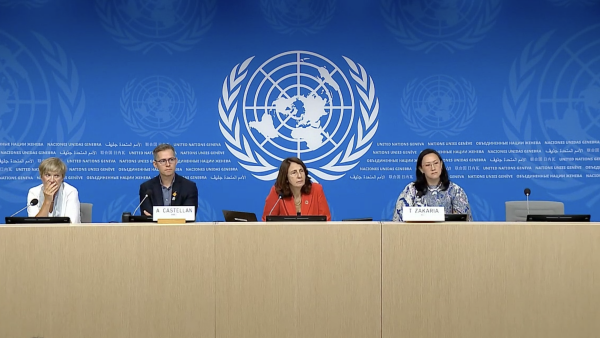
Denise Brown, Humanitarian Coordinator in Ukraine, United Nations Office for the Coordination of Humanitarian Affairs (OCHA) said she was five kilometres from the front line, visiting villages completely submerged by flooding. Daily shelling was occurring. Flooding came in the middle of the night. It came very quickly, taking people by surprise. The United Nations Children's Fund had done a terrific job in providing supplies. Authorities said that OCHA had arrived on time. It was providing food and assistance to affected people, many of whom were resiliently vowing to stay in their homes.
OCHA had sat down with stakeholders to pool together information and conduct a disaster means assessment. Homes had been destroyed, water and energy resources were affected, and there was possible water contamination. There were huge, immediate humanitarian needs.
In response to questions, Ms. Brown said this was a hugely difficult situation that was moving quickly. OCHA’s commercial transporters may have not been immediately visible. OCHA was discussing with authorities about how to move forward with aid efforts. OCHA would continue to do its best to support the affected population.
A United Nations Mine Action Service (UNMAS) mine expert was working with the UN system to produce a map of areas where mines were likely to be located. Flood waters could have displaced mines, posing risks to the local population and particularly children. OCHA was posting information on mines in Ukrainian on Telegram to inform the local population. Health was also a big concern in the region due to the stagnant water. Thousands of bottles of water were being delivered to help the local population access safe water. This was an issue that OCHA would continue to focus on in cooperation with World Health Organization.
OCHA was meeting with the Government, discussing reconstruction efforts and humanitarian activities. The Government was still assessing the damage. The initial estimates were that 17,000 people had been affected. OCHA was discussing how to reach those people. It was important for OCHA to have a presence in the region. Local communities were absolutely devasted by the incident.
Shabia Mantoo for the United Nations High Commissioner for Refugees (UNHRC) said UNHCR was appalled by the destruction of the Kakhovka dam, resulting in the extensive flooding of settlements in the region, including Kherson city, located 60 kilometres from the dam. At least 80 towns and villages in Kherson region were already flooded or partially flooded, as well as thousands of hectares of agricultural land, according to Ukrainian authorities.
Some 17,000 people in areas controlled by the Government of Ukraine had reportedly been impacted by the flooding, however it was reported that this could rise to nearly 40,000 people. Many thousands more in the areas under the temporary military control of the Russian Federation to whom humanitarian organizations currently had no access had also been affected. So far, some 2,200 people had been evacuated or left the area, most opting to remain in nearby areas of Kherson and Mykolaiv regions.
Water, sanitation and hygiene needs were a priority. Hundreds of thousands lacked access to safe drinking water, as the Kakhovka reservoir served as a critical water source for the surrounding regions. There were also public health concerns, with pollutants including sewage, heavy oil and pesticides mixing with the floodwaters, which were not expected to recede for several more days.
Serious humanitarian consequences would last long after the water receded. Kherson region was one of the most landmine-affected region of the country. Floodwaters were reportedly dislodging landmines, posing significant security risks to populations. Longer term consequences of the flooding were a major concern, with damage to homes, water and energy infrastructure, agricultural production and livelihoods.
Ukrainian authorities were leading evacuation efforts and had dispatched emergency supplies to affected areas. Authorities had established temporary collective sites to host evacuees in hospitals and other facilities. UNHCR remained on standby to support the identified needs of these sites once lists are received from the authorities. It had pre-positioned and begun delivering emergency supplies to respond to the evacuees as well as affected communities in Kherson, Mykolaiv, Odesa and Dnipropetrovsk regions, including jerry cans, hygiene kits and bedding items. UNHCR’s Dnipro warehouse had received a stock of 20,000 jerrycans and dispatched 7,000 to Kherson, where access to safe drinking water was a critical need.
Partners were also present at bus and train stations in Kherson and nearby regions, including Dnipropetrovsk, Mykolaiv and Odesa, to provide mental health and psychosocial support, as well as legal counselling and assistance to arriving evacuees. Vulnerable families were also being registered for cash assistance and provided with core relief items.
Those in need were being supported with access to accommodation in collective and reception centres. Partners were assessing needs and mapping temporary accommodation capacity in collective centres in nearby regions to ensure readiness to receive and assist potential arrivals.
UNHCR would participate in an inter-agency convoy today and tomorrow (9 and 10 June) to Kherson and Zaporizhzhia to deliver supplies to the worst-affected areas. With interagency partner agencies, it was also currently carrying out damage assessments to understand the scale of the impact of the flooding. UNHCR and its partners were determined to continue to support authorities in responding to the needs on the ground.
In response to questions, Rolando Gómez, Chief of the Press and External Relations Section at the United Nations Information Service (UNIS) in Geneva, quoted the United Nations Secretary-General António Guterres, who said that the UN sought to ensure accountability for the incident, and provide support to all affected civilians, particularly vulnerable groups such as children.
Jens Laerke for United Nations Office for the Coordination of Humanitarian Affairs (OCHA), responding to questions, said he did not have updates on bilateral aid. Many UN agencies had rushed to the affected area to provide support. Independent investigation of the incident was outside of the mandate of OCHA.
OCHA was continuing to try to access all areas of Ukraine. It had not yet been able to access the other side of the river in the affected region, but would continue to do so.
It was too early to report on the cost of the disaster, which was not over. There were concerns for the medium- and longer-term impact, with vast sways of agricultural land impacted. OCHA would report on the full impact of the disaster when information came to hand.
Jeremy Laurence for Office of the High Commissioner for Human Rights (OHCHR) said the destruction of the dam had had a serious impact on thousands of civilians living in the region, further affecting their rights to housing, health and security of person. Those downstream have evacuated from their homes, leaving everything behind and not knowing if they might lose their homes forever, and hospitals had been flooded. The risk of water-borne diseases, such as cholera, diarrhoea, and others, was very high. The main source of drinking water, the Kakhovka water reservoir, had been drained, as such, the right to clean water was also impacted, with people in the region told to limit their water use because of the rapidly depleting reservoir. The flood waters could cause mines and unexploded ordnance to shift, so the whole flood zone could be considered a mine-contaminated area.
It was premature to examine whether a war crime had been committed. OHCHR reiterated its call for an independent investigation to be carried out. OHCHR had repeatedly asked the Russian Federation for access to the occupied territories, but had been denied that access. OHCHR repeated its call to the Russian Federation to provide that access.
Detention of Minority Baha’i Faith Followers in Yemen
Jeremy Laurence for Office of the High Commissioner for Human Rights (OHCHR) said the detention by the de facto authorities in Sana’a (a.k.a Huthis or Ansar Allah) of a group of followers of the minority Baha’i faith and a subsequent sermon by Shamseddin Sharafeddin, the Mufti in Sana’a, inciting hatred against the Baha’is and other religious groups were matters of serious concern.
OHCHR was calling for the immediate release of the 16 people still being held incommunicado. It condemned the use of any language that incited discrimination and violence, particularly against minorities, which often led to forced exile and displacement.
On 25 May, security forces stormed a peaceful meeting of Baha’is in Sana’a. Seventeen people, including five women, were forcefully taken to an unknown location, and their books, phones, laptops and other belongings confiscated. One of those had since been released.
Last Friday, during a sermon in Sana’a, the Mufti appointed by the de facto authorities in Sana’a accused the detained Baha’i followers of apostasy and of being traitors, and said that if they did not repent, they should be killed. OHCHR deplored the use of such language, which starkly defied international law.
OHCHR reminded the de facto authorities in Sana’a that they must respect the human rights of people living under their control. Human rights guaranteed minorities, among other things, the right to profess and practice their own religion and the right to a fair trial before an independent and impartial tribunal. Pre-trial detention should be the exception and should be used only if reasonable and necessary, based on an individual assessment of each case.
Update on Human Rights Situation in Sudan
Jeremy Laurence for Office of the High Commissioner for Human Rights (OHCHR) expressed concern regarding the continued devastating impact of the fighting in Sudan on civilians.
This week alone, an attack striking a busy livestock market in the capital Khartoum left at least eight civilians dead, among them at least three members of the same family. The air strike on Al-Muwaliyyah market on 7 June was allegedly carried out by the Sudan Armed Forces. In another incident on 7 June, a child was reportedly killed after a shell hit his family home in the Al-Shajraa district in southern Khartoum.
Reports had been received of the killings of four other civilians in Khartoum on 5 June, and on 4 June at least three civilians, all members of the same family, including a pregnant woman, were reportedly killed. On the same day, airstrikes near the Sport Complex in southern Khartoum hit a refugee centre, reportedly killing at least 10 refugees. No fewer than 71 children had died at an orphanage in Khartoum since the fighting began due to lack of humanitarian assistance, including medical supplies.
OHCHR was also concerned by reports of conflict-related sexual violence. Since the fighting began, the Office had received credible reports of 12 incidents of sexual violence related to the conflict against at least 37 women, although the number could be higher. In at least three incidents, the victims were young girls. In one case, 18 to 20 women were reportedly raped.
Growing reports of apparent enforced disappearance and arbitrary detention were another cause for concern. Journalists were also at heightened risk amid a rise in online hate speech and disinformation. The Office had learnt of a list circulating on social media accusing certain journalists of being supporters of the Rapid Support Forces (RSF). It had observed comments on Facebook calling for the killing of the journalists on the list.
OHCHR reiterated the High Commissioner’s call on both parties to the fighting to ensure protection of civilians and respect for international humanitarian law and international human rights law. They also needed to ensure all violations were effectively and independently investigated and that those responsible were held accountable.
In response to questions, Mr. Laurence said there had been intense fighting in various regions of Khartoum last night. There were credible reports of looting and other incidents of fighting in other regions also, but the fighting appeared to be heaviest in Khartoum.
In response to a question, Rolando Gómez, Chief of the Press and External Relations Section at the United Nations Information Service (UNIS) in Geneva, said the Secretary-General had repeated expressed his confidence in Volker Perthes, his Special Representative for Sudan and Head of the United Nations Integrated Transition Assistance Mission in Sudan.
Alfonso Verdu Perez, Head of Delegation in Sudan, International Committee of the Red Cross (ICRC), said he was in Khartoum when the fighting broke out on 15 April. The situation was initially viewed by the ICRC as an emergency, but combat and violence had become an everyday occurrence. The humanitarian situation was dire. The conflict had taken a huge toll on civilian infrastructure. Electricity and water networks had been severely damaged. The IRCR feared that there would be outbreaks of diseases, as many people were forced to use unsafe drinking water from the Nile and other sources. Food and fuel prices had skyrocketed, and many could not access money in their banks.
The situation in Darfur was equally worrying. Telecommunication networks were often down, making it extremely difficult for affected people to contact humanitarians, and for ICRC staff to respond to needs on the ground. Robberies and looting were on the rise. Power stations and markets had been looted. In the town of Geneina in western Darfur, there had been reports of the killing of more than 200 people in just a few days. This flare up of violence could easily escalate and was extremely worrying.
Health care could collapse at any moment, despite the best efforts of Sudanese doctors and nurses, who were caring for the wounded and providing essential health care services to communities. In Khartoum, ICRC estimated that only 20 per cent of health care facilities were still functioning. Health care facilities were running low on water, food and essential medical supplies. ICRC had managed to deliver surgical supplies to hospitals in Khartoum, but needs were still dire. In one case, a temporary health care facility had been established in a school.
There had been a glimmer of hope this week where humanitarians supported the evacuation of 300 orphans and 70 caretakers in an area affected by heavy fighting. This had been supported by cooperation from parties to the conflict, who had abided by their international obligations. ICRC called on both parties to the conflict to ensure humanitarian access so that more could be done to alleviate the suffering of people in Sudan.
In response to questions, Mr. Verdu Perez said before the conflict broke out, Sudan had 3.7 million internally displaced persons, and approximately 400,000 people were now potentially fleeing the conflict in Khartoum. The main border crossing was intact. The ICRC was operationalising international humanitarian law on the ground. It was keeping a constant dialogue with authorities, which had allowed it to provide support to hospitals and other facilities. The ICRC welcomed the continuation of peace talks.
Ms. Mantoo of UNHCR said the conflict in Sudan had created around 1.42 million internally displaced persons, and almost 500,000 refugees had crossed the borders and taken refuge in South Sudan. There were thus over two million refugees and internally displaced persons fleeing the conflict.
International Labour Conference Update
Rosalind Yarde for the International Labour Organization (ILO) said this was day five of the International Labour Conference.
Governments who made up the membership of the Finance Committee of the International Labour Conference had not been able to reach consensus on the ILO programme and budget for 2024 and 2025. The area of contention related to the inclusion of wording in the section on gender equality, non-discrimination and inclusion. This section included text referring to “other population groups affected by discrimination and exclusion, including on the grounds of race, sexual orientation and gender identity.”
The African Group and the Organisation of Islamic Countries did not want to include wording relating to sexual orientation and gender identity in the Programme and Budget document, specifically in relation to the work of the Office in their countries. They proposed an amendment to this wording that did not name specific vulnerable groups. This amendment was opposed by European countries, countries from the Americas and some Asian Pacific countries. The budget proposal would now go to the Tri-Partite Plenary, made up of government, employers’ and workers’ representatives, which would decide the way forward on Monday, 12 June.
Next week, on 12 June, there would be a panel event to mark World Day Against Child Labour. It would take place in Room XX between 1:30 and 2:45 p.m. Speakers included the ILO Director-General Gilbert Houngbo, Nobel Laureate Kailash Satyarthi, Government workers and employer representatives and a former child labourer from India, Kinsu Kumar, who was now a youth advocate.
The World of Work Summit would also be held next week on 14 and 15 June in Room XX of the Palais des Nations. There would be 17 heads of State attending. The Summit will be webcast here.
In response to questions, Ms. Yarde said the Tri-Partite Plenary would consider various options for the budget. It was unclear at this stage what the procedure for determining the budget would be. The budget outlined the areas that the ILO’s funding would be used for. The section under contention dealt with gender equality. The aim of the Plenary discussions would be to find a way forward. This was the first time that a budget proposal had been blocked.
There had been a resurgence in child labour in recent years, impacted by the COVID-19 pandemic.
Announcements
Sarah Bel for the United Nations Development Programme (UNDP) said UNDP would launch on Monday 12 June its new “Gender Social Norms Index” report. The report captured how social beliefs could obstruct gender equality in multiple dimensions, including political, educational, economic and physical dimensions. The report’s alarming findings were based on indicators using data from 80 countries and territories, covering 85 per cent of the global population.
The report presented an update of the Index, which was first calculated in 2019. The latest report included the most recent data for the period 2017 to 2022. Spokespersons were available in English, Spanish and Portuguese to introduce the findings and comment on the results.
In response to questions, Ms. Bel said a separate press briefing would not be held to announce the release of the report. However, the report’s lead author and UNDP’s Gender Team were available to give statements.
Rolando Gómez, Chief of the Press and External Relations Section at the United Nations Information Service (UNIS) in Geneva, said the United Nations Secretary-General António Guterres would hold a press briefing to address disinformation on digital platforms on Monday, 12 June at 4:15 p.m.
On Monday, 12 June at 2 p.m., the United Nations High Commissioner for Refugees would hold a hybrid press conference to release its annual “Global Trends” report on forced displacement in 2022. Speaking would be Filippo Grandi, UN High Commissioner for Refugees.
Monday, 12 June was the World Day Against Child Labour. This was an opportunity to highlight the plight of children engaged in labour. An estimated 160 million children, or one in 10 children worldwide, were currently engaged in child labour.
Similar Stories
1
1
1
Statements , Press Conferences | OHCHR
1
1
1
Press Conferences | UNHCR , UNICEF , IFRC , OHCHR , UN WOMEN , IOM , OCHA , WHO
UNHCR – ExCom Meeting, UNICEF – Nepal Recovery, IFRC – Flash Floods, WHO – Mental Health, IOM – South Sudan Floods, OCHA – DRC Humanitarian aid, UNHCR – Sahel Displacement, UNICEF – Yemen Update, IOM – Gaza Shelter, UN Women – Gaza Women, OHCHR – Arrests and detentions of Syrians by Israeli force
2
1
2
Press Conferences | UNCTAD
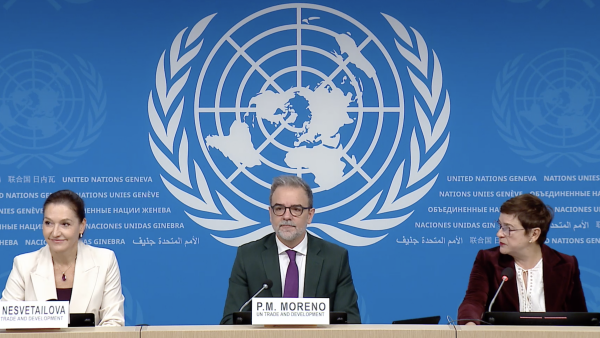
Presentation of the Trade and Developement Report 2026
Embargoed until 9 October 2026 at 11 a.m. (Geneva Time)
UNCTAD: UNCTAD’s flagship report finds that governments increasingly use industrial, trade, financial and technology policies to pursue economic and national security objectives. Market access and the ability to move into higher-value activities now depend more heavily on technology, finance and geopolitics.
1
1
1
Press Conferences | UPU
Release of the State of the Postal Sector Report 2026
1
1
1
Press Conferences | IOM , ITU , UNECE , UNICEF , WHO , WMO
UNICEF: Ebola, DRC - children orphans or separating them from parents and caregivers; IOM: Humanitarian needs in Djibouti amid arrivals from Yemen and increased migrant movements; WHO: Darfur, scale of health needs far exceeds available resources; WMO co-sponsored Global Heat Forum, Bangkok, monthly Global Seasonal Climate Update; UNECE: UN Forum of Mayors; ITU Plenipotentiary Conference 2026; WHO: child and adolescent obesity guidelines and new global roadmap to tackle pregnancy hypertension, a leading cause of maternal mortality
1
1
1
Press Conferences | OCHA , UN WOMEN , UNHCR , WFP , WHO , WTO , UNEP
OCHA – $160M CERF allocation to 12 underfunded crises; UNHCR – 5.8M refugee children remain out of school amid funding cuts; UN Women – Middle East escalation and food security among women/girls; WHO – Gaza supplies and overall situation; WFP – Yemen food insecurity and impact on global hunger ; UNEP - First International Conference of the Global Framework on Chemicals in Geneva | 16-20 November 2026
1
1
1
Press Conferences | UNHCR , WHO
Yemen's health system nears collapse amid conflict, causing rising casualties and medicine shortages.
1
1
1
Press Conferences | HRC
Update by the Expert Mechanism to Advance Racial Justice and Equality in Law Enforcement
1
1
1
Press Conferences | WIPO , WHO , UNICEF , UNHCR , IOM , WFP , FAO
WIPO Global Innovation Index 2026 launch and press conference, WHO Composition of influenza vaccines for the 2027 Southern Hemisphere flu season, UNICEF Yemen hunger and malnutrition; UNHCR Sudan displacement into Chad; IOM Ebola and population movements in DRC; WFP emergency food assistance in Nepal; and FAO food loss and waste.
2
1
2
Press Conferences | UNCTAD
Gaza reconstruction needs reach $71.5 billion as Palestinian economy and public finances face severe strain. Latest UNCTAD report documents the loss of decades of development gains, economic collapse in Gaza and tightening economic constraints in the West Bank.
The report identifies three immediate priorities: transferring withheld Palestinian revenues, safeguarding the banking system and aligning reconstruction support with the documented scale of damage and economic losses.
1
1
1
Press Conferences | HRC
Press conference on the situation of human rights in Nicaragua by the UN Group of Human Rights Experts
1
1
1
Press Conferences | ITU , UNHCR , WHO , WMO
YEMEN - UNHCR: Escalating conflict in Yemen could fuel more displacement, refugee movement
CLIMATE - WHO / WMO: Health and Climate impact of El Niño