

The United Nations Office at Geneva
Multimedia Newsroom
STORYLINE
"Due to armed violence, one in five Central Africans is either an IDP or a refugee in neighboring countries, with Sudan crisis excacerbating the situation"
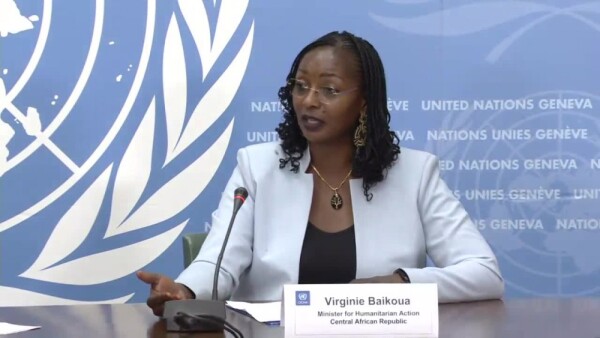
The humanitarian situation in the Central African Republic (CAR) remains critical with 3,4 million people – or half of the population - in need of humanitarian assistance. Of those, 2.4 million have needs so severe that their survival and dignity is at risk, told the Humanitarian Coordinator of the CAR, Mohamed Ag Ayoya, the media at a briefing at the UN in Geneva.
“The number of people in need of humanitarian assistance and protection in CAR (Central African Republic) is quite high”, said Mr. Ag Ayoya. “We are talking about 3.4 million people spread over 623,000 square kilometers area due to underlying factors which are exacerbated by the long-lasting conflict, including, of course, lack of basic services such as health care, clean water and social protection.”
Repeated military confrontations between various armed actors in the country result in a continuously volatile security situation causing population movements.
“Due to armed violence, one in five Central Africans is either an IDP or a refugee in neighboring countries”. Mr. Ag Ayoya said. He added that “it is against this background that the ongoing conflict in Sudan is unfortunately also exacerbating the situation in CAR.”
The impact of the ongoing conflict in Sudan further worsens humanitarian needs in the country. Vulnerable households were already weakened after the combined impact of Covid-19 and the war in Ukraine these past years.
Mr. Ag Ayoya said the conflict in neighbouring Sudan has meant the arrival of nearly 14,000 Sudanese asylum seekers and Central African repatriates in the Northeast. It has also halted commercial traffic across the border, putting additional pressure on the limited resources available to the 130,000 extremely vulnerable people in the region.
“As of 24 May 2023, we have more than thirteen thousand people, actually a little bit less than thirteen thousand, including Central African returnees, who have previously fled from Sudan to Am-Dafockfog in CAR on one site and about ten thousand people have also fled Chad, both Chadians but also Central African returnees who also came into CAR,” said CAR’s Humanitarian Coordinator.
Delivering humanitarian assistance in CAR is often a race against time and a volatile security situation. When the rainy season starts, large parts of the country get cut off from road access and are only accessible via air lifts.
“With the rainy season beginning, the transportation of humanitarian aid by road is becoming almost impossible and extremely very limited,” said Mr. Ag Ayoa. “Warehouses could not be supplied as before due to the Sudan crisis, as I said earlier. The air transportation alternative is also limited by rising fuel prices due to the disruption of supply chain caused by the war in Ukraine and recently again exacerbated by the conflict in Sudan.”
Despite these challenges, humanitarian partners continue to find ways to assist the vulnerable population. In 2022, the humanitarian community helped 1.9 million people. In the first three months of 2023 alone, 658,000 people were reached with live-saving assistance.
The humanitarian appeal of $533 million is currently 25 per cent funded ($125 million).
-ends-
STORY: CAR Humanitarian Situation - OCHA
TRT: 2 mins. 15 sec.
SOURCE: UNTV CH
RESTRICTIONS: NONE
LANGUAGE: ENGLISH/NATS
ASPECT RATIO: 16:9
DATELINE: 5 June 2023 GENEVA, SWITZERLAND
SHOTLIST
- Wide shot, UN Geneva flag alley.
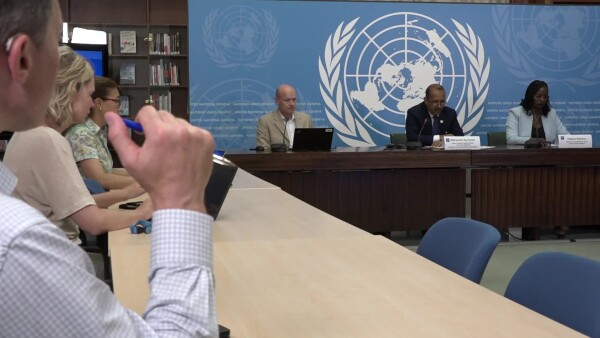
- Medium shot, press room with journalists and panel of speakers
- SOUNDBITE (ENGLISH) – Mohamed Ag Ayoya, Deputy Special Representative of the Secretary-General of the UN Mission in CAR (MINUSCA), Resident and Humanitarian Coordinator: “The number of people in need of humanitarian assistance and protection in the Central African Republic (CAR) is quite high. We are talking about 3.4 million people spread over 623,000 square kilometers area due to underlying factors which are exacerbated by the long-lasting conflict, including, of course, lack of basic services such as health care, clean water and social protection.”
- Close up, Laptop screen with speaker on podium in background
- SOUNDBITE (ENGLISH) - Mohamed Ag Ayoya, Deputy Special Representative of the Secretary-General of the UN Mission in CAR (MINUSCA), Resident and Humanitarian Coordinator: “Due to armed violence one in five Central Africans is either an IDP or a refugee in neighboring countries. It is against this background that the ongoing conflict in Sudan is unfortunately also exacerbating the situation in CAR.”
- Medium shot, journalists
- SOUNDBITE (ENGLISH) - Mohamed Ag Ayoya, Deputy Special Representative of the Secretary-General of the UN Mission in CAR (MINUSCA), Resident and Humanitarian Coordinator: “As of 24 May 2023, we have more than thirteen thousand people, actually a little bit less than thirteen thousand, including Centralafrican returnees, who have previously fled from Sudan to Am-Dafockfog in CAR on one site and about ten thousand people have also fled Chad, both Chadiens but also Centralafrican returnees who also came into CAR.”
- Medium shot, journalists and delegates
- SOUNDBITE (ENGLISH) - Mohamed Ag Ayoya, Deputy Special Representative of the Secretary-General of the UN Mission in CAR (MINUSCA), Resident and Humanitarian Coordinator: “With the rainy season beginning, the transportation of humanitarian aid by road is becoming almost impossible and extremely very limited. Warehouses could not be supplied as before due to the Sudan crisis, as I said earlier. The air transportation alternative is also limited by rising fuel prices due to the disruption of supply chain caused by the war in Ukraine and recently again exacerbated by the conflict in Sudan.”
- Wide shot, spokespeople on podium
- Close-up, hand taking notes
- Medium shot, journalists in press room
Similar Stories

2
17
1
2
Edited News , Press Conferences | OCHA , WMO
Two UN agencies teamed up on Wednesday to issue an appeal for immediate assistance to help communities already being impacted by the strongest El Niño on record.

3
16
2
2
B-roll , Conferences , Edited News | UNITED NATIONS , UNOG
Sixth Consultative Meeting on Enhancing Coordination of Peace Initiatives and Efforts for Sudan

1
1
1
Edited News | UNICEF , WHO , UNHCR
Yemen war continues to force families from homes amid hunger and disease
More than 250,000 people have now fled renewed fighting in Yemen, the UN said on Tuesday, citing particular concern for those sheltering in the southwestern city of Taiz and the wider governorate, where access is “essentially blocked”.

1
1
1
Edited News | UNICEF
A little over one year since a ceasefire agreement was announced between Hamas fighters and Israel, more than 340 children have been reported killed and hundreds more injured, the UN Children’s Fund, UNICEF, said on Friday.

1
1
1
Edited News | UNICEF , IFRC
Six weeks after Nepal’s deadly flooding disaster, communities are still struggling to rebuild their lives, but they will need sustained help as global warming increases the risk of another Himalayan catastrophe, the UN Children’s Fund (UNICEF) said on Friday.

1
1
1
Edited News | WHO
In suspected Russia plague death, testing and monitoring underway – WHO
The death of a lab worker in Russia’s Siberia region has sparked concerns about plague being the cause, the UN World Health Organization (WHO) said on Tuesday, adding that it was following the situation closely.

1
1
Edited News | OHCHR , UNOG
UN Human Rights Chief Volker Türk on Friday provided and oral update to the 63rd session of the Human rights Council on Ukraine.

1
1
1
Edited News | OHCHR , UNOG
UN Human Rights Chief Volker Türk on Friday provided and oral update to the 63rd session of the Human rights Council on the human rights situation in Haiti.

1
1
1
Edited News | WHO
Repeated delays in bringing lifesaving medicines, prosthetics and more from Israel into Gaza risk having devastating consequences on Palestinians who urgently need them in the wartorn enclave, the UN World Health Organization (WHO) said on Friday. “A truck full of non-priority supplies or the right supplies arriving too late, doesn't save lives. That's the question that actually matters," said Dr Reinhilde Van De Weerdt, WHO Representative in the OPT.

1
1
1
Edited News | WHO
DRC: Early access to care and oxygen decisive for Ebola patients’ survival – WHO
In the Democratic Republic of the Congo (DRC), health workers fighting the country’s largest-ever Ebola outbreak are struggling to overcome critical challenges to patient care, the UN World Health Organization (WHO) warned on Tuesday.

1
1
1
Edited News | OCHA , UN
Civilians in Iran are continuing to feel the consequences of months of conflict and military escalation, the UN’s top official in the country has said, as loss of life, damage to civilian infrastructure and mounting economic pressures leave many facing continued uncertainty.

1
1
1
Edited News | WHO , UNICEF
Aid agencies in Yemen highlighted the growing hunger emergency sparked by renewed fighting between Houthi opposition forces and Government troops, after mobile health clinics reported that hundreds of children displaced by the violence are suffering from the most deadly form of malnutrition.