

The United Nations Office at Geneva
Multimedia Newsroom
PRESS BRIEFING BY THE UNITED NATIONS INFORMATION SERVICE
24 March 2023
Islamic giving helps the forcibly displaced
Khaled Khalifa, UN Refugee Agency (UNHCR) Representative to Gulf Cooperation Council Countries, informed that UNHCR had released its Fifth Islamic Philanthropy Annual Report, which showed the power and growing potential of Islamic giving to save lives and build better futures for the forcibly displaced globally. There were many tools that governed finance in Islam, some of which were very much aligned with humanitarian and charity giving. UNHCR had teams around the world doing Islamic philanthropy, while UNHCR’s Refugee Zakat Fund had been piloted in 2017. Some six million forcibly displaced people in 26 countries had benefitted from Zakat (obligatory almsgiving) and Sadaqah (voluntary charity) funds.
Through the Refugee Zakat Fund, in 2022 UNHCR had received more than USD 21.3 million in Zakat contributions and over USD 16.7 million in Sadaqah donations. While this was a small proportion of UNHCR’s total expenditure, its importance and impact on the displaced was growing, contributing to progress towards several Sustainable Development Goals, notably around ending poverty and hunger while improving education and well-being. In 2022, the Refugee Zakat Fund had enabled UNHCR to improve the lives of more than 1.5 million people in 21 countries, with Zakat and Sadaqah funds. Mr. Khalifa explained that Islamic philanthropy funds were channeled to eligible displaced individuals identified through every operation’s vulnerability assessment criteria.
Islamic Philanthropy Annual Report 2023 is available here. Full statement is available here.
Replying to questions, Mr. Khalifa said that the donations came from individuals, who were thus respecting their obligations under Islam to donate 2.5 percent of their savings. For example, the single largest donor, Sheikh Thani Bin Abdullah Bin Thani Al-Thani, UNHCR Eminent Advocate, had so far given more than USD 110 million from his personal wealth. UNHCR was helping displaced people of all religions, and Islamic philanthropy contributed only a small part of UNHCR’s budget. Most of the funds received were earmarked, he explained, but there were also some flexible Islamic philanthropy contributions. Individuals from the Gulf Cooperation Council countries contributed the bulk of the funding to Islamic philanthropy; the average donation in this region stood at about USD 600. The objective was to expand the donor pool rather than rely on just a few large donors, said Mr. Khalifa.
Alessandra Vellucci, for the UN Information Service (UNIS) reminded of the message of the Secretary-General for the beginning of the holy month of Ramadan.
ICRC delivers much-needed aid to civilians near Bakhmut, Ukraine
Umar Khan, head of the Sub-delegation of the International Committee of the Red Cross (ICRC) in Dnipro, Ukraine, speaking from Dnipro, stated that he had visited the region around Bakhmut this week. The horrific humanitarian consequences of armed conflict were clear as areas previously considered safe were now ghost villages due to this recent escalation of hostilities. The sheer scale of destruction was shocking, said Mr. Khan. People who remained in these areas close to the fighting included a lot of elderly residents, people with low-mobility, or people with disabilities and those tied to their land. For these communities, the ICRC had delivered hygiene kits, solar lamps, water containers, essential repair supplies and handheld tools - practical items to give these people in need practical solutions.
Mr. Khan stressed that the ICRC was deeply concerned by the situation unravelling in Bakhmut and nearby communities isolated between living with dignity and an unimaginably violent frontline. The ICRC appealed to the warring parties to respect international humanitarian law, notably by allowing humanitarian aid in and ensuring that civilians under their control have access to essential assistance and those not part of the fight, are protected from targeted attacks wherever they were.
Answering questions from the media, Mr. Khan said that the ICRC believed that several thousand residents still lived in Bakhmut. Those people had the right to live in safety and dignity.
Deepening hunger in Haiti
Jean-Martin Bauer, World Food Programme (WFP) Country Director in Haiti, speaking from Port-au-Prince, said that Haiti was now facing some of the worst food security conditions in history, with currently five million people being acutely food insecure. Armed group violence now affected daily lives of millions of people, and those groups controlled ever increasing areas, including farmland. A widespread inflation had led to the doubling of the basic food basket, and the impact on the population had been extreme. Two WFP offices had been attacked in autumn 2022, but the WFP was nonetheless doing everything it could to help the Haitian population in need. This year, the WFP had been able to reach well over 800,000 people despite the precarious security situation. The needs had risen, but the funding had not risen accordingly.
Haiti needed peace and security, stressed Mr. Bauer. When people were hungry, it was very difficult to stabilize the country. Hunger and violence were intertwined, as hunger only strengthened the hands of armed groups. Haiti was in dire straits, but the country should not be given up on. More information was available here.
In response to numerous questions from the media, Mr. Bauer said that the number of people in acute food insecurity (levels 3, 4, and 5 according to IPC Classification) currently stood at around five million. This was not just an urban phenomenon, as conditions were also quite difficult outside the capital. WFP needed USD 120 million over the next six months to be able to continue with its assistance activities. There were over 300 people working at the WFP in Haiti, across several locations; some 68 percent of distributions was done through local NGOs. WFP purchased some of the food from local farmers, speeding up the delivery times and directly investing in local economy; still, Haiti imported about 80 percent of its food, thus a global rise in prices affected it directly. Mr. Bauer said that he was very concerned about the cholera situation; hot meals were distributed in cholera treatment centers. The only safe way in and out of Port-au-Prince was by air, he explained.
Current global problem of plant pests and the devastating impact on food security
Dr. Osama El-Lissy, Secretary of the International Plant Protection Convention (IPPC), speaking from Rome, said that, even though plants provided 98 percent of the oxygen we breathed and nearly 80 percent of our daily calorie intake, they were under siege. Plant pests destroyed up to 40 percent of agricultural crops, including food crops each year, which cost the world approximately USD 220 billion annually in global trade losses. In an increasingly hungry world, with 828 million people experiencing hunger in 2021 based on FAO estimates, this was alarming and set back global efforts towards achieving the Sustainable Development Goal 2, Zero Hunger, by 2030.
For example, explained Dr. El-Lissy, bananas, the most widely traded fruit in the world, worth USD 7.5 billion, were under attack from the devastating banana fusarium (TR4), a fungus that attacked the roots causing bananas to wilt. In 2019, TR4 had been introduced in Latin America where two-thirds of the global banana trade originated. Based on a scientific review conducted in 2022, climate change was increasing the risk of pests spreading in agricultural and forestry areas. The mission of the International Plant Protection Convention (IPPC), which was an intergovernmental treaty involving 184 countries, was to safeguard agriculture and natural resources against plant pests and to facilitate safe trade. The following week, the IPPC’s governing body, the Commission on Phytosanitary Measures would convene in Rome for its 17th annual session to adopt standards and to take stock of the progress in the global protection of plants.
Mental health and psychosocial support in northwest Syria
Dr. Fahmy Hanna, Mental Health Specialist at the World Health Organization (WHO), said that even before the Syrian war, the northwest Syria had had barely any mental health capacities. WHO and partners had invested significantly in this sector, and now some 35 health facilities could provide mental health care. After the earthquakes, there was a need to significantly scale up such services. Dr. Hanna said that he had been one of the first international mental health specialists to visit the region since the start of the war. Loss, displacement, and insecurity were all among the causes of stress among the local population; those who had had mental conditions before the earthquakes saw their situations further exacerbated.
Even before the earthquakes, WHO estimated, one in five people in conflict settings had mental health challenges. The earthquake and related stress added up to the already existing dire situation, explained Dr. Hanna. WHO and partners now reached 60,000 people, but the hope was to scale up and reach ten times as many people in need. Psychological deep wounds would unfortunately last for years, even if physical reconstruction and recovery were to take place immediately. There was thus a need for continuous support and funding.
Black Sea Grain Initiative
Responding to questions, Jens Laerke, for the Office for the Coordination of Humanitarian Affairs (OCHA) stressed that the United Nations was a witness to the Black Sea Grain Initiative, and it was up to the parties to come to an agreement on the length of further extensions. The whole world was benefiting from this Initiative, which had brought down global food prices, said Mr. Laerke.
Announcements
Christian Lindmeier, for the World Health Organization (WHO), informed that today the WHO would provide an update on the Therapeutics and COVID-19 Guideline Development.
On 27-28 March, there would be a meeting between the World Health Organization, the Food and Agriculture Organization, the World Organization for Animal Health, and the United Nations Environment Programme, who were in partnership for One Health Joint Plan of Action to address health threats to humans, animals, plants and environment. Opening statements by the four principals would be screened live from 9 am on 27 March.
There would be a press briefing on 27 March in the afternoon on latest recommendations by Strategic Advisory Group of Experts on Immunization (SAGE), informed Mr. Lindmeier. More information would be shared soon.
Jens Laerke, on behalf of the United Nations Information Service (UNIS), informed that on 27 March at 1 pm, there would be a hybrid briefing by the Independent Fact-Finding Mission on Libya: Mohamed Auajjar, Chair of the Mission; Tracy Robinson, and Chaloka Beyani, Members of the Mission.
Mr. Laerke further informed that the World Trade Organization would be releasing its annual Trade Forecast on 5 April. The embargoed report would be on WTO's online newsroom at noon that day, with the embargo until 2 pm. A press conference would take place at the same time, which journalists would be able to follow at WTO headquarters and online.
Mr. Laerke said that the Human Rights Committee would close this morning its 137th session and issue its concluding observations on the six countries reviewed during this session: Egypt, Turkmenistan, Zambia, Peru, Sri Lanka, and Panama.
The Committee on the Rights of Persons with Disabilities would also close this afternoon its 28th session and issue its concluding observations on the six countries reviewed during the session: Angola, Georgia, Tunisia, Peru, Argentina, and Togo.
The Committee on Enforced Disappearances would conclude its 24th session on 31 March, when it would issue its concluding observations on the four countries reviewed during the session: Zambia, Argentina, Germany, and Costa Rica.
Finally, Mr. Laerke said that the Committee on the Protection of the Rights of All Migrant Workers and Members of their Families would open on 27 March its 36th session, during which it would review the reports of Nigeria, Morocco, the Philippines, and El Salvador.
Similar Stories

1
1
1
Press Conferences | UNHCR
End of UNHCR's 77th Annual Executive Committee (ExCom) meeting week

1
1
1
Press Conferences | UNICEF , IOM , UNHCR
UN Special Assistant to the Personal Envoy Office (SUDAN): Peace Initiatives and Efforts in Sudan; UNICEF: Dire situation of children in Gaza; IOM: Damaged Homes and Energy Attacks Risk Displacing Ukrainians for this winter; UNHCR: update on EXCOM week

1
1
1
Press Conferences | IOM , UNDRR
UN stresses importance of household preparedness for disaster risk reduction.
1
1
1
Statements , Press Conferences | OHCHR
1
1
1
Press Conferences | UNHCR , UNICEF , IFRC , OHCHR , UN WOMEN , IOM , OCHA , WHO
UNHCR – ExCom Meeting, UNICEF – Nepal Recovery, IFRC – Flash Floods, WHO – Mental Health, IOM – South Sudan Floods, OCHA – DRC Humanitarian aid, UNHCR – Sahel Displacement, UNICEF – Yemen Update, IOM – Gaza Shelter, UN Women – Gaza Women, OHCHR – Arrests and detentions of Syrians by Israeli force
2
1
2
Press Conferences | UNCTAD
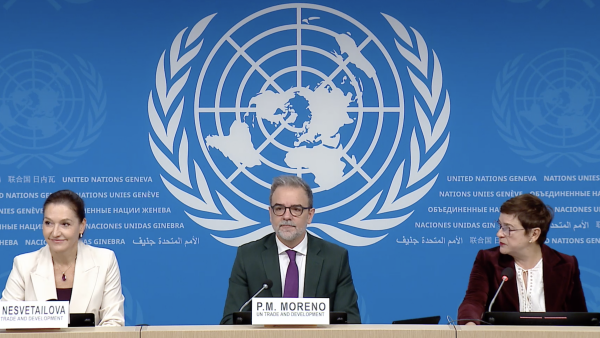
Presentation of the Trade and Developement Report 2026
Embargoed until 9 October 2026 at 11 a.m. (Geneva Time)
UNCTAD: UNCTAD’s flagship report finds that governments increasingly use industrial, trade, financial and technology policies to pursue economic and national security objectives. Market access and the ability to move into higher-value activities now depend more heavily on technology, finance and geopolitics.
1
1
1
Press Conferences | UPU
Release of the State of the Postal Sector Report 2026
1
1
1
Press Conferences | IOM , ITU , UNECE , UNICEF , WHO , WMO
UNICEF: Ebola, DRC - children orphans or separating them from parents and caregivers; IOM: Humanitarian needs in Djibouti amid arrivals from Yemen and increased migrant movements; WHO: Darfur, scale of health needs far exceeds available resources; WMO co-sponsored Global Heat Forum, Bangkok, monthly Global Seasonal Climate Update; UNECE: UN Forum of Mayors; ITU Plenipotentiary Conference 2026; WHO: child and adolescent obesity guidelines and new global roadmap to tackle pregnancy hypertension, a leading cause of maternal mortality
1
1
1
Press Conferences | OCHA , UN WOMEN , UNHCR , WFP , WHO , WTO , UNEP
OCHA – $160M CERF allocation to 12 underfunded crises; UNHCR – 5.8M refugee children remain out of school amid funding cuts; UN Women – Middle East escalation and food security among women/girls; WHO – Gaza supplies and overall situation; WFP – Yemen food insecurity and impact on global hunger ; UNEP - First International Conference of the Global Framework on Chemicals in Geneva | 16-20 November 2026
1
1
1
Press Conferences | UNHCR , WHO
Yemen's health system nears collapse amid conflict, causing rising casualties and medicine shortages.
1
1
1
Press Conferences | HRC
Update by the Expert Mechanism to Advance Racial Justice and Equality in Law Enforcement
1
1
1
Press Conferences | WIPO , WHO , UNICEF , UNHCR , IOM , WFP , FAO
WIPO Global Innovation Index 2026 launch and press conference, WHO Composition of influenza vaccines for the 2027 Southern Hemisphere flu season, UNICEF Yemen hunger and malnutrition; UNHCR Sudan displacement into Chad; IOM Ebola and population movements in DRC; WFP emergency food assistance in Nepal; and FAO food loss and waste.