

The United Nations Office at Geneva
Multimedia Newsroom
Pledges from 18 countries and the private sector topped $826 million on the first day of a High-Level Financing Conference in Geneva where world leaders came together to seek funding for education for children caught up in emergencies and protracted crises.
With more than 78 million children worldwide out of school, Education Cannot Wait (ECW), the United Nations global fund for education in emergencies and protracted crises, stands up for the world’s most vulnerable children and youth.
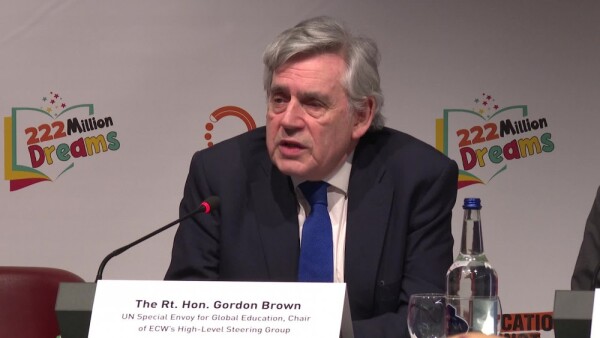
“We are talking about the most isolated, the most desolated, the most neglected children of the world”, said Gordon Brown, UN Special Envoy for Global Education and Chair of ECW’s High-level Steering Group at a press briefing. “We're talking about girls who will find themselves trafficked or forced into child labor or into child marriage unless we can help them. And so I want to begin this event simply by thanking all the countries. There are now 18 donors, $826 million has been pledged”.
The pledging conference co-hosted by ECW and Switzerland – and co-convened by the Governments of Colombia, Germany, Niger, Norway and South Sudan - seeks resources from donors, foundations and high-net-worth individuals to provide 222 million girls and boys around the world with education which has been interrupted by conflicts, forced displacement, the climate crisis, COVID-19 and other emergencies.
“Conflict is more protracted today…we see more and more climate-induced disasters affecting education, interruption…education”, said Yasmine Sherif, Executive Director of Education Cannot Wait. “Funding is not matching the growing need,” she insisted.
Founded in 2016, Education Cannot Wait has already reached close to seven million children and adolescents with education support, including upgrading learning spaces, ensuring that children have quality learning material, providing training and financial support to teachers and school meals.
“School means so much more than just education. They are also a safe place, a place with a warm meal, a bit of normal normality in the midst of a crisis, a place that empowers children to build a better future,” said Svenja Schulze, Federal Minister for Economic Cooperation and Development, Germany.
Germany is the top contributor to Education Cannot Wait, followed by the United Kingdom, Norway, United States and Denmark.
South Sudan’s Minister of General Education and Instruction, Ms. Awut Deng Acuil, emphasized that “education cannot wait”, that it needed to reach those in hard-to-reach areas, those in conflict, crisis, those hit by natural disasters, those who are banned (from going) to school. I think education is a right for every child. We are here today because we are given that opportunity”.
The Conference seeks to mobilize much-needed resources from donors, foundations and high-net-worth individuals to deliver on ECW’s four-year strategic plan, which aims to mobilize $1.5 billion in additional resources to deliver quality education to children and adolescents caught in the world’s worst humanitarian crises.
“We look forward to implement(ing) our strategic plan to reach 20 million children and youth in crisis through the Humanitarian Development Nexus for Peace, Security, Sustainable Development Goals and Human Rights. Education is the foundation,” said ECW’s Executive Director Sherif. She added that “without education, we cannot achieve Sustainable Development Goals (of) ending extreme poverty or gender equality, nor can we achieve human rights”.
ECW supports quality education outcomes for refugee, internally displaced and other crisis-affected girls and boys. ECW urgently appeals to public and private sector donors for expanded support to reach even more vulnerable children and youngsters.
“Education is their hope. It's the tool of empowering them to reclaim their rights and to achieve the Sustainable Development Goals,” said Ms. Sherif. “And those left for behind us in crisis are extremely resilient. But their hope is to have an education to change the life and the destiny for themselves, for their families, to society, the country, and thereby also humanity at large”.
-ends-
- Wide shot, outside, Centre International de Conférences Genève
- Medium shot, Conference building outside with posters of « ECW’s High-level Financing Conference »
- Wide shot, podium with speakers at press conference
- SOUNDBITE (English) - Yasmine Sherif, Executive Director, Education Cannot Wait: “Conflict is more protracted today. Two, we see more and more climate induced disasters affecting education, interruption of education. And three, the funding is not matching the growing need”.
- Medium shot, participant of the press conference reading
- SOUNDBITE (English) - Gordon Brown, UN Special Envoy for Global Education: “We are talking about the most isolated, the most desolated, the most neglected children of the world. We're talking about girls who will find themselves trafficked or forced into child labor or into child marriage unless we can help them. And so I want to begin this event simply by thanking all the countries. There are now 18 donors, 826 million has been pledged”.
- Wide shot, photographer taking photos of panelists
- SOUNDBITE (English) - Svenja Schulze, Federal Minister for Economic Cooperation and Development, Germany: “School means so much more than just education. They are also a safe place, a place with a warm meal, a bit of normal normality in the midst of a crisis, a place that empowers children to build a better future.”
- Medium shot, participants of the press conference
- SOUNDBITE (English) - Awut Deng Acuil, Minister of General Education and Instruction, South Sudan: “Education cannot wait, which is reaching to those who are in hard-to-reach areas, those in conflict, crisis, those hit by natural disasters, those who are banned not to go to school. I think education is a right for every child. We are here today because we are given that opportunity”.
- Two shot, press conference participants
- SOUNDBITE (English) - Yasmine Sherif, Executive Director, Education Cannot Wait: “We look forward to implement our strategic plan to reach 20 million children and youth in crisis through the Humanitarian Development Nexus for Peace, Security, Sustainable Development Goals and Human Rights. Education is the foundation”.
- Wide shot, podium with speakers and journalists
- SOUNDBITE (English) - Yasmine Sherif, Executive Director, Education Cannot Wait: “Without education, we cannot achieve Sustainable Development Goals from ending extreme poverty or gender equality, nor can we achieve human rights”.
- Medium shot, technicians
- SOUNDBITE (English) - Yasmine Sherif, Executive Director, Education Cannot Wait: “Education is their hope. It's the tool of empowering them to reclaim their rights and to achieve the Sustainable Development Goals. And those left for behind us in crisis are extremely resilient. But their hope is to have an education to change the life and the destiny for themselves, for their families, to society, the country, and thereby also humanity at large”.
- Wide shot, journalists during press conference
- Medium shot, journalists from behind with panel of speakers
- Close up, journalist typing in laptop
- Close up, photographer taking photos
- Close up, brochure
- Close up, journalist typing in laptop
- Wide shot, journalists during press conference
- Close up, mobile phone
- Close up, taking photo of podium with cellphone
Similar Stories

1
1
1
Edited News | OCHA , UNICEF , WFP
Aid agencies warned on Friday of the fast-developing humanitarian emergency inside Taiz City in Yemen, which has been encircled by de facto Houthi forces fighting government troops along the country’s west coast.

2
17
1
2
Edited News , Press Conferences , Images | OCHA , WMO
Two UN agencies teamed up on Wednesday to issue an appeal for immediate assistance to help communities already being impacted by the strongest El Niño on record.

3
16
2
2
Edited News , B-roll , Conferences , Images | UNITED NATIONS , UNOG
Sixth Consultative Meeting on Enhancing Coordination of Peace Initiatives and Efforts for Sudan

1
1
1
Edited News | UNICEF , WHO , UNHCR
Yemen war continues to force families from homes amid hunger and disease
More than 250,000 people have now fled renewed fighting in Yemen, the UN said on Tuesday, citing particular concern for those sheltering in the southwestern city of Taiz and the wider governorate, where access is “essentially blocked”.

1
1
1
Edited News | UNICEF
A little over one year since a ceasefire agreement was announced between Hamas fighters and Israel, more than 340 children have been reported killed and hundreds more injured, the UN Children’s Fund, UNICEF, said on Friday.

1
1
1
Edited News | UNICEF , IFRC
Six weeks after Nepal’s deadly flooding disaster, communities are still struggling to rebuild their lives, but they will need sustained help as global warming increases the risk of another Himalayan catastrophe, the UN Children’s Fund (UNICEF) said on Friday.

1
1
1
Edited News | WHO
In suspected Russia plague death, testing and monitoring underway – WHO
The death of a lab worker in Russia’s Siberia region has sparked concerns about plague being the cause, the UN World Health Organization (WHO) said on Tuesday, adding that it was following the situation closely.

1
1
Edited News | OHCHR , UNOG
UN Human Rights Chief Volker Türk on Friday provided and oral update to the 63rd session of the Human rights Council on Ukraine.

1
1
1
Edited News | OHCHR , UNOG
UN Human Rights Chief Volker Türk on Friday provided and oral update to the 63rd session of the Human rights Council on the human rights situation in Haiti.

1
1
1
Edited News | WHO
Repeated delays in bringing lifesaving medicines, prosthetics and more from Israel into Gaza risk having devastating consequences on Palestinians who urgently need them in the wartorn enclave, the UN World Health Organization (WHO) said on Friday. “A truck full of non-priority supplies or the right supplies arriving too late, doesn't save lives. That's the question that actually matters," said Dr Reinhilde Van De Weerdt, WHO Representative in the OPT.

1
1
1
Edited News | WHO
DRC: Early access to care and oxygen decisive for Ebola patients’ survival – WHO
In the Democratic Republic of the Congo (DRC), health workers fighting the country’s largest-ever Ebola outbreak are struggling to overcome critical challenges to patient care, the UN World Health Organization (WHO) warned on Tuesday.

1
1
1
Edited News | OCHA , UN
Civilians in Iran are continuing to feel the consequences of months of conflict and military escalation, the UN’s top official in the country has said, as loss of life, damage to civilian infrastructure and mounting economic pressures leave many facing continued uncertainty.