

The United Nations Office at Geneva
Multimedia Newsroom
Human Rights Council settles into new home in response to Coronavirus COVID-19 threat
In accordance with new coronavirus prevention measures proposed in consultation with host country Switzerland, the Human Rights Council on Tuesday adopted a series of precautionary changes so that its work could proceed safely at the UN in Geneva.
The development is also in line with UN Secretary-General António Guterres’s recent appeal “to step up and do everything possible to contain” COVID-19 “without stigmatization and with full respect for human rights”.
Among the new measures is a change in venue for delegates, away from Room XX – famous for its dramatic, multicoloured ceiling sculpture by Spanish artist Miquel Barceló – to the even larger Assembly Hall, also at the Palais des Nations in the Swiss city.
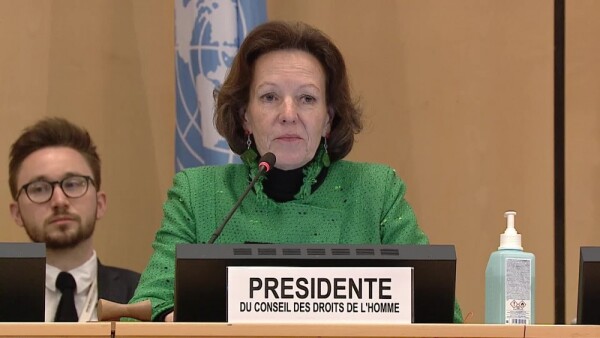
With room for around 2,000 people, the vast hall “will allow for adequate space between delegates” attending the 43rd session of the Council, as its President, Austrian Ambassador Elisabeth Tichy-Fisslberger, said.
The decision was taken after a meeting on Monday between the Council Bureau “and all the vice-presidents and the regional coordinators from all the regions as well as with our representative of our host country Switzerland to discuss how to go on against a background of the COVID-19 situation and its implications, as well as some of the worries which some of you have expressed”, the Ambassador explained.
It follows a decision taken a week ago to cancel all side events linked to the Council – some 200 in all – and moves to encourage Special Rapporteurs and other speakers to address the forum by video, rather than to attend in person.
Listing the other proposals to be adopted by the Council, Ms. Tichy-Fisslberger added that “any delegate sensing that he or she has the slightest problem in terms of coughing or fever or whatever should stay at home. And people over 65 or 70 should stay at home as well.”
Until the current session ends on 20 March, participants would be asked to be present with no more than two delegates in the plenary room and empty seats “would be used to space out the delegations”.
In addition to asking delegates to follow all sanitary measures proposed by UN Geneva, such as refraining from shaking hands and using hand sanitisers provided, the Council President noted that all informal meetings would be moved to larger rooms -“again, with the purpose of allowing for adequate spacing between delegations, and would not allow more than two people per delegation and delegations would be invited to send only the number of people necessary.”
- Wide shot: exterior, flag alley, Palais des Nations, United Nations Geneva.
- Medium shot, panning: Human Rights Council delegates with country name plates in Room XX at UN Geneva.
- SOUNDBITE (EN) — President of the Human Rights Council, Ambassador Elisabeth Tichy-Fisslberger (Austria): “Yesterday, we held an extended Bureau meeting; so that was with all the Vice-Presidents and the regional coordinators from all the regions as well as with our representative of our host country Switzerland to discuss how to go on against a background of the COVID-19 situation and its implications, as well as some of the worries which some of you have expressed.”
- Medium shot: Human Rights Council delegates in Room XX, seated, one of whom is taking off his scarf.
- SOUNDBITE (EN) — President of the Human Rights Council, Ambassador Elisabeth Tichy-Fisslberger (Austria): “The plenary meetings would be moved away from Room XX to the Assembly Hall, which as you know is the biggest room in the building and can take around 2,000 people, which would allow us to space, to allow for adequate space between delegates.”
- Medium shot: Human Rights Council delegates in Room XX at UN Geneva; they are seated and one of them is smiling broadly.
- SOUNDBITE (EN) — President of the Human Rights Council, Ambassador Elisabeth Tichy-Fisslberger (Austria): “Any delegate sensing that he or she has the slightest problem in terms of coughing or fever or whatever should stay at home. And people over 65 or 70 should stay at home as well.”
- Medium shot: Human Rights Council delegate in Room XX at UN Geneva, wearing conference hearing device, looking around the chamber.
- SOUNDBITE (EN) — President of the Human Rights Council, Ambassador Elisabeth Tichy-Fisslberger (Austria): “Delegations would be asked to be present with no more than two delegates in the plenary room; the empty seats would be used to space out the delegations.”
- Medium shot: Human Rights Council delegates in Room XX at UN Geneva, seated, wearing conference hearing devices, looking ahead.
- SOUNDBITE (EN) — President of the Human Rights Council, Ambassador Elisabeth Tichy-Fisslberger (Austria): “All informal meetings would be moved to larger rooms, again with the purpose of allowing for adequate spacing between delegations, and would not allow more than two people per delegation and delegations would be invited to send only the number of people necessary.”
- Medium shot: Human Rights Council delegates in Room XX at UN Geneva, seated in front of country nameplates.
- Medium shot: Human Rights Council delegates in Room XX at UN Geneva, seated at some distance from each other.
- Wide shot: Assembly Hall at UN Geneva, temporarily housing the Human Rights Council, delegates standing and talking, others seated.
- Medium shot: showing President of the Human Rights Council, Ambassador Elisabeth Tichy-Fisslberger (Austria) speaking into desk microphone at the Assembly Hall at UN Geneva; UN flag and observer shown behind.
- Medium shot: Assembly Hall at UN Geneva, temporarily housing the Human Rights Council; delegates seating or taking seats.
- Medium shot: Assembly Hall at UN Geneva, temporarily housing the Human Rights Council; delegates, one wearing a face mask which has been lowered to reveal his mouth.
- Medium shot: Assembly Hall at UN Geneva, temporarily housing the Human Rights Council; delegates, seated.
- Medium shot: Assembly Hall at UN Geneva, temporarily housing the Human Rights Council; delegates, seated, semi-profile.
- Medium shot: Assembly Hall at UN Geneva, temporarily housing the Human Rights Council; delegates, seated.
Similar Stories

1
1
1
Edited News | OCHA , UNICEF , WFP
Aid agencies warned on Friday of the fast-developing humanitarian emergency inside Taiz City in Yemen, which has been encircled by de facto Houthi forces fighting government troops along the country’s west coast.

2
17
1
2
Edited News , Press Conferences , Images | OCHA , WMO
Two UN agencies teamed up on Wednesday to issue an appeal for immediate assistance to help communities already being impacted by the strongest El Niño on record.

3
16
2
2
Edited News , B-roll , Conferences , Images | UNITED NATIONS , UNOG
Sixth Consultative Meeting on Enhancing Coordination of Peace Initiatives and Efforts for Sudan

1
1
1
Edited News | UNICEF , WHO , UNHCR
Yemen war continues to force families from homes amid hunger and disease
More than 250,000 people have now fled renewed fighting in Yemen, the UN said on Tuesday, citing particular concern for those sheltering in the southwestern city of Taiz and the wider governorate, where access is “essentially blocked”.

1
1
1
Edited News | UNICEF
A little over one year since a ceasefire agreement was announced between Hamas fighters and Israel, more than 340 children have been reported killed and hundreds more injured, the UN Children’s Fund, UNICEF, said on Friday.

1
1
1
Edited News | UNICEF , IFRC
Six weeks after Nepal’s deadly flooding disaster, communities are still struggling to rebuild their lives, but they will need sustained help as global warming increases the risk of another Himalayan catastrophe, the UN Children’s Fund (UNICEF) said on Friday.

1
1
1
Edited News | WHO
In suspected Russia plague death, testing and monitoring underway – WHO
The death of a lab worker in Russia’s Siberia region has sparked concerns about plague being the cause, the UN World Health Organization (WHO) said on Tuesday, adding that it was following the situation closely.

1
1
Edited News | OHCHR , UNOG
UN Human Rights Chief Volker Türk on Friday provided and oral update to the 63rd session of the Human rights Council on Ukraine.

1
1
1
Edited News | OHCHR , UNOG
UN Human Rights Chief Volker Türk on Friday provided and oral update to the 63rd session of the Human rights Council on the human rights situation in Haiti.

1
1
1
Edited News | WHO
Repeated delays in bringing lifesaving medicines, prosthetics and more from Israel into Gaza risk having devastating consequences on Palestinians who urgently need them in the wartorn enclave, the UN World Health Organization (WHO) said on Friday. “A truck full of non-priority supplies or the right supplies arriving too late, doesn't save lives. That's the question that actually matters," said Dr Reinhilde Van De Weerdt, WHO Representative in the OPT.

1
1
1
Edited News | WHO
DRC: Early access to care and oxygen decisive for Ebola patients’ survival – WHO
In the Democratic Republic of the Congo (DRC), health workers fighting the country’s largest-ever Ebola outbreak are struggling to overcome critical challenges to patient care, the UN World Health Organization (WHO) warned on Tuesday.

1
1
1
Edited News | OCHA , UN
Civilians in Iran are continuing to feel the consequences of months of conflict and military escalation, the UN’s top official in the country has said, as loss of life, damage to civilian infrastructure and mounting economic pressures leave many facing continued uncertainty.