

The United Nations Office at Geneva
Multimedia Newsroom
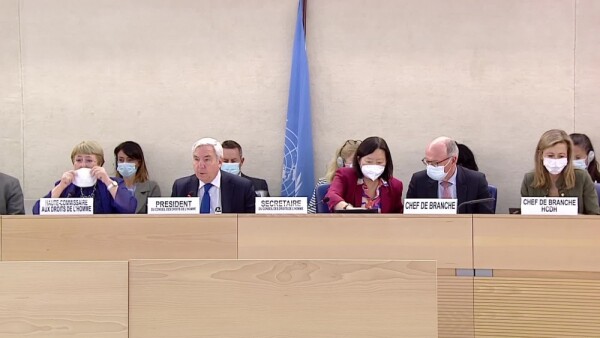
In an urgent debate on the situation of women and girls in Afghanistan, the United Nations Human rights chief Michelle Bachelet urged the Taliban, Afghanitan's de facto authorities, to respect the human rights of women and girls who are experiencing a “rapid roll-back in enjoyment of their rights across the board in decades”.
Ms Bachelet recalled in today's address to the Human Rights Council in Geneva only some of the daily experiences of women and girls in Afghanistan. “Attacks on women human rights defenders, journalists, judges, lawyers and prosecutors. Massive unemployment of women, amidst an economy on the brink of total collapse. Restrictions on movement, dress, and its impact on access to basic services, and growing anxiety and depression. Women-owned and operated businesses shut down. Persistent impunity. Secondary schooling for 1.2 million girls discontinued”, Ms Bachelet said.
According to Ms. Bachelet, their future will be even darker, unless something changes quickly.
“The de facto authorities I met with during my visit in March this year said they will honour their human rights obligations, as far as consistent with Islamic sharia law. Yet, despite these assurances, we are witnessing the progressive exclusion of women and girls from the public sphere and their institutionalized, systematic oppression”.
The UN human rights chief also reminded that as a de facto authority exercising effective control, the Taliban are a primary duty-bearer in view of Afghanistan’s legal obligations under international treaties.
“I also call upon the de facto authorities to set a firm date for the opening of secondary schools for girls, and to ensure quality education, without discrimination, and resources for teachers”, Ms Bachelet said. “I urge them to remove restrictions on women’s freedom of movement including the requirement of maharam (male chaperone) and the mandatory face covering, and enabling their right to access employment, including self-employment”.
Ms. Bachelet also encouraged the re-establishment of an independent mechanism to receive complaints from the public and protect victims of gender-based violence.
“Beyond being right, it is also a matter of practical necessity”, said the High Commissioner. “Amid the economic crisis, women’s contribution to economic activity is indispensable, which itself requires access to education, and freedom of movement and from violence”.
In his first address to the Council as the Special Rapporteur on the situation of human rights in Afghanistan, Richard Bennett said that “the Taliban’s intentions are not only to impose absolute gender discrimination, they are aimed at making women invisible by excluding them almost entirely from society”. He added that “for example, women are represented by men at the current Grand Assembly. These measures contravene Afghanistan’s obligations under numerous human rights treaties to which it is a State party”.
During his recent trip in May to Afghanistan where he also spoke to the authorities, Mr Bennett could witness that the Taliban have wiped out gains made by women and girls over the last 20 years including restrictions on employment, travel and attire.
“They massively diminish women’s lives, deliberately attack women and girls’ autonomy, freedom and dignity, and create a culture of impunity for domestic violence, child marriage and sale and trafficking of girls, to name but a few of the consequences”, said Special Rapporteur Bennett.
Since August 2021, when the Taliban took control of the country, there has been an enormous deterioration in the recognition and protection of the rights of women and girls in Afghanistan.
“Every day there is at least one or two women who commit suicide for the lack of opportunity, for the mental health, for the pressure they receive”, said Fawzia Koofi, the first woman Vice President of the Afghan Parliament. “The fact that girls as young as 9 years old are being s old – not only because of economic pressure – but because of the fact that there is no hope for them, for their family, it is not normal”, said the human rights activist.
Despite public assurances from the Taliban to respect women and girls’ rights, they are reinstituting step by step the discrimination against women and girls. Ms Koofi, a former member of the peace negotiation team with the Taliban said that “Taliban obviously have not kept their promises of what they were telling us during the negotiations in terms of their respect for Islamic rights for women”. Ms Koofi added that “in fact, what they do is in contradiction to Islam. Our beautiful religion starts with reading. But today, Taliban under the name of the same religion, deprive 55 percent of the society from going to school”.
For Nasir Andisha, Ambassador and Permanent Representative of Afghanistan to the UN in Geneva, “the situation of women and girls in Afghanistan demands nothing less than a robust monitoring mechanism to collect, consolidate, and analyse evidence of violations, to document and verify information, to identify those responsible to promote accountability and remedies for victims, and to make recommendations for effective prevention for future violations”.
A draft resolution on the situation of women and girls in Afghanistan is being negotiated at the Human Rights Council and will be considered on 7 July.
- ends-
- Exterior shot, wide shot Palais des Nations on a sunny day
- Wide shot, Human Rights Room
- SOUNDBITE (English) - Michelle Bachelet, High Commissioner for Human Rights: “Attacks on women human rights defenders, journalists, judges, lawyers and prosecutors. Massive unemployment of women, amidst an economy on the brink of total collapse. Restrictions on movement, dress, and its impact on access to basic services, and growing anxiety and depression. Women-owned and operated businesses shut down. Persistent impunity. Secondary schooling for 1.2 million girls discontinued”.
- Wide shot, podium with speakers in Human Rights Room
- SOUNDBITE (English) - Michelle Bachelet, High Commissioner for Human Rights: “The de facto authorities I met with during my visit in March this year said they will honour their human rights obligations, as far as consistent with Islamic sharia law. Yet, despite these assurances, we are witnessing the progressive exclusion of women and girls from the public sphere and their institutionalized, systematic oppression”.
- Medium shot, delegates in Human Rights Room
- SOUNDBITE (English) - Michelle Bachelet, High Commissioner for Human Rights: “I also call upon the de facto authorities to set a firm date for the opening of secondary schools for girls, and to ensure quality education, without discrimination, and resources for teachers. I urge them to remove restrictions on women’s freedom of movement including the requirement of maharam (male chaperone) and the mandatory face covering, and enabling their right to access employment, including self-employment”.
- Medium shot, delegates in Human Rights Room
- SOUNDBITE (English) - Michelle Bachelet, High Commissioner for Human Rights: “Beyond being right, it is also a matter of practical necessity. Amid the economic crisis, women’s contribution to economic activity is indispensable, which itself requires access to education, and freedom of movement and from violence”.
- Wide shot, Human Rights Room with podium with speakers and with Afghanistan Special Rapporteur Richard Bennett on screen
- SOUNDBITE (English) – Richard Bennett, Special Rapporteur for Human Rights in Afghanistan: “The Taliban’s intentions are not only to impose absolute gender discrimination, they are aimed at making women invisible by excluding them almost entirely from society. For example, women are represented by men at the current Grand Assembly. These measures contravene Afghanistan’s obligations under numerous human rights treaties to which it is a State party”.
- Medium shot, delegates in Human Rights Room
- SOUNDBITE (English) - Richard Bennett, Special Rapporteur for Human Rights in Afghanistan: “They massively diminish women’s lives, deliberately attack women and girls’ autonomy, freedom and dignity, and create a culture of impunity for domestic violence, child marriage and sale and trafficking of girls, to name but a few of the consequences”.
- Medium shot, delegates in Human Rights Room
- SOUNDBITE (English) - Fawzia Koofi, First woman Vice President of the Afghan Parliament, former member of the peace negotiation team with Taliban and human rights activist: “Every day there is at least one or two women who commit suicide for the lack of opportunity, for the mental health, for the pressure they receive. The fact that girls as young as 9 years old are being s old – not only because of economic pressure – but because of the fact that there is no hope for them, for their family, it is not normal”.
- Close up, delegate of France
- SOUNDBITE (English) - Fawzia Koofi, First woman Vice President of the Afghan Parliament, former member of the peace negotiation team with Taliban and human rights activist: “Taliban obviously have not kept their promises of what they were telling us during the negotiations in terms of their respect for Islamic rights for women. In fact, what they do is in contradiction to Islam. Our beautiful religion starts with reading. But today, Taliban under the name of the same religion, deprive 55 percent of the society from going to school”.
- Medium shot, delegates in Human Rights Room
- SOUNDBITE (English) – Nasir Andisha, Ambassador and Permanent Representative of Afghanistan to the UN in Geneva: “The situation of women and girls in Afghanistan demands nothing less than a robust monitoring mechanism to collect, consolidate, and analyse evidence of violations, to document and verify information, to identify those responsible to promote accountability and remedies for victims, and to make recommendations for effective prevention for future violations”.
- Wide shot, delegates in Human Rights Room
- Wide shot, delegates in Human Rights Room
- Medium shot, Afghanistan delegate in Human Rights Room
Similar Stories
1
1
1
Edited News | OHCHR
A UN Human Rights Office report released today covers 19 months of large-scale violations of international law including atrocity crimes, from October 2023 to the end of May 2025.
1
1
1
Edited News | OCHA , UNICEF
At least six million people in Somalia are going days without enough food, UN aid teams warned on Friday, highlighting that nearly two million of this number are young children “at high risk of illness or death”.
1
1
1
Edited News | UNICEF , WHO
Children shot, stabbed and pepper-sprayed in occupied West Bank; scores of Gaza amputees denied prosthetics, aid teams warn
Israeli military operations and surging settler attacks in the occupied West Bank are killing and maiming Palestinian children, while in Gaza tens of thousands with life-changing injuries lack access to treatment and rehabilitation, UN agencies warned on Tuesday.
1
1
1
Edited News | WHO
The risk of hantavirus spreading to the general population is “absolutely low”, the UN World Health Organization (WHO) stressed on Friday.
1
1
1
Edited News | UNHCR , IFRC
Death and destruction have continued unabated in Lebanon while communities are still unable to return to their homes despite a ceasefire that began on 17 April, humanitarians said on Tuesday.
1
1
Edited News | WHO
Deadly hantavirus on board cruise ship may be transmitted among humans - WHO
Hantavirus victims on a ship in the Atlantic Ocean may have been infected prior to joining the cruise and human-to-human transmission on board cannot be ruled out – although it is rare - the World Health Organization (WHO) said on Tuesday.
1
1
1
Edited News | OHCHR
UN rights chief concerned by upheld convictions of Cambodian activists.
1
1
1
Edited News | UNHCR , OHCHR
Middle East crisis puts aid, food, fuel further out of reach for millions already struggling – UN agencies
As the Middle East crisis continues the humanitarian fallout is worsening, with aid route disruptions and food and fuel price hikes wrecking the lives and rights of the most vulnerable, UN agencies warned on Friday.
1
1
2
Edited News | UNMAS
Demining experts from around the world have been sharing their collective shock at the widespread and growing threat from unexploded ordnance, the new head of the UN Mine Action Service (UNMAS) said on Wednesday.
1
1
1
Edited News | OHCHR , UNOG
The UN Human Rights Office in Syria conducted a 5-day visit to the northeast of the country where they received accounts of human rights violations and abuses.
1
1
1
Edited News | UNICEF
Sudan: ‘History repeating itself’ for Darfur’s children - UNICEF
Mass atrocities in Sudan’s Darfur 20 years ago reverberated as far as Hollywood, but today, a new generation of children faces attacks, hunger and displacement in an emergency largely ignored by the outside world, the UN Children’s Fund (UNICEF) warned on Tuesday.
1
1
Edited News | WHO , UNMAS
Desperate and dangerous conditions in Gaza continue to hamper recovery efforts for the wartorn enclave's people, the UN health agency said on Friday, while demining experts warned that they’ve “barely scratched the surface” in assessing the level of contamination of unexploded ordnance.