

The United Nations Office at Geneva
Multimedia Newsroom
Edited News | UNICEF , UNITED NATIONS
Bi-Weekly Press Briefing: Ukraine Women And Children Alert - UNICEF
UNICEF highlights devastating mental health dangers for Ukraine’s children
Ten weeks into the war in Ukraine, UN humanitarians on Friday said that they were urgently ramping up efforts to provide vulnerable children with specialist and psychosocial support, amid “tremendous” mental health needs and ongoing dangers linked to the Russian invasion and sexual and gender-based violence.
“We’re anticipating numbers in terms of all forms of violence against children to be in the tens of thousands for sure,” said Aaron Greenberg, UNICEF’s regional child protection advisor for Europe & Central Asia.
Before 24 February, Ukraine’s orphanages, boarding schools and other institutions for youngsters housed more than 91,000 children, around half with disabilities. Today, only around one-third of that number have returned home, including those evacuated from the east and south, according to UN Children’s Fund UNICEF.
“The impact of the war on these children has been particularly devastating,” said Mr. Greenberg, speaking to journalists in Geneva via Zoom from Lviv. “Tens of thousands of children living in institutional or foster care have been returned to families, many of them hastily, as the war got started. Many have not received the care and protection they require, especially children with disabilities.”
Bouncing back
Condemning the fact that hundreds of youngsters have been killed in shelling attacks already, the UN agency warned that others had suffered serious mental health trauma linked to “direct experience” of violence, both physical and sexual.
While insisting that many children “will bounce back” if they can get back to school and start seeing some form of “normalisation” in their lives, Mr. Greenberg insisted that it was more important than ever to ensure that Ukraine’s social service workforce was reassured and encouraged to stay and help.
He noted too that “a smaller, but important number” would likely develop post-traumatic stress disorder between two and four months after they were traumatised.
“Since 24 February UNICEF and our partners have reached over 140,000 children and their caregivers with mental health and psychosocial services,” he continued. “But a vast majority of that, 95 per cent, are direct engagements with children and trained psychologists.”
Priorities for the UN agency include scaling up investments in local NGO mental health providers to help the youngsters still in care, in support of Ukrainian government policy.
But it is proving difficult to find enough professionals to help, “as social workers, child psychologists and other professionals are equally impacted by this conflict”, Mr. Greenberg continued.
“If you start doing the math, there are children who remain in institutions who were not evacuated either internally or externally, and there are children in foster care families whose payments were temporarily interrupted, and there are children in guardianship arrangements, a significant number, so when you layer this, the number of children in need who were vulnerable pre-crisis and whose now vulnerabilities have been accelerated, is incredibly high.”
Throughout Ukraine, UNICEF has 56 deployed mobile units to provide specialised health services to traumatised children. There are also 12 “dedicated violence mobile teams in the east”, where fighting is ongoing, Mr. Greenberg said. “To date, those mobile teams in the east have worked with 7,000 cases of women and children in terms of responding to specific violence-related queries and reports that the mobile team then follows up on.”
ends
STORY: Ukraine Women And Children Alert - UNICEF
TRT: 1 min 53s
SOURCE: UNTV CH
RESTRICTIONS: NONE
LANGUAGE: ENGLISH / NATS
ASPECT RATIO: 16:9
DATELINE: 6 May 2022 GENEVA, SWITZERLAND
SHOTLIST
- Exterior medium shot, Palais des Nations flag alley, a sunny day.
- Wide shot, podium with moderator in Press briefing room, Palais des Nations.
- SOUNDBITE (English) — Aaron Greenberg, UNICEF’s regional child protection advisor for Europe & Central Asia (via Zoom from Lviv): “Since 24 February UNICEF and our partners have reached over 140,000 children and their caregivers with mental health and psychosocial services; but a vast majority of that, 95 per cent, are direct engagements with children and trained psychologists.”
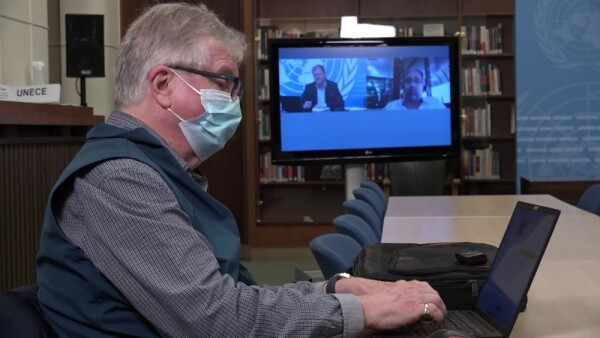
- Medium shot, journalist wearing facemask with large-screen TV to rear showing podium moderator and Mr. Greenberg speaking via Zoom from Ukraine.
- SOUNDBITE (English) — Aaron Greenberg, UNICEF’s regional child protection advisor for Europe & Central Asia (via Zoom from Lviv): “If you start doing the math, there are children who remain in institutions who were not evacuated either internally or externally, and there are children in foster care families whose payments were temporarily interrupted, and there are children in guardianship arrangements, a significant number, so when you layer this, the number of children in need who were vulnerable pre-crisis and whose now vulnerabilities have been accelerated, is incredibly high.”
- Close-up, participant wearing facemask and headphones, looking down, journalist wearing facemask to rear.
- SOUNDBITE (English) — Aaron Greenberg, UNICEF’s regional child protection advisor for Europe & Central Asia (via Zoom from Lviv): “UNICEF and other partners as well, but UNICEF is supporting 12 dedicated violence mobile teams in the east. To date, those mobile teams in the east have worked with 7,000 cases of women and children in terms of responding to specific violence-related queries and reports that the mobile team then follows up on.”
- Wide shot of room showing journalists wearing facemasks, large-screen TV and TV camera on tripod with lighting panel.
- SOUNDBITE (English) — Aaron Greenberg, UNICEF’s regional child protection advisor for Europe & Central Asia (via Zoom from Lviv): “We’re anticipating numbers in terms of all forms of violence against children to be in the tens of thousands for sure.”
- Close-up, TV camera lens, blurred, with large-screen TV monitor to rear in focus showing moderator and Mr. Greenberg.
- Medium shot, participants, journalists wearing facemasks, side shot.
- Medium shot, participant’s face reflected in laptop.
Similar Stories

1
1
1
Edited News | OCHA , UNICEF , WFP
Aid agencies warned on Friday of the fast-developing humanitarian emergency inside Taiz City in Yemen, which has been encircled by de facto Houthi forces fighting government troops along the country’s west coast.

2
17
1
2
Edited News , Press Conferences , Images | OCHA , WMO
Two UN agencies teamed up on Wednesday to issue an appeal for immediate assistance to help communities already being impacted by the strongest El Niño on record.

3
16
2
2
Edited News , B-roll , Conferences , Images | UNITED NATIONS , UNOG
Sixth Consultative Meeting on Enhancing Coordination of Peace Initiatives and Efforts for Sudan

1
1
1
Edited News | UNICEF , WHO , UNHCR
Yemen war continues to force families from homes amid hunger and disease
More than 250,000 people have now fled renewed fighting in Yemen, the UN said on Tuesday, citing particular concern for those sheltering in the southwestern city of Taiz and the wider governorate, where access is “essentially blocked”.

1
1
1
Edited News | UNICEF
A little over one year since a ceasefire agreement was announced between Hamas fighters and Israel, more than 340 children have been reported killed and hundreds more injured, the UN Children’s Fund, UNICEF, said on Friday.

1
1
1
Edited News | UNICEF , IFRC
Six weeks after Nepal’s deadly flooding disaster, communities are still struggling to rebuild their lives, but they will need sustained help as global warming increases the risk of another Himalayan catastrophe, the UN Children’s Fund (UNICEF) said on Friday.

1
1
1
Edited News | WHO
In suspected Russia plague death, testing and monitoring underway – WHO
The death of a lab worker in Russia’s Siberia region has sparked concerns about plague being the cause, the UN World Health Organization (WHO) said on Tuesday, adding that it was following the situation closely.

1
1
Edited News | OHCHR , UNOG
UN Human Rights Chief Volker Türk on Friday provided and oral update to the 63rd session of the Human rights Council on Ukraine.

1
1
1
Edited News | OHCHR , UNOG
UN Human Rights Chief Volker Türk on Friday provided and oral update to the 63rd session of the Human rights Council on the human rights situation in Haiti.

1
1
1
Edited News | WHO
Repeated delays in bringing lifesaving medicines, prosthetics and more from Israel into Gaza risk having devastating consequences on Palestinians who urgently need them in the wartorn enclave, the UN World Health Organization (WHO) said on Friday. “A truck full of non-priority supplies or the right supplies arriving too late, doesn't save lives. That's the question that actually matters," said Dr Reinhilde Van De Weerdt, WHO Representative in the OPT.

1
1
1
Edited News | WHO
DRC: Early access to care and oxygen decisive for Ebola patients’ survival – WHO
In the Democratic Republic of the Congo (DRC), health workers fighting the country’s largest-ever Ebola outbreak are struggling to overcome critical challenges to patient care, the UN World Health Organization (WHO) warned on Tuesday.

1
1
1
Edited News | OCHA , UN
Civilians in Iran are continuing to feel the consequences of months of conflict and military escalation, the UN’s top official in the country has said, as loss of life, damage to civilian infrastructure and mounting economic pressures leave many facing continued uncertainty.