

The United Nations Office at Geneva
Multimedia Newsroom
UNHCR warns of dire impact from floods in South Sudan as new wet season looms
South Sudan battles record floods amid changing climate.
Prolonged flooding and displacement are expected to worsen when the wet season begins in May, the refugee agency warned on Tuesday. Urgent action is needed to protect already vulnerable populations from its worst impacts.
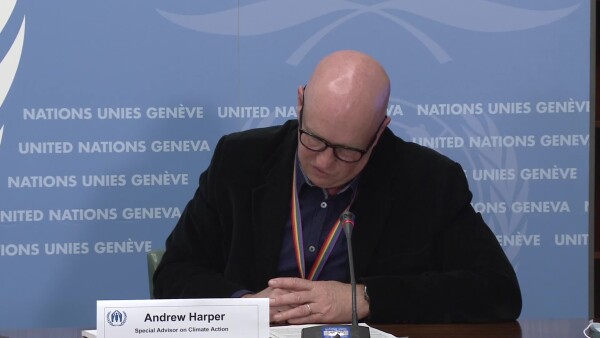
Returning from a visit to South Sudan’s most affected areas, Special Advisor on Climate Action to UNHCR, Andrew Harper, said that parts of the country were “still affected by high water levels from last year's flooding, and it seems unlikely that the waters will recede completely before the onset of the next rainy season.” The rains forecast for 2022 are expected to be even worse than last year, he emphasized. “These two circumstances combined, set the tone for what appears will be a disastrous rainy season.”
In all, 33 of South Sudan’s 79 counties have been badly affected by flooding. Thousands of people have been displaced, while others are marooned in dyke-ringed compounds, holding back floodwaters with mud, sticks and plastic sheeting. Residents need water pumps and heavy equipment to build sturdy flood barriers and keep their livestock above water, UNHCR insisted.
To put the situation into perspective, Mr Harper said, “you've got elderly women, vulnerable populations who are basically grabbing mud and trying to build up the berms around their villages. This is during the dry season. The wet season hasn't even started yet. So, we have to expect that many of these very defenses will be overcome by the upcoming rainy season.”
The fragile country has been struggling to overcome political and economic challenges since it gained independence in 2011. The worst flooding on record was in 2021, killing an estimated 800,000 livestock, submerging crops and impacting more than 835,000 people, according to the UN Office for the Coordination of Humanitarian Affairs (OCHA). South Sudan counts the largest refugee population in Africa with 2.5 million people displaced. Those multiple factors of instability fuel violence, warned
Mr Harper: “As more and more people get displaced from their safe zones and they have to encroach into an area where they're not the traditional population, then, there will be conflict. We're seeing that time and time again. So, you have villages which are holding out, doing whatever they can in order not to be forced to move to where they may face violence.”
Amid a backdrop of climate events that are worsening globally, UNHCR warned that floods and droughts are becoming more frequent and intense, and that catastrophic food insecurity is looming. “As you have crops wiped out, as you have livestock dying, season after season, you have this compounded series of disasters and a lack of international response in terms of providing support for food security, then you will be facing the situation of a famine in that region. I don't think it's ‘if’, it's going to be ‘when’.”
Ends
STORY: South Sudan Floods Dire Impact - UNHCR
TRT: 2 mins 16s
SOURCE: UNTV CH
LANGUAGE: ENGLISH
ASPECT RATIO: 16:9
DATELINE: 29 March 2022
VIRTUAL PRESS BRIEFING
GENEVA, SWITZERLAND
SHOTLIST
- Exterior wide shot: UN flag alley UN Geneva.
- Cutaway: Wide shot, Press room, UN Geneva
- SOUNDBITE (ENGLISH) Andrew Harper, Special Advisor on Climate Action to the United Nations High Commissioner for Refugees: “Parts of South Sudan, such as Fangak in Jonglei (State) and Bentiu in Unity State, are still affected by high water levels from last year's flooding, and it seems unlikely that the waters will recede completely before the onset of the next rainy season. And IGAD (Intergovernmental Authority on Development), which is the Regional Institute, forecasts that the rains in 2022 will be even more than last year. These two circumstances combined, set the tone for what appears will be a disastrous rainy season.”
- Cutaway: wide shot of press room
- SOUNDBITE (ENGLISH) Andrew Harper, Special Advisor on Climate Action to the United Nations High Commissioner for refugees: “Just to put it in perspective, you've got elderly women, you've got vulnerable populations who are basically grabbing mud and trying to build up the berms around their villages. And this is during summer. This is during the dry season. The wet season hasn't even started yet. So, we have to expect that many of these very defenses will be overcome by the upcoming rainy season.”
- Cutaway: medium shot, podium
- SOUNDBITE (ENGLISH) Andrew Harper, Special Advisor on Climate Action to the United Nations High Commissioner for refugees: “As more and more people get displaced from their safe zones and they have to encroach into an area where they're not the traditional population, then, there will be conflict. We're seeing that time and time again. So, you have people, you have villages which are holding out, doing whatever they can in order not to be forced to move to where they may face violence.”
- Cutaway: Medium shot journalists listening in the Press room
- SOUNDBITE (ENGLISH) Andrew Harper, Special Advisor on Climate Action to the United Nations High Commissioner for refugees: “The other issue that will be coming to the fore is the food insecurity. As you have crops wiped out, as you have livestock dying, season after season, you have this compounded series of disasters and a lack of international response in terms of providing support for food security, then you will be facing the situation of a famine in that region. I don't think it's “if”, it's going to be “when”.”
- Various: Medium shot journalists taking notes and listening
B-Roll from UNHCR, shot between March 7-10, 2022 in South Sudan available on: https://www.unmultimedia.org/tv/unifeed/asset/2723/2723593/
Similar Stories

1
1
1
Edited News | UNICEF
A little over one year since a ceasefire agreement was announced between Hamas fighters and Israel, more than 340 children have been reported killed and hundreds more injured, the UN Children’s Fund, UNICEF, said on Friday.

1
1
1
Edited News | UNICEF , IFRC
Six weeks after Nepal’s deadly flooding disaster, communities are still struggling to rebuild their lives, but they will need sustained help as global warming increases the risk of another Himalayan catastrophe, the UN Children’s Fund (UNICEF) said on Friday.

1
1
1
Edited News | WHO
In suspected Russia plague death, testing and monitoring underway – WHO
The death of a lab worker in Russia’s Siberia region has sparked concerns about plague being the cause, the UN World Health Organization (WHO) said on Tuesday, adding that it was following the situation closely.

1
1
Edited News | OHCHR , UNOG
UN Human Rights Chief Volker Türk on Friday provided and oral update to the 63rd session of the Human rights Council on Ukraine.

1
1
1
Edited News | OHCHR , UNOG
UN Human Rights Chief Volker Türk on Friday provided and oral update to the 63rd session of the Human rights Council on the human rights situation in Haiti.

1
1
1
Edited News | WHO
Repeated delays in bringing lifesaving medicines, prosthetics and more from Israel into Gaza risk having devastating consequences on Palestinians who urgently need them in the wartorn enclave, the UN World Health Organization (WHO) said on Friday. “A truck full of non-priority supplies or the right supplies arriving too late, doesn't save lives. That's the question that actually matters," said Dr Reinhilde Van De Weerdt, WHO Representative in the OPT.

1
1
1
Edited News | WHO
DRC: Early access to care and oxygen decisive for Ebola patients’ survival – WHO
In the Democratic Republic of the Congo (DRC), health workers fighting the country’s largest-ever Ebola outbreak are struggling to overcome critical challenges to patient care, the UN World Health Organization (WHO) warned on Tuesday.

1
1
1
Edited News | OCHA , UN
Civilians in Iran are continuing to feel the consequences of months of conflict and military escalation, the UN’s top official in the country has said, as loss of life, damage to civilian infrastructure and mounting economic pressures leave many facing continued uncertainty.
1
1
1
Edited News | WHO , UNICEF
Aid agencies in Yemen highlighted the growing hunger emergency sparked by renewed fighting between Houthi opposition forces and Government troops, after mobile health clinics reported that hundreds of children displaced by the violence are suffering from the most deadly form of malnutrition.
1
1
1
Edited News | UNHCR
Displacement on the rise in Yemen as fighting continues - UNHCR
As hostilities worsen in Yemen, more people have been fleeing their homes, further intensifying the humanitarian crisis within the region, the UN Refugee Agency (UNHCR) warned on Tuesday.
1
1
1
Edited News | IOM , OHCHR , UNFPA , UNOG , UNHCR , WHO
Yemen’s humanitarian crisis growing by the hour amid spike in displacement
Yemenis displaced by renewed fighting have described fleeing for their lives amid shelling and gunfire, aid agencies reported on Friday, while highlighting the dramatic increase in humanitarian needs in the country and in Djibouti, where thousands have sought shelter.
1
1
1
Edited News | OHCHR , UNOG
The UN Human Rights Office issued on Friday a report documenting a shocking pattern of sexual violence amid Russia’s full-scale armed attack on Ukraine.