

The United Nations Office at Geneva
Multimedia Newsroom
Ukraine crisis: Bachelet leads calls for ceasefire in urgent debate at UN’s rights council
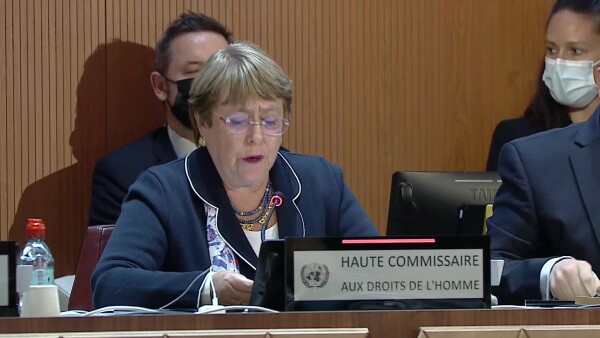
An urgent debate on the Ukraine crisis began at the Human Rights Council in Geneva on Thursday, as UN rights chief Michelle Bachelet led calls for a ceasefire, while insisting that Russia’s “military attack on Ukraine opened a new and dangerous chapter in world history”.
Convened at the request of Ukraine, Council Members gathered in Geneva to consider a draft resolution on the “situation of human rights in Ukraine stemming from the Russian aggression”, a week after its self-styled “special military operation” began, which has seen heavy shelling of Ukrainian cities.
“One week ago, the Russian Federation's military attack on Ukraine opened a new and dangerous chapter in world history,” Ms. Bachelet said. “Military operations are escalating further as we speak, with military strikes on and near large cities, including Chernihiv, Kharkiv, Kherson, Lysychansk, Sievierodonetsk, Sumy, Mariupol and Zhytomyr, and the capital, Kyiv. The town of Volnovakha in Donetsk region has been almost completely destroyed by shelling, and its remaining residents have been hiding in basements.”
Latest casualty figures from the Office of the High Commissioner for Human Rights (OHCHR) until Tuesday evening indicated 752 confirmed civilian casualties, including 227 killed – 15 of them children, Ms. Bachelet continued. At least 525 have been injured, including 28 children.
Of that number, 323 casualties were recorded in Donetsk and Luhansk regions (65 killed and 258 injured), while 429 casualties were recorded in other regions of Ukraine – Kyiv, Cherkasy, Chernihiv, Kharkiv, Kherson, Kyiv, Odesa, Sumy, Zaporizhzhia, and Zhytomyr regions – with 162 killed and 267 injured.
Ms. Bachelet added that “most civilian casualties were caused by the use of heavy artillery, multi-launch rocket systems and air strikes in populated areas, with concerning reports of use of cluster munitions striking civilian targets”.
Rejecting the premise of the debate, Gennady Gatilov, Permanent Representative of the Russian Federation to UN Geneva questioned the motives of those behind international condemnation for his country’s actions: “I would like to ask a question of the representatives of the USA and EU countries: what are the international human rights instruments to which you are party which say that supplying lethal weapons facilitates the saving of human lives? And that those weapons are regularly coming and you are seeing on your TV screens how those weapons are being provided to the Kiev forces.”
Mr. Gatilov added: “The peace and prosperity of Ukraine are not in your interests. The lives of ordinary Ukrainians are of no interest to you. You don’t need a settlement of the situation in Ukraine. The puppet regime of Mr. Zelensky is of interest to you only as a means of pressure and is a trump card in your confrontation with Russia.”
Addressing the Council from Ukraine, Emine Dzhaparova, spokesperson, First Deputy Minister of Foreign Affairs of Ukraine, declared that Russia’s “full-scale invasion” had entered its second week, her following overnight reports of huge explosions in Kyiv, and confirmation that Russian troops had taken the key southern port of Kherson.
“Every day, we witness both death and life, dignity and dishonour,” Ms. Dzhaparova said. “Death when, for example, a bleeding six-year-old girl with unicorn pyjamas could not be saved by doctors in Mariopol a couple of days ago…The only reason why this is taking place is because a group of war criminals with an access to the nuclear button concluded that our people are too weak to resist and to fight, and the world would not care. They put themselves above the international law and above the rules-based order.”
Also addressing the rights forum, Victor Madrigal-Borloz, independent UN-appointed rights expert and spokesperson for the Special Procedures Coordinating Committee, said that the military attack “which flagrantly violates international law and strikes at the very heart of the spirit and object of the Charter, is fundamentally an attack on the order that enables our work to further human rights and their objective to promote the respect of human dignity.”
Mr. Madrigal-Borloz, who is also the UN-appointed Independent Expert on violence and discrimination based on sexual orientation and gender identity, highlighted allegations of freedom of expression curbs inside Russia.
“Peaceful anti-war demonstrators continue to be arbitrarily arrested, with reports suggesting some 7,000 people have been arrested since Thursday last week,” he said.
The development in Geneva was just the latest expression of international condemnation for the Russian intervention.
It followed UN Member States’ overwhelmingly support on Wednesday for a General Assembly resolution in New York, which demanded that Russia immediately end its military operations in Ukraine, at the culmination of an unscheduled special session that was prompted by the crisis.
A total of 141 countries voted in favour of the resolution, which reaffirmed Ukrainian sovereignty, independence and territorial integrity.
Only four countries joined Russia in opposing the resolution – Belarus, Eritrea, North Korea and Syria – and 35 abstained.
Speaking after the vote, UN Secretary-General António Guterres, said that the message of the General Assembly was “loud and clear: end hostilities in Ukraine now. Silence the guns now. Open the door to dialogue and diplomacy now.”
On Wednesday evening, the International Criminal Court announced that it was opening a probe into possible war crimes in Ukraine.
ICC Prosecutor Karim Khan tweeted the decision, adding that his office would be looking for evidence for “any past and present” allegations of war crimes, crimes against humanity and genocide, committed inside Ukraine.
Although Ukraine has accepted the jurisdiction of the ICC since 2013, Russia is not a member of the court. The ICC prosecutes individuals, as opposed to the International Court of Justice, which resolves disputes between countries.
ends
STORY: Ukraine Urgent Debate – Human Rights Council
TRT: 3 mins 51s
SOURCE: UNTV CH
RESTRICTIONS: NONE
LANGUAGE: ENGLISH Channel 2 / RUSSIAN Channel 1
ASPECT RATIO: 16:9
DATELINE: 03 March 2022 GENEVA, SWITZERLAND
SHOTLIST
- Exterior wide shot, UN flag alley UN Geneva.
- Wide shot, Human Rights Council, UN Geneva.
- SOUNDBITE (English): Michelle Bachelet, UN High Commissioner for Human Rights (UNHCR): “One week ago, the Russian Federation's military attack on Ukraine opened the new and dangerous chapter in world history.”
- Medium shot, Ukraine delegation in focus in centre of shot.
- SOUNDBITE (English): Michelle Bachelet, UN High Commissioner for Human Rights (UNHCR): “Military operations are escalating further as we speak, with military strikes on and near large cities, including Chernihiv, Kharkiv, Kherson, Lysychansk, Sievierodonetsk, Sumy, Mariupol and Zhytomyr, and the capital, Kyiv. The town of Volnovakha in Donetsk region has been almost completely destroyed by shelling, and its remaining residents have been hiding in basements.”
- Medium shot, US delegation.
- SOUNDBITE (English): Michelle Bachelet, UN High Commissioner for Human Rights (UNHCR): “Most civilian casualties were caused by the use of heavy artillery, multi-launch rocket systems and air strikes in populated areas, with concerning reports of use of cluster munitions striking civilian targets.”
- Wide shot, panning, Human Rights Council, UN Geneva.
- SOUNDBITE (original in Russian, English guidance provided): Gennady Gatilov, Permanent Representative of the Russian Federation to UN Geneva: “I would like to ask a question of the representatives of the USA and EU countries: what are the international human rights instruments to which you are party which say that supplying lethal weapons facilitates the saving of human lives? And that those weapons are regularly coming and you are seeing on your TV screens how those weapons are being provided to the Kiev forces.”
- Wide shot, delegations seated and masked at the Human Rights Council, UN Geneva.
- SOUNDBITE (original in Russian, English guidance provided): Gennady Gatilov, Permanent Representative of the Russian Federation to UN Geneva: “The peace and prosperity of Ukraine are not in your interests. The lives of ordinary Ukrainians are of no interest to you. You don’t need a settlement of the situation in Ukraine. The puppet regime of Mr. Zelensky is of interest to you only as a means of pressure and is a trump card in your confrontation with Russia.”
- Medium shot, Polish delegation in centre of shot, masked.
- SOUNDBITE (English): Emine Dzhaparova, First Deputy Minister of Foreign Affairs of Ukraine: “As we speak here today, Russia's full-scale invasion entered its second week. Every day, we witness both death and life, dignity and dishonour. Death when, for example, a bleeding 6-year-old girl with unicorn pyjamas could not be saved by doctors in Mariopol a couple of days ago.”
- Close shot, Russian delegation, masked.
- SOUNDBITE (English): Emine Dzhaparova, First Deputy Minister of Foreign Affairs of Ukraine: “The only reason why this is taking place is because a group of war criminals with an access to the nuclear button concluded that our people are too weak to resist and to fight, and the world would not care. They put themselves above the international law and above the rules-based order.”
- Wide shot, Human Rights Council, UN Geneva.
- SOUNDBITE (English): Victor Madrigal-Borloz, Chair of the Special Procedures Coordinating Committee, and UN-appointed Independent Expert on violence and discrimination based on sexual orientation and gender identity: “This military attack, which flagrantly violates international law and strikes at the very heart of the spirit and object of the Charter, is fundamentally an attack on the order that enables our work to further human rights and their objective to promote the respect of human dignity.”
- Medium wide shot, delegates seated and masked at UN Human Rights Council, UN Geneva.
- SOUNDBITE (English): Victor Madrigal-Borloz, Chair of the Special Procedures Coordinating Committee, and UN-appointed Independent Expert on violence and discrimination based on sexual orientation and gender identity: “Peaceful anti-war demonstrators continue to be arbitrarily arrested, with reports suggesting some 7,000 people have been arrested since Thursday last week.”
- Medium shot, China delegate, masked.
- Medium shot, Council participants working on laptops, side shot.
- Medium shot, delegates seated and masked.
Similar Stories

1
1
1
Edited News | OCHA , UNICEF , WFP
Aid agencies warned on Friday of the fast-developing humanitarian emergency inside Taiz City in Yemen, which has been encircled by de facto Houthi forces fighting government troops along the country’s west coast.

2
17
1
2
Edited News , Press Conferences , Images | OCHA , WMO
Two UN agencies teamed up on Wednesday to issue an appeal for immediate assistance to help communities already being impacted by the strongest El Niño on record.

3
16
2
2
Edited News , B-roll , Conferences , Images | UNITED NATIONS , UNOG
Sixth Consultative Meeting on Enhancing Coordination of Peace Initiatives and Efforts for Sudan

1
1
1
Edited News | UNICEF , WHO , UNHCR
Yemen war continues to force families from homes amid hunger and disease
More than 250,000 people have now fled renewed fighting in Yemen, the UN said on Tuesday, citing particular concern for those sheltering in the southwestern city of Taiz and the wider governorate, where access is “essentially blocked”.

1
1
1
Edited News | UNICEF
A little over one year since a ceasefire agreement was announced between Hamas fighters and Israel, more than 340 children have been reported killed and hundreds more injured, the UN Children’s Fund, UNICEF, said on Friday.

1
1
1
Edited News | UNICEF , IFRC
Six weeks after Nepal’s deadly flooding disaster, communities are still struggling to rebuild their lives, but they will need sustained help as global warming increases the risk of another Himalayan catastrophe, the UN Children’s Fund (UNICEF) said on Friday.

1
1
1
Edited News | WHO
In suspected Russia plague death, testing and monitoring underway – WHO
The death of a lab worker in Russia’s Siberia region has sparked concerns about plague being the cause, the UN World Health Organization (WHO) said on Tuesday, adding that it was following the situation closely.

1
1
Edited News | OHCHR , UNOG
UN Human Rights Chief Volker Türk on Friday provided and oral update to the 63rd session of the Human rights Council on Ukraine.

1
1
1
Edited News | OHCHR , UNOG
UN Human Rights Chief Volker Türk on Friday provided and oral update to the 63rd session of the Human rights Council on the human rights situation in Haiti.

1
1
1
Edited News | WHO
Repeated delays in bringing lifesaving medicines, prosthetics and more from Israel into Gaza risk having devastating consequences on Palestinians who urgently need them in the wartorn enclave, the UN World Health Organization (WHO) said on Friday. “A truck full of non-priority supplies or the right supplies arriving too late, doesn't save lives. That's the question that actually matters," said Dr Reinhilde Van De Weerdt, WHO Representative in the OPT.

1
1
1
Edited News | WHO
DRC: Early access to care and oxygen decisive for Ebola patients’ survival – WHO
In the Democratic Republic of the Congo (DRC), health workers fighting the country’s largest-ever Ebola outbreak are struggling to overcome critical challenges to patient care, the UN World Health Organization (WHO) warned on Tuesday.

1
1
1
Edited News | OCHA , UN
Civilians in Iran are continuing to feel the consequences of months of conflict and military escalation, the UN’s top official in the country has said, as loss of life, damage to civilian infrastructure and mounting economic pressures leave many facing continued uncertainty.