

The United Nations Office at Geneva
Multimedia Newsroom
Venezuela: Rights probe points to unprecedented repression of critics
Violence used against opponents of the Venezuelan authorities has reached unprecedented levels, a top independent human rights probe alleged on Tuesday, citing arrests, sexual abuse and torture as just some of the methods used by the Government of President Nicolas Maduro to stay in power.
In a new report, the Human Rights Council-mandated investigators described how security forces had raided dozens of homes of suspected critics of the Government “just using social media videos as the only evidence to arrest people”.
Victims’ testimonies gathered either side of the disputed Presidential election on 28 July which returned Mr. Maduro to office for the third time pointed to “one of the most acute human rights crises in recent history”, the Independent International Fact-Finding Mission on Venezuela further maintained.
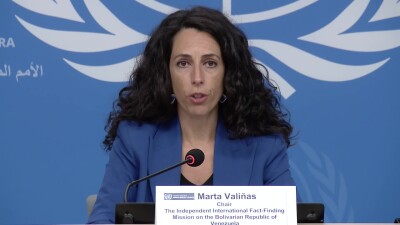
Speaking to journalists in Geneva, Marta Valiñas, Chair of the investigation, insisted that that its latest findings were “overwhelming: not only have there been no improvements, but the violations have intensified, reaching unprecedented levels of violence”.
The independent rights expert described “an intensification of the State’s repressive machinery” with regard to its critics which represented “a continuation of previous patterns” that the independent rights panel had already condemned as likely crimes against humanity.
Following the re-election of Mr. Maduro – whose victory announcement prompted widespread protests across Venezuela - Ms. Valiñas said that the probe had confirmed 25 fatalities. Most of the victims were “young people under 30 years old from popular neighbourhoods. There are two children among them,” she said.
One of the deceased was a member of the Bolivarian National Guard, Ms. Valiñas noted, before adding that 24 “died from gunshot wounds [and] the other was beaten to death”.
The Fact-Finding Mission’s latest report examines the human rights situation in Venezuela between September 2023 and August 2024. It points to a further deterioration of the rule of law following the Presidential elections, while public authorities “have abandoned all semblance of independence”, leaving citizens “helpless” against the “arbitrary exercise” of power.
“We documented more than 40 cases in which the security forces entered private homes without warrants, just using social media videos as the only evidence to arrest people who they thought had participated in protests or who had expressed criticism in social media,” explained Francisco Cox Vial, Member of the fact-finding mission that was created by the Human Rights Council in 2019.
According to the independent investigators, more than 120 people were arrested in July in the context of opposition campaign events. In the first week of protests following the elections, based on figures released by the authorities, more than 2,000 people were detained. Individuals included more than 100 children, some with disabilities, who faced accusations of terrorism and incitement to hatred and serious violations of due process, the investigators added.
“Of the people detained in this period, many were subjected to torture and other cruel, inhuman or degrading treatment, as well as sexual violence which was perpetrated against women and girls, but also against men with reported electric shocks, beating with blunt objects, suffocation with plastic bags, immersion in cold water and forced sleep deprivation,” said Patricia Tappatá Valdez, member of the fact-finding mission.
“We had been able to verify that at least 143 of these arrests involved members of seven opposition parties, including 66 leaders of political movements,” she added.
According to the rights probe, from December 2023 to March 2024, at least 48 people were detained on the grounds of “so-called conspiracy theories” against the Government, with arrest warrants issued for others. The individuals included military personnel, human rights defenders, journalists and political opposition representatives, the fact-finding mission said.
“We cannot ignore that these violations represent a clear and deliberate line of conduct by the authorities of politically motivated persecution,” said investigator Mr. Cox Vial. “We have come to the conclusion that many of these allegations constitute crimes against humanity.”
Story: Venezuela human rights probe
TRT: 02’21”
SOURCE: UNTV CH
LANGUAGE: ENGLISH / NATS
ASPECT RATIO: 16:9
DATELINE: 17 September 2024 - GENEVA, SWITZERLAND
RESTRICTIONS: NONE
Speakers:
• Marta Valiñas, Chair of the Fact-Finding Mission
• Francisco Cox Vial, Member of the Fact-Finding Mission
• Patricia Tappatá Valdez, Member of the Fact-Finding Mission
SHOTLIST
- Exterior medium shot: UN Geneva flag alley.
- Wide shot of the podium and Press room.
- SOUNDBITE (English): Marta Valiñas, Chair of the Fact-Finding Mission: “Our findings are overwhelming: not only have there been no improvements, but the violations have intensified, reaching unprecedented levels of violence.”
- Medium-wide, podium speakers and Press room.
- SOUNDBITE (English): Marta Valiñas, Chair of the Fact-Finding Mission: “In the post-election context, we have documented 25 confirmed deaths, most of them young people under 30 years old from popular neighbourhoods. There are two children among them. One of the victims is a member of the Bolivarian National Guard. Of these 25 victims, we have confirmed that 24 died from gunshot wounds. The other was beaten to death.”
- Medium-wide, podium speakers and Press room.
- SOUNDBITE (English): Francisco Cox Vial, Member of the Fact-Finding Mission: “We documented more than 40 cases in which the security forces entered private homes without warrants, just using social media videos as the only evidence to arrest people who they thought had participated in protests or who had expressed criticism in social media.”
- Wide, Press room, photographer.
- SOUNDBITE (English): Patricia Tappatá Valdez, Member of the Fact-Finding Mission: “Of the people detained in this period, many were subjected to torture and other cruel, inhuman or degrading treatment, as well as sexual violence which was perpetrated against women and girls, but also against men with reported electric shocks, beating with blunt objects, suffocation with plastic bags, immersion in cold water and forced sleep deprivation.”
- Medium, video journalist operating TV camera.
- SOUNDBITE (English): Patricia Tappatá Valdez, Member of the Fact-Finding Mission: “We had been able to verify that at least 143 of these arrests involved members of seven opposition parties, including 66 leaders of political movements.”
- Medium, journalists/participants.
- SOUNDBITE (English): Francisco Cox Vial, Member of the Fact-Finding Mission: “We cannot ignore that these violations represent a clear and deliberate line of conduct by the authorities of politically motivated persecution. We have come to the conclusion that many of these allegations constitute crimes against humanity.”
- Medium-close, journalist.
- Medium-close, journalist.
- Medium-close, journalist.
Similar Stories

1
1
1
Edited News | OCHA , UNICEF , WFP
Aid agencies warned on Friday of the fast-developing humanitarian emergency inside Taiz City in Yemen, which has been encircled by de facto Houthi forces fighting government troops along the country’s west coast.

2
17
1
2
Edited News , Press Conferences , Images | OCHA , WMO
Two UN agencies teamed up on Wednesday to issue an appeal for immediate assistance to help communities already being impacted by the strongest El Niño on record.

3
16
2
2
Edited News , B-roll , Conferences , Images | UNITED NATIONS , UNOG
Sixth Consultative Meeting on Enhancing Coordination of Peace Initiatives and Efforts for Sudan

1
1
1
Edited News | UNICEF , WHO , UNHCR
Yemen war continues to force families from homes amid hunger and disease
More than 250,000 people have now fled renewed fighting in Yemen, the UN said on Tuesday, citing particular concern for those sheltering in the southwestern city of Taiz and the wider governorate, where access is “essentially blocked”.

1
1
1
Edited News | UNICEF
A little over one year since a ceasefire agreement was announced between Hamas fighters and Israel, more than 340 children have been reported killed and hundreds more injured, the UN Children’s Fund, UNICEF, said on Friday.

1
1
1
Edited News | UNICEF , IFRC
Six weeks after Nepal’s deadly flooding disaster, communities are still struggling to rebuild their lives, but they will need sustained help as global warming increases the risk of another Himalayan catastrophe, the UN Children’s Fund (UNICEF) said on Friday.

1
1
1
Edited News | WHO
In suspected Russia plague death, testing and monitoring underway – WHO
The death of a lab worker in Russia’s Siberia region has sparked concerns about plague being the cause, the UN World Health Organization (WHO) said on Tuesday, adding that it was following the situation closely.

1
1
Edited News | OHCHR , UNOG
UN Human Rights Chief Volker Türk on Friday provided and oral update to the 63rd session of the Human rights Council on Ukraine.

1
1
1
Edited News | OHCHR , UNOG
UN Human Rights Chief Volker Türk on Friday provided and oral update to the 63rd session of the Human rights Council on the human rights situation in Haiti.

1
1
1
Edited News | WHO
Repeated delays in bringing lifesaving medicines, prosthetics and more from Israel into Gaza risk having devastating consequences on Palestinians who urgently need them in the wartorn enclave, the UN World Health Organization (WHO) said on Friday. “A truck full of non-priority supplies or the right supplies arriving too late, doesn't save lives. That's the question that actually matters," said Dr Reinhilde Van De Weerdt, WHO Representative in the OPT.

1
1
1
Edited News | WHO
DRC: Early access to care and oxygen decisive for Ebola patients’ survival – WHO
In the Democratic Republic of the Congo (DRC), health workers fighting the country’s largest-ever Ebola outbreak are struggling to overcome critical challenges to patient care, the UN World Health Organization (WHO) warned on Tuesday.

1
1
1
Edited News | OCHA , UN
Civilians in Iran are continuing to feel the consequences of months of conflict and military escalation, the UN’s top official in the country has said, as loss of life, damage to civilian infrastructure and mounting economic pressures leave many facing continued uncertainty.