

The United Nations Office at Geneva
Multimedia Newsroom
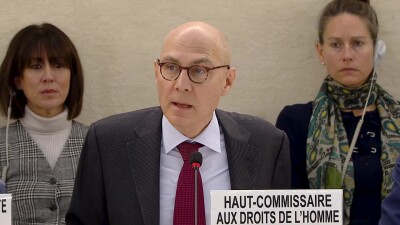
“There appear to be no bounds to – nor words to capture - the horrors that are unfolding before our eyes in Gaza,” Türk said.
“Today, the total number of people killed has exceeded 30,000. And tens of thousands of people are missing, many presumed buried under the rubble of their homes. This is carnage, ” the High Commissioner said.
“The war in Gaza must end. Clear violations of international human rights and humanitarian laws, including war crimes and possibly other crimes under international law, have been committed by all parties. It is time – well past time – for peace, investigation and accountability,” he said.
The UN Human Rights Office report makes for very painful reading, Türk said. Thousands of tonnes of munitions have been dropped by Israel on Gaza, including repeated use of explosive weapons with wide-area effects.
“In Egypt's Arish hospital, last November, I saw children whose flesh had been seared. I will never forget this,” he said.
Regarding the possibility of an Israeli operation on Rafah, the High Commissioner said he failed to see how such an operation could be consistent with the binding provisional measures issued by the International Court of Justice.
“Let me be absolutely clear, and issue yet another stark warning. The prospect of an Israeli ground assault on Rafah would take the nightmare being inflicted on people in Gaza to a new dimension,” Türk said, calling on all States with influence to do everything within their power to avert such an outcome.
The report also covers the occupied West Bank, including East Jerusalem, where Israeli forces’ use of airstrikes, attack helicopters, anti-tank missiles, shoulder-fired explosive projectiles and other weapons of war, has continued to increase, with lethal results. From 7 October to 23 February, at least 401 Palestinians in the West Bank were killed, 102 of them children. The vast majority of cases that the Office has monitored raise concerns of unlawful killings, including extra-judicial killings.
Peace in the Occupied Palestinian Territory and in Israel is achievable, but for that to work, the occupation must end, the UN Human Rights Chief stressed.
“Israeli leaders must accept the right of Palestinians to live in an independent state. And all Palestinian factions must accept the right of Israel to exist in peace and security,” Türk said.
“The goal is to achieve a safer, more peaceful future for all, and the war in Gaza is taking Palestinians and Israelis further from that goal every day. There must be an end to these hostilities – not only an immediate ceasefire, but an end to this war. All hostages must immediately and unconditionally be released, and the thousands of Palestinians arbitrarily detained by Israel must also be released,” the High Commissioner added.
Accountability must be served on all sides. A raft of measures to re-establish human rights, equality, accountability and justice must be adopted across the Occupied Palestinian Territory and Israel.
“Keeping Palestinians and their rights walled off – "out of sight, out of mind" – has not worked in 56 years, and it can never ever work. The core challenge of building peace is for all to see and fully grasp the humanity of the other, overcoming mindsets that have been deeply engraved by generations of harm and rage, and which conceal the truth: that people – Palestinian and Israeli people – are being cruelly harmed,” the High Commissioner stressed.
For more information and media requests:
Ravina Shamdasani - + 41 22 917 9169 / ravina.shamdasani@un.org
Liz Throssell + 41 22 917 9296 / elizabeth.throssell@un.org
Jeremy Laurence - + 41 22 917 9383 / jeremy.laurence@un.org
Tag and share - Twitter: @UNHumanRights and Facebook: unitednationshumanrights
STORY: UN High Commissioner for Human Rights Volker Türk on the human rights situation in the Occupied Palestinian Territory
TRT: 03:10
SOURCE: UNTV/ OHCHR
RESTRICTIONS: NONE
LANGUAGE: English/NATS
ASPECT RATIO: 16:9
DATELINE: 29 February 2024 GENEVA, SWITZERLAND
SHOTLIST
1. Exterior shots : Palais des Nations
2. SOUNDBITE (English)— Volker Türk, UN High Commissioner for Human Rights: “There appear to be no bounds to – no words to capture - the horrors that are unfolding before our eyes in Gaza.”
3. Cut away: Room 20
4. SOUNDBITE (English)— Volker Türk, UN High Commissioner for Human Rights: “Today, the total number of people killed has exceeded 30,000. And tens of thousands of people are missing, many presumed buried under the rubble of their homes. This is carnage. ”
5. Cut away: Room 20
6. SOUNDBITE (English)— Volker Türk, UN High Commissioner for Human Rights: “The war in Gaza must end. Clear violations of international human rights and humanitarian laws, including war crimes and possibly other crimes under international law, have been committed by all parties. It is time – well past time – for peace, investigation and accountability.”
7. Cut away: Room 20
8. SOUNDBITE (English)— Volker Türk, UN High Commissioner for Human Rights: “In Egypt's Arish hospital, last November, I saw children whose flesh had been seared. I will never forget this.”
9. Cut away: Room 20
10. SOUNDBITE (English)— Volker Türk, UN High Commissioner for Human Rights: “Let me be absolutely clear, and issue yet another stark warning. The prospect of an Israeli ground assault on Rafah would take the nightmare being inflicted on people in Gaza to a new dimension.”
11. Cut away: Room 20
12. SOUNDBITE (English)— Volker Türk, UN High Commissioner for Human Rights: “Israeli leaders must accept the right of Palestinians to live in an independent state. And all Palestinian factions must accept the right of Israel to exist in peace and security.”
13. Cut away: Room 20
14. SOUNDBITE (English)— Volker Türk, UN High Commissioner for Human Rights: “The goal is to achieve a safer, more peaceful future for all, and the war in Gaza is taking Palestinians and Israelis further from that goal every day. There must be an end to these hostilities – not only an immediate ceasefire, but an end to this war. All hostages must immediately and unconditionally be released, and the thousands of Palestinians arbitrarily detained by Israel must also be released.”
15. Cut away: Room 20
16. SOUNDBITE (English)— Volker Türk, UN High Commissioner for Human Rights: “Keeping Palestinians and their rights walled off – "out of sight, out of mind" – has not worked in 56 years, and it can never ever work. The core challenge of building peace is for all to see and fully grasp the humanity of the other, overcoming mindsets that have been deeply engraved by generations of harm and rage, and which conceal the truth: that people – Palestinian and Israeli people – are being cruelly harmed.”
Similar Stories

1
1
1
Edited News | UNICEF
A little over one year since a ceasefire agreement was announced between Hamas fighters and Israel, more than 340 children have been reported killed and hundreds more injured, the UN Children’s Fund, UNICEF, said on Friday.

1
1
1
Edited News | UNICEF , IFRC
Six weeks after Nepal’s deadly flooding disaster, communities are still struggling to rebuild their lives, but they will need sustained help as global warming increases the risk of another Himalayan catastrophe, the UN Children’s Fund (UNICEF) said on Friday.

1
1
1
Edited News | WHO
In suspected Russia plague death, testing and monitoring underway – WHO
The death of a lab worker in Russia’s Siberia region has sparked concerns about plague being the cause, the UN World Health Organization (WHO) said on Tuesday, adding that it was following the situation closely.

1
1
Edited News | OHCHR , UNOG
UN Human Rights Chief Volker Türk on Friday provided and oral update to the 63rd session of the Human rights Council on Ukraine.

1
1
1
Edited News | OHCHR , UNOG
UN Human Rights Chief Volker Türk on Friday provided and oral update to the 63rd session of the Human rights Council on the human rights situation in Haiti.

1
1
1
Edited News | WHO
Repeated delays in bringing lifesaving medicines, prosthetics and more from Israel into Gaza risk having devastating consequences on Palestinians who urgently need them in the wartorn enclave, the UN World Health Organization (WHO) said on Friday. “A truck full of non-priority supplies or the right supplies arriving too late, doesn't save lives. That's the question that actually matters," said Dr Reinhilde Van De Weerdt, WHO Representative in the OPT.

1
1
1
Edited News | WHO
DRC: Early access to care and oxygen decisive for Ebola patients’ survival – WHO
In the Democratic Republic of the Congo (DRC), health workers fighting the country’s largest-ever Ebola outbreak are struggling to overcome critical challenges to patient care, the UN World Health Organization (WHO) warned on Tuesday.

1
1
1
Edited News | OCHA , UN
Civilians in Iran are continuing to feel the consequences of months of conflict and military escalation, the UN’s top official in the country has said, as loss of life, damage to civilian infrastructure and mounting economic pressures leave many facing continued uncertainty.
1
1
1
Edited News | WHO , UNICEF
Aid agencies in Yemen highlighted the growing hunger emergency sparked by renewed fighting between Houthi opposition forces and Government troops, after mobile health clinics reported that hundreds of children displaced by the violence are suffering from the most deadly form of malnutrition.
1
1
1
Edited News | UNHCR
Displacement on the rise in Yemen as fighting continues - UNHCR
As hostilities worsen in Yemen, more people have been fleeing their homes, further intensifying the humanitarian crisis within the region, the UN Refugee Agency (UNHCR) warned on Tuesday.
1
1
1
Edited News | IOM , OHCHR , UNFPA , UNOG , UNHCR , WHO
Yemen’s humanitarian crisis growing by the hour amid spike in displacement
Yemenis displaced by renewed fighting have described fleeing for their lives amid shelling and gunfire, aid agencies reported on Friday, while highlighting the dramatic increase in humanitarian needs in the country and in Djibouti, where thousands have sought shelter.
1
1
1
Edited News | OHCHR , UNOG
The UN Human Rights Office issued on Friday a report documenting a shocking pattern of sexual violence amid Russia’s full-scale armed attack on Ukraine.