

The United Nations Office at Geneva
Multimedia Newsroom
Edited News , Press Conferences | UNOG , UNITED NATIONS
Libya Ceasefire Announcement Presser (UNSMIL)
Libya’s warring sides agree permanent ceasefire at Geneva talks
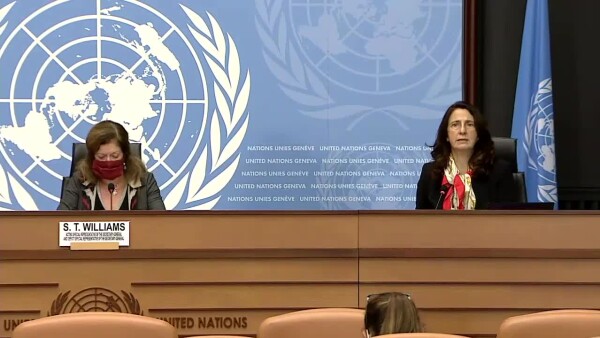
Peace talks aimed at ending almost a decade of chaos in Libya reached agreement on a permanent ceasefire on Friday. Five senior officers from the Government of National Accord (GNA) in Tripoli and five from the opposition Libyan National Army (LNA) signed the deal after talks mediated by Stephanie Williams, the head of the UN Support Mission in Libya (UNSMIL).
“Today is a good day for the Libyan people,” Williams told a press conference in Geneva. “At 11.15 am this morning here in the UN headquarters in Geneva, the two Libyan delegations to the 5+5 Joint Military Commission talks signed a complete, countrywide, and permanent ceasefire agreement with immediate effect.”
The oil-rich country has been divided and beset by conflict since the overthrow of former dictator Muammar Gaddafi in 2011, and the two rival administrations have effectively split the country, with the GNA holding Tripoli and the LNA controlling large areas of the east and laying siege to the capital for months.
“The parties agreed that all military units and armed groups on the frontlines shall return to their camps. This shall be accompanied by the departure of all mercenaries and foreign fighters from all Libyan territories -- land, air and sea -- within a maximum period of three months from today. The ceasefire does not apply to UN-designated terrorist groups,” Williams said.
The ceasefire also followed a call from UN Secretary-General Antonio Guterres for ceasefires in conflicts globally during the global Coronavirus pandemic, she added.
The parties involved needed the international community and the UN Security Council to support the agreement, she said, including by respecting the principle of non-interference in Libya’s internal affairs.
“We need to appeal to countries involved, particularly those who are interfering directly in the conflict, particularly those who are blatantly violating the arms embargo, that it is time to listen to the Libyans themselves. Libya is for the Libyans. And they now want to come together to rebuild their country, to end this long state of crisis and division, to rebuild their institutions. It is incumbent on the international community to support them in this effort.”
The parties to the deal also agreed to start identifying and categorising members of armed groups and reintegrating Libyan nationals into state institutions, while foreign fighters from both sides should leave within three months.
“The issue of the presence of foreign fighters and mercenaries is not an issue that is monopolised by one side of this conflict. There are mercenaries from I would say seven, eight, maybe nine countries on the ground. So it is incumbent on all those responsible for the insertion of mercenaries into Libya, within the calendar that has been agreed to by the Libyans themselves, to withdraw these forces and to respect and implement the will of the Libyan parties.”
The peace deal opens the way for a resumption of flights between Tripoli and Benghazi, and Libya’s oil installations at Ras Lanuf and Sidra should be able to resume production in the very near future.
It also includes measures to curb hate speech and incitement of violence, to facilitate the exchange of detainees, and to support restructuring of petroleum facilities guards. Political talks are expected to get underway in Tunis in the first week of November, Williams said.
Broad consultations with youth, women, mayors, political forces and representatives of minority communities had shown that Libyans were keen for change, she said.
“What I hear most clearly is a call for elections. Libyans want elections. Elections are the single most important means through which they can reassert their sovereignty and destiny. Free, fair, democratic elections where they are choosing their representatives, whether it’s the parliament or for the presidency. They would like to end the long transitional period that the country has suffered from. They are right to be sceptical about the introduction of another transitional period.”
SHOTLIST OF THE EDITED STORY
- Exterior wide shot, Palais des Nations flag alley, nations’ flags flying, a rainy day.
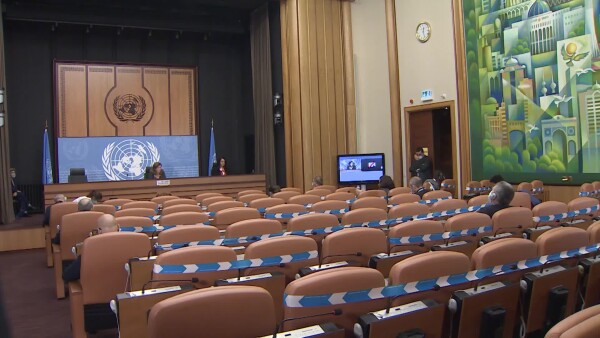
- Wide shot, podium with speakers in a near-empty Room XIV in line with COVID-19 distancing measures, Palais des Nations.
- SOUNDBITE (English) — Stephanie Williams, Acting Special Representative of the Secretary-General and Head of the United Nations Support Mission for Libya (UNSMIL): “Today is a good day for the Libyan people. At 11.15 am this morning here in the UN Headquarters in Geneva, the two Libyan delegations to the 5+5 Joint Military Commission talks signed a complete, countrywide, and permanent ceasefire agreement with immediate effect.”
- Medium shot, journalist typing on laptop with conference listening device, Room XIV, Palais des Nations.
- SOUNDBITE (English) — Stephanie Williams, Acting Special Representative of the Secretary-General and Head of the United Nations Support Mission for Libya (UNSMIL): “The ceasefire also responds to the Secretary General’s call for a global ceasefire and cessation of hostilities related to the COVID pandemic.”
- Medium shot, journalist typing on laptop with conference listening device, Room XIV, Palais des Nations.
- SOUNDBITE (English) — Stephanie Williams, Acting Special Representative of the Secretary-General and Head of the United Nations Support Mission for Libya (UNSMIL): “The parties agreed that all military units and armed groups on the frontlines shall return to their camps. This shall be accompanied by the departure of all mercenaries and foreign fighters from all Libyan territories -- land, air and sea -- within a maximum period of three months from today. The ceasefire does not apply to UN-designated terrorist groups.”
- Medium shot, journalist sitting in front of laptop, readjusting her mask, Room XIV, Palais des Nations.
- SOUNDBITE (English) — Stephanie Williams, Acting Special Representative of the Secretary-General and Head of the United Nations Support Mission for Libya (UNSMIL): “We need to appeal to countries involved, particularly those who are interfering directly in the conflict, particularly those who are blatantly violating the UN arms embargo, that it is time to listen to the Libyans themselves. Libya is for Libyans. And they now want to come together to rebuild their country, to end this long state of crisis and division, to rebuild their institutions. It is incumbent on the international community to support them in this effort.”
- Wide shot, TV camera in foreground and Room XIV to rear, Palais des Nations.
- SOUNDBITE (English) — Stephanie Williams, Acting Special Representative of the Secretary-General and Head of the United Nations Support Mission for Libya (UNSMIL): “So, the issue of presence of foreign fighters and mercenaries is not an issue that is monopolized by one side of this conflict. There are mercenaries from, I would say probably, seven, eight, maybe nine countries on the ground and it’s, so it is, you know, incumbent on all those responsible for the insertion of mercenaries into Libya to, within the calendar that has been agreed to by the Libyans themselves, to withdraw these forces and to respect and implement the will of the Libyan parties.”
- Medium shot, podium with speakers, Room XIV, Palais des Nations.
- SOUNDBITE (English) — Stephanie Williams, Acting Special Representative of the Secretary-General and Head of the United Nations Support Mission for Libya (UNSMIL): “What I hear most clearly is a call for elections. Libyans want elections. Elections are the single most important means through which they can reassert their sovereignty and destiny. Free, fair, democratic elections where they are choosing their representatives, whether the parliament or for the presidency. They would like to end the long transitional period that the country has suffered from. They are right to be skeptical about the introduction of another transitional period.”
- Close-up, hands typing on laptop, Room XIV, Palais des Nations.
- Medium shot, journalist taking notes, Room XIV, Palais des Nations.
- Medium shot, TV cameras in the back of Room XIV, Palais des Nations.
- Medium shot, podium with speakers, Room XIV, Palais des Nations.
- Close-up, TV camera filming the speaker, Room XIV, Palais des Nations.
- Wide shot, TV camera and UN staff members in foreground and podium to rear, Room XIV, Palais des Nations.
Similar Stories

1
1
1
Edited News | UNICEF , IFRC
Six weeks after Nepal’s deadly flooding disaster, communities are still struggling to rebuild their lives, but they will need sustained help as global warming increases the risk of another Himalayan catastrophe, the UN Children’s Fund (UNICEF) said on Friday.

1
1
1
Statements , Press Conferences | OHCHR

1
1
1
Press Conferences | UNHCR , UNICEF , IFRC , OHCHR , UN WOMEN , IOM , OCHA , WHO
UNHCR – ExCom Meeting, UNICEF – Nepal Recovery, IFRC – Flash Floods, WHO – Mental Health, IOM – South Sudan Floods, OCHA – DRC Humanitarian aid, UNHCR – Sahel Displacement, UNICEF – Yemen Update, IOM – Gaza Shelter, UN Women – Gaza Women, OHCHR – Arrests and detentions of Syrians by Israeli force

2
1
2
Press Conferences | UNCTAD
Presentation of the Trade and Developement Report 2026
Embargoed until 9 October 2026 at 11 a.m. (Geneva Time)
UNCTAD: UNCTAD’s flagship report finds that governments increasingly use industrial, trade, financial and technology policies to pursue economic and national security objectives. Market access and the ability to move into higher-value activities now depend more heavily on technology, finance and geopolitics.

1
1
1
Press Conferences | UPU
Release of the State of the Postal Sector Report 2026

1
1
1
Edited News | WHO
In suspected Russia plague death, testing and monitoring underway – WHO
The death of a lab worker in Russia’s Siberia region has sparked concerns about plague being the cause, the UN World Health Organization (WHO) said on Tuesday, adding that it was following the situation closely.
1
1
1
Press Conferences | IOM , ITU , UNECE , UNICEF , WHO , WMO
UNICEF: Ebola, DRC - children orphans or separating them from parents and caregivers; IOM: Humanitarian needs in Djibouti amid arrivals from Yemen and increased migrant movements; WHO: Darfur, scale of health needs far exceeds available resources; WMO co-sponsored Global Heat Forum, Bangkok, monthly Global Seasonal Climate Update; UNECE: UN Forum of Mayors; ITU Plenipotentiary Conference 2026; WHO: child and adolescent obesity guidelines and new global roadmap to tackle pregnancy hypertension, a leading cause of maternal mortality

1
1
Edited News | OHCHR , UNOG
UN Human Rights Chief Volker Türk on Friday provided and oral update to the 63rd session of the Human rights Council on Ukraine.

1
1
1
Edited News | OHCHR , UNOG
UN Human Rights Chief Volker Türk on Friday provided and oral update to the 63rd session of the Human rights Council on the human rights situation in Haiti.

1
1
1
Edited News | WHO
Repeated delays in bringing lifesaving medicines, prosthetics and more from Israel into Gaza risk having devastating consequences on Palestinians who urgently need them in the wartorn enclave, the UN World Health Organization (WHO) said on Friday. “A truck full of non-priority supplies or the right supplies arriving too late, doesn't save lives. That's the question that actually matters," said Dr Reinhilde Van De Weerdt, WHO Representative in the OPT.
1
1
1
Press Conferences | OCHA , UN WOMEN , UNHCR , WFP , WHO , WTO , UNEP
OCHA – $160M CERF allocation to 12 underfunded crises; UNHCR – 5.8M refugee children remain out of school amid funding cuts; UN Women – Middle East escalation and food security among women/girls; WHO – Gaza supplies and overall situation; WFP – Yemen food insecurity and impact on global hunger ; UNEP - First International Conference of the Global Framework on Chemicals in Geneva | 16-20 November 2026

1
1
1
Edited News | WHO
DRC: Early access to care and oxygen decisive for Ebola patients’ survival – WHO
In the Democratic Republic of the Congo (DRC), health workers fighting the country’s largest-ever Ebola outbreak are struggling to overcome critical challenges to patient care, the UN World Health Organization (WHO) warned on Tuesday.