

The United Nations Office at Geneva
Multimedia Newsroom
Yemen violence deepens concerns over child hunger crisis
Aid agencies in Yemen highlighted the growing hunger emergency sparked by renewed fighting between Houthi opposition forces and Government troops, after mobile health clinics reported that hundreds of children displaced by the violence are suffering from the most deadly form of malnutrition.
Of nearly 2,900 children screened in areas where there is safe humanitarian access, the UN Children’s Fund, UNICEF, said that more than one in four was acutely malnourished, while around 200 were sick with severe acute malnutrition.
“This is only a glimpse of how devastating the situation is across Yemen; every day we are seeing more and more cases,” said Akhil Iyer, the agency’s top official in the country.
Testimonies from some of the approximately 130,000 people who have fled clashes in the southwest illustrate how civilians have been severely impacted by the fighting in recent weeks, after years of food and nutrition crises.
“We spoke to Haifa, a young mother who fled Yemen's west coast as well, and she told us that the sounds of gunfire were closing in on her house, as her house was shaking. She told us that she didn't have time to think, she just knew that she had to run and run quickly with her family,” the UNICEF official said.
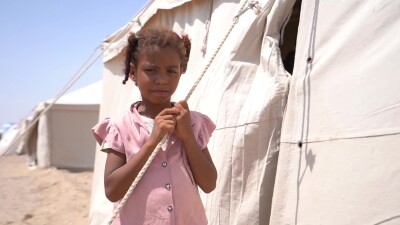
Today, Haifa and her family “live in extreme heat, in [one] a side of a tent”, in AlFirdos displacement camp near Aden. They have no way of earning money and they struggle to find food and medicine, Mr. Iyer explained. “She pointed out to us that displacement has stripped them of their dignity. This is in fact what displacement does.”
Briefing journalists from Aden, Mr. Iyer also described the plight of four-year-old Taha, who he found receiving treatment at a UNICEF-supported mobile clinic.
“His family had just fled violence in Mokha district, some 200 kilometres (124 miles) away, leaving behind their home and belongings. His mother told us, ‘We escaped with nothing. My only fear was that I would lose my son before finding help.’ Taha’s story is sadly not unique.”
Over the past three weeks, nearly 130,000 people in Yemen have been forced from their homes. That number includes an estimated 71,000 children. The majority have been uprooted in southwestern Taiz governorate where they are unable to move to safer areas “because of fighting, blocked roads, or lack of transportation”, Mr. Iyer continued.
Since 3 September, UNICEF has verified that at least 15 children have been killed and 14 injured, primarily by shelling attacks. Three more youngsters are still missing. “Behind every one of those children is a parent living through the unimaginable – grief, fear, or the agony of not knowing,” Mr. Iyer stressed.
Before the latest uptick in fighting, more than 2.2 million children under five in Yemen were projected to be acutely malnourished this year, with more than half a million suffering from severe acute malnutrition.
Providing healthcare for all those exhausted by repeated displacement is vitally important, particularly amid a spread of preventable diseases, including measles, acute respiratory infections, diarrhoea and cholera. But reaching communities with the highest health needs is becoming “increasingly difficult”, according to the UN World Health Organization (WHO).
In 90 of the 105 health-cluster priority districts in northern Yemen, “UN operations have been suspended”, explained the agency’s Amna Smailbegović. “The disruption has a direct impact on essential services, including outpatient consultation, skilled deliveries and child health services.”
For its part, UNICEF and other aid agencies do not have safe and unimpeded humanitarian access to between 65-70 per cent of children because the areas where they live are controlled by Houthi opposition forces.
ends
Story: Yemen update – UNICEF, WHO
SOURCE: UNTV CH
RESTRICTIONS: NONE
LANGUAGE: ENGLISH / NATS
ASPECT RATIO: 16:9
Duration: 4’06”
DATELINE: 25 September 2026 - GENEVA, SWITZERLAND & AlFirdos displacement camp near Aden, Yemen (please credit UNICEF) More broll available here: https://weshare.unicef.org/Share/aoqbg65bq221k7i4s52t7y82q13ty26s
Speakers:
- Akhil Iyer, Country Representative in Yemen, UNICEF, Aden
- Amna Smailbegović, WHO
SHOTLIST
- Exterior medium shot, UN flag alley, UN Geneva.
- Wide, Press Room, podium moderator, journalists.
- SOUNDBITE (English) – Akhil Iyer, Country Representative in Yemen, UNICEF, from Aden: “Absolutely, we are seeing an uptick in acute malnutrition among children, including the worst form, which is severe acute malnutrition. So, every day we are seeing more and more cases in these mobile and health and nutrition clinics that we've set up, not just around Aden, but in all accessible areas where IDPs have arrived and where we can assist them.”
- Wide, Press Room podium speaker and remote speaker on TV screen.
- SOUNDBITE (English) – Akhil Iyer, Country Representative in Yemen, UNICEF, from Aden: “We spoke to Haifa, a young mother who fled Yemen's west coast as well, and she told us that the guns, the sounds of gunfire were closing in on her house, as her house was shaking. She told us that she didn't have time to think, she just knew that she had to run and run quickly with her family.”
- Medium, Press Room, podium moderator.
- SOUNDBITE (English) – Akhil Iyer, Country Representative in Yemen, UNICEF, from Aden: “Today, she and her family live in extreme heat in [one] side of a tent with no source of income and they are struggling for food and medicine.”
- Wide, Press Room, remote speaker on TV screens, participants.
- SOUNDBITE (English) – Akhil Iyer, Country Representative in Yemen, UNICEF, from Aden: “In the past weeks, some nearly 2,900 children have been screened by UNICEF mobile nutrition teams in areas where we have safe humanitarian access. And more than one in four of these children are acutely malnourished. And some 200 had the very serious condition of severe acute malnutrition; and this is only a glimpse of how devastating the situation is across Yemen.”
- Medium, control booth.
- SOUNDBITE (English) – Akhil Iyer, Country Representative in Yemen, UNICEF, from Aden: “The journey in Yemen is extremely harsh, it's extremely arduous. So, it’s, they are much more vulnerable to the effects of the conflict, which are forced displacement. And their chances of surviving it and overcoming their dire state of acute - often severe acute malnutrition - is lessened with each movement, with each forced displacement.”
- Wide, Press Room podium moderator, external speaker on TV screen.
- SOUNDBITE (English) – Amna Smailbegović, WHO: “The areas with some of the highest health needs are increasingly difficult to reach. [In] 90 of the 105 health clusters priority districts in the north, the UN operations have been suspended. The disruption has a direct impact on essential services, including outpatient consultation, skilled deliveries and child health services.”
- Wide, Press Room.
- SOUNDBITE (English) – Akhil Iyer, Country Representative in Yemen, UNICEF, from Aden: “Over the past three weeks, some nearly 130,000 people, including 71,000 children, have been forced from their homes due to the conflict. The majority are displaced from within the southern-western governorate of Taiz and they have been unable to move to safer areas often because of fighting, blocked roads or lack of transportation.”
- Wide, AlFirdos displacement camp near Aden.
- Wide, a family outside a tent at the camp.
- Medium-wide, a young girl holding onto a guy rope.
- Wide, a line of tents on scrubland.
- Children gathering outside a tent.
- Women and children walking along gravel path.
- A young girl sitting with empty bottles of water.
Similar Stories

1
1
1
Edited News | OCHA , UNICEF , WFP
Aid agencies warned on Friday of the fast-developing humanitarian emergency inside Taiz City in Yemen, which has been encircled by de facto Houthi forces fighting government troops along the country’s west coast.

2
17
1
2
Edited News , Press Conferences , Images | OCHA , WMO
Two UN agencies teamed up on Wednesday to issue an appeal for immediate assistance to help communities already being impacted by the strongest El Niño on record.

3
16
2
2
Edited News , B-roll , Conferences , Images | UNITED NATIONS , UNOG
Sixth Consultative Meeting on Enhancing Coordination of Peace Initiatives and Efforts for Sudan

1
1
1
Edited News | UNICEF , WHO , UNHCR
Yemen war continues to force families from homes amid hunger and disease
More than 250,000 people have now fled renewed fighting in Yemen, the UN said on Tuesday, citing particular concern for those sheltering in the southwestern city of Taiz and the wider governorate, where access is “essentially blocked”.

1
1
1
Edited News | UNICEF
A little over one year since a ceasefire agreement was announced between Hamas fighters and Israel, more than 340 children have been reported killed and hundreds more injured, the UN Children’s Fund, UNICEF, said on Friday.

1
1
1
Edited News | UNICEF , IFRC
Six weeks after Nepal’s deadly flooding disaster, communities are still struggling to rebuild their lives, but they will need sustained help as global warming increases the risk of another Himalayan catastrophe, the UN Children’s Fund (UNICEF) said on Friday.

1
1
1
Edited News | WHO
In suspected Russia plague death, testing and monitoring underway – WHO
The death of a lab worker in Russia’s Siberia region has sparked concerns about plague being the cause, the UN World Health Organization (WHO) said on Tuesday, adding that it was following the situation closely.

1
1
Edited News | OHCHR , UNOG
UN Human Rights Chief Volker Türk on Friday provided and oral update to the 63rd session of the Human rights Council on Ukraine.

1
1
1
Edited News | OHCHR , UNOG
UN Human Rights Chief Volker Türk on Friday provided and oral update to the 63rd session of the Human rights Council on the human rights situation in Haiti.

1
1
1
Edited News | WHO
Repeated delays in bringing lifesaving medicines, prosthetics and more from Israel into Gaza risk having devastating consequences on Palestinians who urgently need them in the wartorn enclave, the UN World Health Organization (WHO) said on Friday. “A truck full of non-priority supplies or the right supplies arriving too late, doesn't save lives. That's the question that actually matters," said Dr Reinhilde Van De Weerdt, WHO Representative in the OPT.

1
1
1
Edited News | WHO
DRC: Early access to care and oxygen decisive for Ebola patients’ survival – WHO
In the Democratic Republic of the Congo (DRC), health workers fighting the country’s largest-ever Ebola outbreak are struggling to overcome critical challenges to patient care, the UN World Health Organization (WHO) warned on Tuesday.

1
1
1
Edited News | OCHA , UN
Civilians in Iran are continuing to feel the consequences of months of conflict and military escalation, the UN’s top official in the country has said, as loss of life, damage to civilian infrastructure and mounting economic pressures leave many facing continued uncertainty.