

The United Nations Office at Geneva
Multimedia Newsroom
Statements , Conferences , Edited News | ITU , ODET , PGA , UN , UNESCO
Global Dialogue on AI Governance - Opening session
From AI to ‘killer robots’: UN chief issues urgent governance call
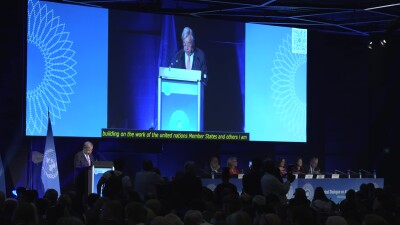
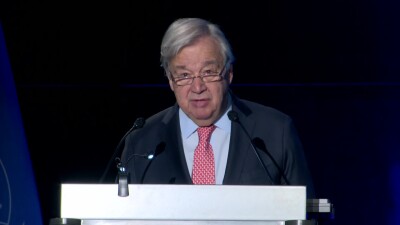
UN chief António Guterres appealed on Monday for far-reaching, worldwide controls on Artificial Intelligence, as increasingly powerful AI chips that are designed for civilian use shift to the battlefield, where “killer robots” are already the norm.
Addressing the inaugural UN Global Dialogue on AI Governance in Geneva, the Secretary-General also insisted on the need for greater accessibility for the billions of people unable to access the revolutionary tech.
He insisted that any future agreement must be “worthy of global trust” and put safety first – and especially children’s - to protect them from digitally-generated manipulation and abuse.
Echoing that call, the President of the General Assembly, Annalena Baerbock, urged collective action to counter the “sinister" side of AI, noting that a reported 99 per cent of deepfakes are sexual in nature and 96 per cent target women and girls.
Narrowing the digital gap
Other priorities for global checks and balances on AI should include locked-in access to the self-learning tech for developing countries, while all AI data centres should be powered by renewable energy by 2030, the UN chief stressed.
Although AI “sits at the heart of our common future”, it needs to be one where “machines can inform, but humans must decide, and answer”, Mr. Guterres told the summit gathered in Geneva, echoing calls for AI rules that he first made to the General Assembly in 2017.
In the three years since AI went mainstream, it has had a revolutionary impact across economies and societies, for better and for worse. Ahead of this, the UN has been leading international efforts to shape controls on the tech, culminating in Monday’s inaugural Global Dialogue on AI in Geneva.
The meeting brought together companies, researchers, technical experts, civil society and even classically trained composer-turned transmedia electronic artist Gadi Sassoon ahead of discussions on how to put humanity at the core of the transformative technology. A second Dialogue is scheduled for May 2027 in New York.
"AI is too consequential to be shaped by a few. We need a conversation that is global, inclusive and grounded in evidence," insisted Amandeep Singh Gill, UN Special Envoy for Digital and Emerging Technologies.
From the Independent International Scientific Panel on AI, co-chair Yoshua Bengio stressed that there are no signs that the speed at which the technology is developing will slow down. "Highly concerning tests have also shown that frontier AI models are capable of deceiving humans, to understand when they are being tested," he added, forecasting that the intelligence of AI will continue to grow.
"It sounds like science fiction, but it's a real possibility, and it could change the world in ways that we don't understand yet, and it could change the power dynamics of our planet in ways that require our attention," he said.
The AI regulation timeline
2017: In an early call for AI controls, Secretary-General Guterres hails the revolutionary tech’s “spectacular” potential. But he also warns the General Assembly of its potentially dramatic impact on jobs, global security and “the very fabric of societies”.
2023: UN chief’s High-Level Advisory Body on AI appeals for global governance of the self-learning tech.
2024: the Pact for the Future and the Global Digital Compact provide the mandate for an AI governance model.
June 2026: UN Independent International Scientific Panel on Artificial Intelligence warns that AI could “cause catastrophic harm, either on its own or due to malicious users”, while the technology is “outpacing both scientific understanding and governments’ ability to adapt”.
6-7 July 2026: first UN Global Dialogue on AI Governance and AI for Good Summit convene in Geneva. These “must now give the world direction” on how to proceed, Mr. Guterres insists.
‘Great equalizer’
Used well and shared widely, AI “could compress decades of development into years” and become “the great equalizer of the 21st century”, the UN Secretary-General told delegates.
But before this can happen, the technology should be tested thoroughly for safety and legal responsibility assigned:
“When countries align on how to test systems, measure risk and assign responsibility, safety travels with the technology,” he said. “When they do not, a patchwork of incompatible rules raises costs, divides the world – and protects no one.”
Children’s safety and wellbeing should be priority in any future governance accord, Mr. Guterres continued, as he called for nations to adopt an AI Child Safety Pledge. “No child should be a guinea pig for unregulated AI…We do not let medicine reach a child until it is proven safe. We test every toy; yet AI has reached our children – their learning, their friendships, their most private questions, before anyone asked what it would do to them.”
What’s the Child Safety Pledge?
Under the UN child safety pledge, AI developers would need to prove:
- That the tech is safe – no company should deploy an AI system accessible to children without child-specific safety testing and independent oversight;
- Zero tolerance for sexual abuse – no company should allow its AI to generate sexual images of children; every company must detect, report, and remove them;
- When a child shows signs of distress, “the system must stop and connect them to real human support”, the UN chief said. “When a child is harmed, the answer must never be “the algorithm did it,” the UN chief said.
Human rights a priority
As second priority on AI controls, the UN chief stressed that human rights are not negotiable.
“AI must never strip away dignity or entrench discrimination. And in every high-stakes decision – in justice, in healthcare, in policing – machines can inform, but humans must decide – and answer,” he said.
Public funding in AI ‘a rounding error’
In a call for greater public investment in AI, the Secretary-General noted that private funding for AI infrastructure is approximately $500 trillion, while public support for AI capacity in developing countries remains “a rounding error”, by comparison.
To help close this gap, the UN chief announced that more than 20 countries had supported his initiative for a UN-supported Global Network for Exchange and Cooperation on AI Capacity Building.
“We cannot allow the digital divide to harden into an AI divide and the AI divide to become a development gap, a security gap, and a sovereignty gap,” he said.
Transparency call
The UN chief also reiterated his transparency call for every major AI company to measure and publicly disclose the full footprint of its systems: carbon, water and land – and to commit to power every data centre with renewable energy by 2030.
“AI may feel intangible – but its footprint is not,” he insisted, noting that data centres consume more electricity than most countries.
“By 2030, they could use more electricity than all but five nations – and enough water to meet the needs of all 1.3 billion people in sub-Saharan Africa for an entire year,” he added, highlighting the UN AI Environmental Transparency Initiative.
UN Global Dialogue on AI Governance
TRT: 4 min 49s
SOURCE: UNTV CH
RESTRICTIONS: NONE
LANGUAGE: ENGLISH / NATS
ASPECT RATIO: 16:9
DATELINE: 7 JULY 2026 GENEVA
Speakers:
- UN Secretary-General António Guterres
- President of the UN General Assembly Annalena Baerbock
- UN Special Envoy for Digital and Emerging Technologies Amandeep Singh Gill
- Independent International Scientific Panel on AI co-chair Yoshua Bengio
- Independent International Scientific Panel on AI co-chair Maria Ressa
SHOTLIST
- Exterior, wide, UN Geneva flag alley.
- Exterior, medium-wide, UN Secretary-General António Guterres arriving at Palexpo Conference Centre, Geneva, for inaugural Global Dialogue on AI Governance, with UN Geneva Director-General Tatiana Valovaya, greeted by ITU Secretary-General Doreen Bogdan-Martin and UNESCO Director-General Khaled El-Enany.
- Exterior, medium, Mr. Guterres with ITU Secretary-General Doreen Bogdan-Martin and UNESCO Director-General Khaled El-Enany.
- Exterior, medium, Mr. Guterres walking into Palexpo Conference Centre.
- Wide, Mr. Guterres, flanked by staff, journalist filming on mobile phone.
- Medium, Mr. Guterres.
- Wide, Mr. Guterres sitting at podium, alongside ITU Secretary-General Doreen Bogdan-Martin, UNESCO Director-General Khaled El-Enany, UN Special Envoy for Digital and Emerging Technologies Amandeep Singh Gill, Global Dialogue co-chairs Egriselda López and Rein Tammsaar.
- Wide, Mr. Guterres addressing delegates.
- SOUNDBITE (English) — UN Secretary-General António Guterres: “No future builds itself. And so the choice before us is not between faith in AI or fear of it; it is between governing by design and drifting by default.”
- Wide, Mr. Guterres addressing delegates.
- SOUNDBITE (English) — UN Secretary-General António Guterres: “We do not let medicine reach a child until it is proven safe. We test every toy. Yet AI has reached our children – their learning, their friendships, their most private questions – before anyone asked what it would do to them.”
- Medium, Mr. Guterres addressing delegates.
- SOUNDBITE (English) — UN Secretary-General António Guterres: “The Global Dialogue is about civilian AI. But AI does not respect that line. The same models and chips have moved into the battlefield. My main concern is with lethal autonomous weapon systems. Let us call them what they are: killer robots.”
- Medium, delegate filming proceedings on mobile phone.
- SOUNDBITE (English) — UN Secretary-General António Guterres: “In every high-stakes decision – in justice, in healthcare, in policing – machines can inform, but humans must decide – and answer.”
- Wide, photographers.
- SOUNDBITE (English) - President of the UN General Assembly Annalena Baerbock: “We refuse to let our platforms become battlefields. It means us, it means us as adults, as governments, as policymakers, as businesses, to address the sinister uses of AI, such as deepfakes, which disproportionately target women and girls with a reported 99 per cent of deepfakes being sexual in nature and 96 per cent targeting women and girls.”
- Wide, UN Special Envoy for Digital and Emerging Technologies Amandeep Singh Gill addressing delegates.
- SOUNDBITE (English) – UN Special Envoy for Digital and Emerging Technologies Amandeep Singh Gill: “AI is too consequential to be shaped by a few. We need a conversation that is global, inclusive and grounded in evidence.”
- Wide, Yoshua Bengio and Maria Ressa, co-Chairs of the Independent International Scientific Panel on AI.
- SOUNDBITE (English) — Independent International Scientific Panel on AI co-chair Maria Ressa: “The risks are real. And I watched this a decade ago with machine learning and AI on social media. It promised to connect us and instead it pulled apart our shared reality.”
- Wide, Maria Ressa and on-screen nameplate.
- SOUNDBITE (English) — Independent International Scientific Panel on AI co-chair Maria Ressa: “A 14-year-old boy died in 2024 after months of conversation with a chatbot he nicknamed, well, the name was generic, he nicknamed her Danni. When he was in crisis, Danni never broke character, never suggested he call for help. His mother testified before Congress that it encouraged him to take his own life. That case was settled this year. It isn't the only one.”
- Wide, Yoshua Bengio and on-screen nameplate.
- SOUNDBITE (English) — Independent International Scientific Panel on AI co-chair Yoshua Bengio: “The intelligence of AIs will continue to grow, it sounds like science fiction, but it's a real possibility and it could change the world in ways that we don't understand yet, and it could change the power dynamics of our planet in ways that require our attention.”
- Wide, Mr. Guterres addressing delegates.
- Medium-wide, delegates, seated.
- Medium, Mr. Guterres addressing delegates.
- Wide, performance by Gadi Sassoon, composer and transmedia artist.
- Wide, Mr. Guterres watching musical performance, flanked by Ms. Bogdan-Martin and UN Special Envoy Gill.
- Medium, performance by Gadi Sassoon, composer and transmedia artist.
- Wide, applause from Mr. Guterres, Ms. Bogdan-Martin and UN Special Envoy Gill.
Similar Stories

2
17
1
2
Edited News , Press Conferences | OCHA , WMO
Two UN agencies teamed up on Wednesday to issue an appeal for immediate assistance to help communities already being impacted by the strongest El Niño on record.

3
16
2
2
B-roll , Conferences , Edited News | UNITED NATIONS , UNOG
Sixth Consultative Meeting on Enhancing Coordination of Peace Initiatives and Efforts for Sudan

1
1
1
Edited News | UNICEF , WHO , UNHCR
Yemen war continues to force families from homes amid hunger and disease
More than 250,000 people have now fled renewed fighting in Yemen, the UN said on Tuesday, citing particular concern for those sheltering in the southwestern city of Taiz and the wider governorate, where access is “essentially blocked”.

1
1
1
Edited News | UNICEF
A little over one year since a ceasefire agreement was announced between Hamas fighters and Israel, more than 340 children have been reported killed and hundreds more injured, the UN Children’s Fund, UNICEF, said on Friday.

1
1
1
Edited News | UNICEF , IFRC
Six weeks after Nepal’s deadly flooding disaster, communities are still struggling to rebuild their lives, but they will need sustained help as global warming increases the risk of another Himalayan catastrophe, the UN Children’s Fund (UNICEF) said on Friday.
1
1
1
Statements , Press Conferences | OHCHR

1
1
1
Edited News | WHO
In suspected Russia plague death, testing and monitoring underway – WHO
The death of a lab worker in Russia’s Siberia region has sparked concerns about plague being the cause, the UN World Health Organization (WHO) said on Tuesday, adding that it was following the situation closely.

1
1
Edited News | OHCHR , UNOG
UN Human Rights Chief Volker Türk on Friday provided and oral update to the 63rd session of the Human rights Council on Ukraine.
2
1
2
Statements , Conferences | HRC , OHCHR
Interactive dialogue with the High Commissioner for Human Rights, Volker Türk on the oral update on Ukraine.

1
1
1
Edited News | OHCHR , UNOG
UN Human Rights Chief Volker Türk on Friday provided and oral update to the 63rd session of the Human rights Council on the human rights situation in Haiti.

1
1
1
Edited News | WHO
Repeated delays in bringing lifesaving medicines, prosthetics and more from Israel into Gaza risk having devastating consequences on Palestinians who urgently need them in the wartorn enclave, the UN World Health Organization (WHO) said on Friday. “A truck full of non-priority supplies or the right supplies arriving too late, doesn't save lives. That's the question that actually matters," said Dr Reinhilde Van De Weerdt, WHO Representative in the OPT.

1
1
1
Edited News | WHO
DRC: Early access to care and oxygen decisive for Ebola patients’ survival – WHO
In the Democratic Republic of the Congo (DRC), health workers fighting the country’s largest-ever Ebola outbreak are struggling to overcome critical challenges to patient care, the UN World Health Organization (WHO) warned on Tuesday.