

The United Nations Office at Geneva
Multimedia Newsroom
Ebola in DRC: first month of outbreak sees record number of cases – UN humanitarians
Ebola has been spreading at unprecedented speed in the eastern Democratic Republic of the Congo (DRC), bringing risk and fear into people’s daily lives, UN humanitarians said on Tuesday.
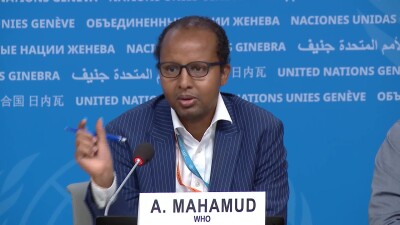
Dr Abdirahman Mahamud, Director, Health Emergency Alert and Response Operations at the World Health Organization (WHO), who returned last week from one month in the DRC, said that as of Monday, there are 1,048 confirmed cases reported, of which 267 deaths.
“This is the largest number of confirmed cases in the first month of an Ebola disease outbreak in Africa,” he said.
During the current outbreak due to the Bundibugyo species of Ebola virus, declared on 15 May, it only took 37 days to reach 250 deaths, Dr Mahamud explained, while in comparison, it took 78 days to reach that number in the 2014 and 2016 West Africa outbreak, and 130 days in the 2018-2019 outbreak.
Ugochi Daniels, Deputy Director General for Operations at the UN International Organization for Migration (IOM), highlighted the dramatic impact of the disease on families, who are carrying “immense burdens”.
“Everyday life has become fraught with risk,” she insisted. “The journey to feed your family or earn a living can also become a journey into danger.”
The virus has become “more than a health crisis,” she explained. “It touches every aspect of daily life, bringing uncertainty and fear.”
Ms. Daniels said that the outbreak is “centered on areas where people cross borders every day.” An effective response therefore requires maintaining surveillance as formal and informal cross-border movements continue, she explained, among communities affected by conflict and insecurity.
Since the start of the response, IOM and partners have screened over a million travelers “at key points of entry and along major mobility corridors”, she said.
The IOM official said that out of $55.8 million required to support cross-border coordination and surveillance across 11 countries over the next six months a funding gap of some $35 million remains.
“What is needed in order for us to get ahead of the outbreak is a collective commitment to ensure that the effort is now fully resourced,” she insisted.
WHO’s Dr Mahamud noted encouraging signs that the response has been expanding to keep pace with the spread.
The number of treatment beds has increased over the last two weeks, “going from a handful to over 500 beds across 19 health zones,” he said.
At the same time, surveillance has been scaled up, with laboratory capacity going from 30 tests a day in Kinshasa at the start of the outbreak to over 2,000 tests per day through a network of eight decentralized labs across Ituri, North Kivu and South Kivu.
Paolo Cravero, Senior Officer, Communications and Media Relations at the International Federation of the Red Cross and Red Crescent Societies (IFRC), highlighted safe and dignified burials as another pillar of the response. IFRC has been delivering dedicated kits and body bags to the affected areas despite their remote location and security challenges, he said.
“Like in any crisis, any outbreak, such as Ebola, the tension tends to grow,” Mr. Cravero stressed. “And we have seen violence against our volunteers at [safe and dignified burial] sites.”
The IFRC spokesperson highlighted “a lack of trust in the response,” insisting that the organization is “working hard with communities to bridge that gap.”
“Rumour and misinformation are creating some difficulties,” he acknowledged.
-ends-
STORY Ebola DRC update – WHO, IOM, IFRC
TRT: 2:38’’
SOURCE: UNTV CH
RESTRICTIONS: NONE
LANGUAGE: ENGLISH/NATS
ASPECT RATIO: 16:9
DATELINE: 23 JUNE 2026 GENEVA, SWITZERLAND
1. Exterior wide shot: Palais des Nations, Flag Alley.
2. Medium shot: Speakers at the podium of the press conference.
3. SOUNDBITE (English) – Dr Abdirahman Mahamud, Director, Health Emergency Alert and Response Operations, World Health Organization (WHO): “As of yesterday, there are 1,048 confirmed cases reported, of which 267 deaths. This is the largest number of confirmed cases in the first month of an Ebola disease outbreak in Africa. It took 78 days to reach 250 deaths during the 2014 and 2016 West Africa outbreak. In the previous outbreak, 2018-19, it took 130 days, but for this outbreak, it only took 37 days.”
4. Medium-wide shot: Journalists in the Press room; speaker on screens.
5. SOUNDBITE (English) – Ugochi Daniels, Deputy Director General for Operations, International Organization for Migration (IOM): “In the Eastern Democratic Republic of the Congo, everyday life has become fraught with risk. The journey to feed your family or earn a living can also become a journey into danger. Families are carrying immense burdens. The virus has become more than a health crisis. It touches every aspect of daily life, bringing uncertainty and fear.”
6. Medium reverse shot: Speakers at the podium of the press conference; speaker on screens; journalists in the Press room.
7. SOUNDBITE (English) – Dr Abdirahman Mahamud, Director, Health Emergency Alert and Response Operations, World Health Organization (WHO): “The number of treatment beds has increased over the last two weeks, going from a handful to over 500 beds across 19 health zones. I visited several centres, saw the partners working with the local health workers, saw various sick patients and those who had recovered.”
8. Wide reverse shot: Speakers at the podium of the press conference; speaker on screens; journalists in the Press room.
9. SOUNDBITE (English) – Dr Abdirahman Mahamud, Director, Health Emergency Alert and Response Operations, World Health Organization (WHO): “Surveillance has been scaled up, and the laboratory capacity has gone from 30 tests a day at the start of this outbreak in Kinshasa to now over 2,000 tests per day through a network of eight decentralized labs across Ituri, North Kivu and South Kivu.”
10. Medium-shot: Journalists in the Press room; speaker on screens.
11. SOUNDBITE (English) – Paolo Cravero, Senior Officer, Communications and Media Relations, International Federation of the Red Cross and Red Crescent Societies (IFRC): “Like in any crisis, any outbreak, such as Ebola, the tension tends to grow. And we have seen violence against our volunteers at SDB [safe and dignified burial] sites. And that is because, as we discussed last week and has been discussed in other occasions, there is a lack of trust in the response, and we're working hard with communities to bridge that gap.”
12. Various shots: Journalists in the Press room.
Similar Stories

2
17
1
2
Edited News , Press Conferences | OCHA , WMO
Two UN agencies teamed up on Wednesday to issue an appeal for immediate assistance to help communities already being impacted by the strongest El Niño on record.

3
16
2
2
B-roll , Conferences , Edited News | UNITED NATIONS , UNOG
Sixth Consultative Meeting on Enhancing Coordination of Peace Initiatives and Efforts for Sudan

1
1
1
Edited News | UNICEF , WHO , UNHCR
Yemen war continues to force families from homes amid hunger and disease
More than 250,000 people have now fled renewed fighting in Yemen, the UN said on Tuesday, citing particular concern for those sheltering in the southwestern city of Taiz and the wider governorate, where access is “essentially blocked”.

1
1
1
Edited News | UNICEF
A little over one year since a ceasefire agreement was announced between Hamas fighters and Israel, more than 340 children have been reported killed and hundreds more injured, the UN Children’s Fund, UNICEF, said on Friday.

1
1
1
Edited News | UNICEF , IFRC
Six weeks after Nepal’s deadly flooding disaster, communities are still struggling to rebuild their lives, but they will need sustained help as global warming increases the risk of another Himalayan catastrophe, the UN Children’s Fund (UNICEF) said on Friday.

1
1
1
Edited News | WHO
In suspected Russia plague death, testing and monitoring underway – WHO
The death of a lab worker in Russia’s Siberia region has sparked concerns about plague being the cause, the UN World Health Organization (WHO) said on Tuesday, adding that it was following the situation closely.

1
1
Edited News | OHCHR , UNOG
UN Human Rights Chief Volker Türk on Friday provided and oral update to the 63rd session of the Human rights Council on Ukraine.

1
1
1
Edited News | OHCHR , UNOG
UN Human Rights Chief Volker Türk on Friday provided and oral update to the 63rd session of the Human rights Council on the human rights situation in Haiti.

1
1
1
Edited News | WHO
Repeated delays in bringing lifesaving medicines, prosthetics and more from Israel into Gaza risk having devastating consequences on Palestinians who urgently need them in the wartorn enclave, the UN World Health Organization (WHO) said on Friday. “A truck full of non-priority supplies or the right supplies arriving too late, doesn't save lives. That's the question that actually matters," said Dr Reinhilde Van De Weerdt, WHO Representative in the OPT.

1
1
1
Edited News | WHO
DRC: Early access to care and oxygen decisive for Ebola patients’ survival – WHO
In the Democratic Republic of the Congo (DRC), health workers fighting the country’s largest-ever Ebola outbreak are struggling to overcome critical challenges to patient care, the UN World Health Organization (WHO) warned on Tuesday.

1
1
1
Edited News | OCHA , UN
Civilians in Iran are continuing to feel the consequences of months of conflict and military escalation, the UN’s top official in the country has said, as loss of life, damage to civilian infrastructure and mounting economic pressures leave many facing continued uncertainty.
1
1
1
Edited News | WHO , UNICEF
Aid agencies in Yemen highlighted the growing hunger emergency sparked by renewed fighting between Houthi opposition forces and Government troops, after mobile health clinics reported that hundreds of children displaced by the violence are suffering from the most deadly form of malnutrition.