

The United Nations Office at Geneva
Multimedia Newsroom
Hottest summer on record in north fuels concerns over wildfire destruction on US west coast
The northern hemisphere has just had its hottest summer and warmest August on record, the World Meteorological Organization (WMO) said on Tuesday, amid searing conditions that have contributed to devastating wildfires on the US west coast.
“The northern hemisphere just had its hottest summer on record,” said Clare Nullis, WMO spokesperson.
“It also had its hottest August on record; this is according to figures which released last night by the US National Oceanic and Atmospheric Administration (NOAA).”
Data indicates that from June to August, temperatures were 2.11 degrees Fahrenheit (1.17 degrees Celsius) above average.
This surpasses previous warmest periods in 2016 and 2019, Ms. Nullis said, adding that the five warmest summers for the northern hemisphere have occurred since 2015.
At a global level, August was the second warmest on record, the WMO spokesperson added, citing NOAA data, at 1.69F (0.94C) above the 20th-century average of 60.1F (15.6C): “August 2020 was the 44th consecutive August and the 428th consecutive month with temperatures above the 20th century average. The 10 warmest Augusts on record have all occurred since 1998.”
The 2020 fire season on the West Coast of the USA has also been record-breaking in its scale, with some 16,0000 firefighters involved in the effort to protect people and towns in California alone.
“The heat has contributed to a very, very destructive fire season,” Ms. Nullis said. “As we know, the states of California, Oregon and Washington have been worst-hit, entire neighbourhoods razed to the ground, forcing the evacuation of hundreds and thousands of people and tragically causing casualties.”
In addition to fatalities and destruction, the fires have impacted air quality for millions of people and turned skies orange, the UN agency warned. Satellite images show clouds of smoke billowing over the western Pacific and likely travelling more than 1,300 miles (2,092 kilometres).
Citing “red flag” conditions in northeastern California for much of this week, Ms. Nullis explained that this was the most dangerous threat level and that it is characterised by a combination of strong winds and tinder-dry conditions.
Of 41,599 fires recorded in the US so far this year, 36,383 were caused by human activity, the WMO spokesperson continued, with more than 2.5 million acres scorched across the United States.
California saw most individual blazes, with 7,072 human-caused fires reported, according to the US National Interagency Fire Center.
Ms. Nullis also warned that the US National Hurricane Center issued advisories for “no less than five” tropical cyclones over the Atlantic basin – tying with the record for the highest number of tropical cyclones there at one time.
The 2020 Atlantic hurricane season is so active that it is expected to exhaust the regular list of storm names, the WMO spokesperson said. “If this happens, the Greek alphabet will be used for only the second time on record,” she added.
- Exterior wide shot, Palais des Nations flag alley, nations’ flags flying, a beautiful day.
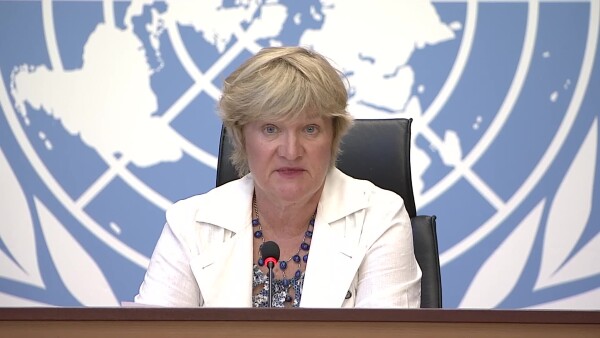
- Wide shot, podium with WMO spokesperson in a near-empty Room XIV in line with COVID-19 distancing measures, Palais des Nations.
- SOUNDBITE (English) — Clare Nullis, spokesperson, WMO (World Meteorological Organization): “The Northern hemisphere just had its hottest summer on record. It also had its hottest August on record; this is according to figures which released last night by the US National Oceanic and Atmospheric Administration.”
- Close-up, photographer taking picture between two chairs, Room XIV, Palais des Nations.
- SOUNDBITE (English) — Clare Nullis, spokesperson, WMO (World Meteorological Organization): “The heat has contributed to a very, very destructive fire season. As we know, the states of California, Oregon and Washington have been worst-hit, entire neighbourhoods razed to the ground, forcing the evacuation of hundreds and thousands of people and tragically causing casualties.”
- Close-up, fingers typing on laptop, Press Room XIV, Palais des Nations.
- SOUNDBITE (English) — Clare Nullis, spokesperson, WMO (World Meteorological Organization): “August 2020 was the 44th consecutive August and the 428th consecutive month with temperatures above the 20th century average. The 10 warmest Augusts on record have all occurred since 1998.”
- Medium shot, showing journalist with headphone typing on laptop in foreground and two journalists listening to rear, Room XIV, Palais des Nations.
- SOUNDBITE (English) — Clare Nullis, spokesperson, WMO (World Meteorological Organization): “On Monday, the US National Hurricane Center was issuing advisories for five, no less than five, tropical cyclones over the Atlantic basin. This ties the record for the most number of tropical cyclones in that basin at one time."
- Medium shot, journalists and UN Geneva staff sitting in Room XIV, Palais des Nations.
- Medium shot, podium with WMO spokesperson talking, Room XIV, Palais des Nations.
- Medium shot, journalist, masked, using listening device and holding laptop, another journalist to rear, Room XIV, Palais des Nations.
Similar Stories

1
1
1
Edited News | OCHA , UNICEF , WFP
Aid agencies warned on Friday of the fast-developing humanitarian emergency inside Taiz City in Yemen, which has been encircled by de facto Houthi forces fighting government troops along the country’s west coast.

2
17
1
2
Edited News , Press Conferences , Images | OCHA , WMO
Two UN agencies teamed up on Wednesday to issue an appeal for immediate assistance to help communities already being impacted by the strongest El Niño on record.

3
16
2
2
Edited News , B-roll , Conferences , Images | UNITED NATIONS , UNOG
Sixth Consultative Meeting on Enhancing Coordination of Peace Initiatives and Efforts for Sudan

1
1
1
Edited News | UNICEF , WHO , UNHCR
Yemen war continues to force families from homes amid hunger and disease
More than 250,000 people have now fled renewed fighting in Yemen, the UN said on Tuesday, citing particular concern for those sheltering in the southwestern city of Taiz and the wider governorate, where access is “essentially blocked”.

1
1
1
Edited News | UNICEF
A little over one year since a ceasefire agreement was announced between Hamas fighters and Israel, more than 340 children have been reported killed and hundreds more injured, the UN Children’s Fund, UNICEF, said on Friday.

1
1
1
Edited News | UNICEF , IFRC
Six weeks after Nepal’s deadly flooding disaster, communities are still struggling to rebuild their lives, but they will need sustained help as global warming increases the risk of another Himalayan catastrophe, the UN Children’s Fund (UNICEF) said on Friday.

1
1
1
Edited News | WHO
In suspected Russia plague death, testing and monitoring underway – WHO
The death of a lab worker in Russia’s Siberia region has sparked concerns about plague being the cause, the UN World Health Organization (WHO) said on Tuesday, adding that it was following the situation closely.

1
1
Edited News | OHCHR , UNOG
UN Human Rights Chief Volker Türk on Friday provided and oral update to the 63rd session of the Human rights Council on Ukraine.

1
1
1
Edited News | OHCHR , UNOG
UN Human Rights Chief Volker Türk on Friday provided and oral update to the 63rd session of the Human rights Council on the human rights situation in Haiti.

1
1
1
Edited News | WHO
Repeated delays in bringing lifesaving medicines, prosthetics and more from Israel into Gaza risk having devastating consequences on Palestinians who urgently need them in the wartorn enclave, the UN World Health Organization (WHO) said on Friday. “A truck full of non-priority supplies or the right supplies arriving too late, doesn't save lives. That's the question that actually matters," said Dr Reinhilde Van De Weerdt, WHO Representative in the OPT.

1
1
1
Edited News | WHO
DRC: Early access to care and oxygen decisive for Ebola patients’ survival – WHO
In the Democratic Republic of the Congo (DRC), health workers fighting the country’s largest-ever Ebola outbreak are struggling to overcome critical challenges to patient care, the UN World Health Organization (WHO) warned on Tuesday.

1
1
1
Edited News | OCHA , UN
Civilians in Iran are continuing to feel the consequences of months of conflict and military escalation, the UN’s top official in the country has said, as loss of life, damage to civilian infrastructure and mounting economic pressures leave many facing continued uncertainty.