

The United Nations Office at Geneva
Multimedia Newsroom
While world waits for details on Iran-US accord, UN calls for Hormuz aid corridor
As representatives of Iran and the United States reportedly prepared to sign a new peace agreement at the end of the week, the UN on Monday stressed the urgent need to open an aid corridor to transit the choked-off Strait of Hormuz and prevent a global hunger crisis.
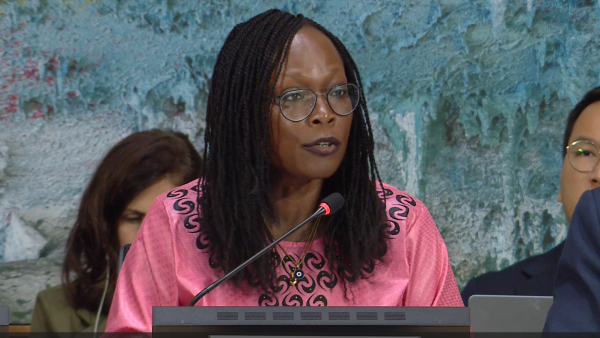
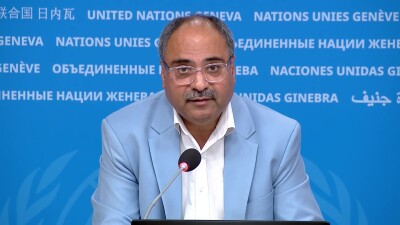
At the Human Rights Council in Geneva, deputy UN rights chief Awa Dabo stressed how disruption to shipping in the Gulf’s narrow strait and the US naval blockade on ships using Iranian ports had upended the world’s energy supply network.
The crisis has seriously impacted aviation and restricted humanitarian aid flows, causing a much broader crisis that continues to affect people across the region and beyond, with fertilizer shortages another deepening concern.
“Economists warn that unless the Strait is opened, some of the world's most vulnerable economies could be thrown into chaos, increasing poverty and hunger for millions,” Deputy High Commissioner Dabo said.
Bulwark against food crisis
Delivering an update on the fallout from the Iranian strikes against Bahrain, Kuwait, Oman, Qatar, Saudi Arabia, the United Arab Emirates and Jordan, she insisted that “at a bare minimum, specialised agencies, including the UN World Food Programme (WFP) and the UN Food and Agriculture Organization (FAO), must have the resources needed to prevent the projected global food security crisis”.
Also speaking at the Council, United Arab Emirates (UAE) Permanent Representative to the UN in Geneva, Jamal Al Musharakh, said he hoped that the “ongoing negotiations” on the Middle East crisis would bring an end to attacks.
Since 28 February, the UAE has been targeted by more than 3,000 “ballistic missile and cruise missile and drone attacks”, he noted.
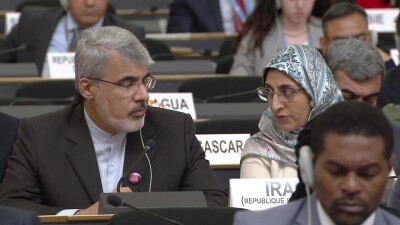
Questioning the credibility of the international human rights system in calling the debate, Iran’s Ambassador Ali Bahreini, insisted that his country had exercised its right to self-defence in line with international law, while Iranians faced “indiscriminate aerial bombardment”.
“If Iran ultimately accepted the ceasefire, despite its imperfections and subsequent challenges, it did so out of a profound sense of responsibility toward regional chiefs and collective security,” Mr. Bahreini said.
“We finally brought the war to an end so that we would never again have to hear the roar of advanced and indiscriminate weapons over schools and students,” he added.
Turk’s support for ‘fragile’ deal
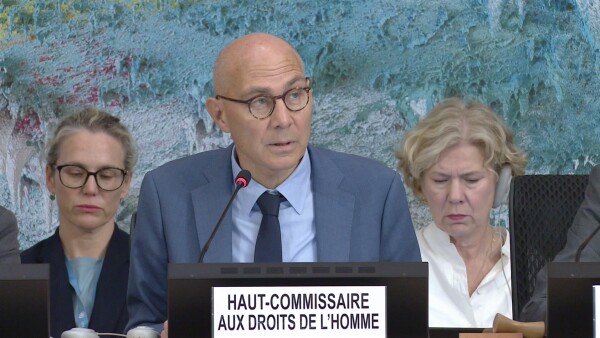
Earlier, UN human rights chief Volker Türk welcomed the reported peace agreement echoed and called on all parties to end hostilities and push for a lasting ceasefire.
“At this fragile moment, all sides need to exercise maximum restraint and work to consolidate the ceasefire and translate it into a comprehensive peace agreement,” Volker Türk said, addressing the Human Rights Council.
That appeal followed the UN Secretary-General’s comments welcoming the announcement as a “critical step” toward ending the conflict.
According to a statement issued by the UN chief’s Spokesman on Sunday, the agreement provides for an immediate and permanent ceasefire, the reopening of the Strait of Hormuz, and a framework for further negotiations.
The strategic strait is a key shipping lane through which about 20 per cent of the world’s oil and liquefied natural gas normally passes.
Seafarers’ plight
Also responding to the potential diplomatic breakthrough, the UN International Maritime Organization (IMO) said that it represented “an important step toward restoring safety in this vital maritime corridor for seafarers and ships, as well as safeguarding the fundamental principle of freedom of navigation”.
After the conflict began on 28 February with US and Israeli strikes across Iran, the Iranian military responded with attacks on Israel and US‑allied States in the Gulf. Lebanon’s people were also drawn into the war after Hezbollah fighters based in the country began firing at Israel.
In Iran alone, Israeli and US strikes have reportedly killed thousands of civilians, “including hundreds of children, and destroyed hospitals, schools, homes, and other infrastructure”, Mr. Türk told the Human Rights Council.
Highlighting the mass killing of mainly Iranian schoolchildren on the first day of the war, the UN rights chief called for the findings to be made public of the US investigation into the attack on Minab school which left more than 156 people dead.
- Exterior wide, UN Geneva flag alley.
- Wide, UN Human Rights Council, Geneva.
- SOUNDBITE (English) — Volker Türk, UN High Commissioner for Human Rights: “I welcome the announcement that the United States and Iran have agreed on a peace deal that provides for an immediate and permanent ceasefire, the reopening of the Strait of Hormuz and a framework for further negotiations. The conflict has had a devastating impact on human rights across the region and around the world. The last months have shown that the deep differences in the region cannot be resolved by military means.”
- Wide, podium speakers, UN Human Rights Council.
- SOUNDBITE (English) – UN Deputy High Commissioner Awa Dabo: “The priority must be an end to all armed attacks, a commitment to protect civilians and their infrastructure and strenuous efforts to move forward from the current ceasefire to a comprehensive and sustainable peace agreement. It is essential that all those involved in the blockade of maritime traffic restore the free flow of goods and energy supplies through the Strait of Hormuz immediately to prevent a global energy and food security catastrophe.”
- Wide, podium.
- SOUNDBITE (English) – UN Deputy High Commissioner Awa Dabo: “Until that time, we urge States to support the UN initiative to establish a humanitarian corridor to allow the unimpeded passage of food, medicines, fertilizers and essential goods through the Strait. At a bare minimum, specialized agencies, including WFP and FAO, must have the resources needed to prevent the projected global food security crisis.”
- Medium-wide, Iranian delegation.
- Medium-wide, Iranian delegation.
- SOUNDBITE (English) – Ali Bahreini, Permanent Representative of Iran to the UN in Geneva
- “We finally brought the war to an end so that we would never again have to hear the roar of advanced and indiscriminate weapons over schools and students, and so that mothers like who, months after the attack on the men of a school, still has found, has not found any trace of her child, would no longer be left waiting for the discovery of even fragments of their children's remains.”
- Medium-wide, UAE delegate.
- Medium-wide, UAE delegate.
- Wide, Human Rights Council Member States and participants.
- SOUNDBITE (Arabic) – Jamal Al Musharakh, United Arab Emirates Permanent Representative to the UN in Geneva: “Iran has disrupted the maritime, access in the Strait of Hormuz, preventing tankers and ships from passing, undermining international trade. And the ongoing negotiations might carry the promise of putting an end to these, hostile actions. And we insist on the importance of applying and adhering to all the items of any agreement. Since 28 February, the UAE has been subjected to over 3,000 ballistic missile and cruise missile and drone attacks. And those assaults were not just an attack on our sovereignty, but also an attack on human rights, including the right to life, security, healthcare, education and work.”
- Wide, Human Rights Council from above.
- Medium, Bahrain delegate.
- Medium-wide, delegates.
Similar Stories

1
1
1
Edited News | UNICEF
A little over one year since a ceasefire agreement was announced between Hamas fighters and Israel, more than 340 children have been reported killed and hundreds more injured, the UN Children’s Fund, UNICEF, said on Friday.

1
1
1
Edited News | UNICEF , IFRC
Six weeks after Nepal’s deadly flooding disaster, communities are still struggling to rebuild their lives, but they will need sustained help as global warming increases the risk of another Himalayan catastrophe, the UN Children’s Fund (UNICEF) said on Friday.

1
1
1
Statements , Press Conferences | OHCHR

1
1
1
Edited News | WHO
In suspected Russia plague death, testing and monitoring underway – WHO
The death of a lab worker in Russia’s Siberia region has sparked concerns about plague being the cause, the UN World Health Organization (WHO) said on Tuesday, adding that it was following the situation closely.

1
1
Edited News | OHCHR , UNOG
UN Human Rights Chief Volker Türk on Friday provided and oral update to the 63rd session of the Human rights Council on Ukraine.
2
1
2
Statements , Conferences | HRC , OHCHR
Interactive dialogue with the High Commissioner for Human Rights, Volker Türk on the oral update on Ukraine.

1
1
1
Edited News | OHCHR , UNOG
UN Human Rights Chief Volker Türk on Friday provided and oral update to the 63rd session of the Human rights Council on the human rights situation in Haiti.

1
1
1
Edited News | WHO
Repeated delays in bringing lifesaving medicines, prosthetics and more from Israel into Gaza risk having devastating consequences on Palestinians who urgently need them in the wartorn enclave, the UN World Health Organization (WHO) said on Friday. “A truck full of non-priority supplies or the right supplies arriving too late, doesn't save lives. That's the question that actually matters," said Dr Reinhilde Van De Weerdt, WHO Representative in the OPT.

1
1
1
Edited News | WHO
DRC: Early access to care and oxygen decisive for Ebola patients’ survival – WHO
In the Democratic Republic of the Congo (DRC), health workers fighting the country’s largest-ever Ebola outbreak are struggling to overcome critical challenges to patient care, the UN World Health Organization (WHO) warned on Tuesday.

1
1
1
Edited News | OCHA , UN
Civilians in Iran are continuing to feel the consequences of months of conflict and military escalation, the UN’s top official in the country has said, as loss of life, damage to civilian infrastructure and mounting economic pressures leave many facing continued uncertainty.
1
1
1
Edited News | WHO , UNICEF
Aid agencies in Yemen highlighted the growing hunger emergency sparked by renewed fighting between Houthi opposition forces and Government troops, after mobile health clinics reported that hundreds of children displaced by the violence are suffering from the most deadly form of malnutrition.
1
1
1
Edited News | UNHCR
Displacement on the rise in Yemen as fighting continues - UNHCR
As hostilities worsen in Yemen, more people have been fleeing their homes, further intensifying the humanitarian crisis within the region, the UN Refugee Agency (UNHCR) warned on Tuesday.