

The United Nations Office at Geneva
Multimedia Newsroom
UN INFORMATION SERVICE GENEVA PRESS BRIEFING
12 June 2026
Update on Ebola in the Democratic Republic of the Congo
Dr. Douglas Noble, United Nations Children’s Fund (UNICEF) Global Lead for Public Health Emergencies and Global Incident Manager for Ebola, who had just returned from Bunia in the Democratic Republic of the Congo (DRC), stated that eastern DRC had endured years of conflict, with many children and families displaced, hospitals short on supplies, and people constantly on the move, which made surveillance and response difficult. The situation of children was particularly challenging; in Ituri, more than half of children under five were chronically malnourished and more than one in five were zero-dose children, which meant that they had never received their first dose of the basic diphtheria, tetanus, and pertussis vaccine, making them very vulnerable. Past Ebola outbreaks had shown what it could mean for children, who had made a significant share of cases and even higher share of deaths. Dr. Noble had heard of people stopping coming to medical centres for routine care out of fear, which also cost lives, not only because of Ebola, but also other diseases. He said that, as of 10 June, there had been 676 registered cases and 136 confirmed deaths, most of whom among socially and economically active adults, but more children were likely to be affected in the days ahead. Early symptoms in children: fever, diarrhea, vomiting, tiredness and loss of appetite were hard to distinguish from malaria symptoms, which meant that precious time for early reaction could be lost.
A recent survey showed that two-thirds of young people did not know how Ebola spread, and nearly half would not welcome a survivor back to their community, a recent survey showed. Building a shared understanding and trust was essential, which was the focus of UNICEF’s work together with WHO and partners, stressed Dr. Noble. UNICEF was establishing nurseries close to Ebola treatment centres, where children could be cared for while their parents were being treated. The outbreak had crossed into Uganda, over the 800-km porous border, with 19 registered cases and two registered deaths. Children could be spared of the worst, with concerted, swift and well-funded operation. There, UNICEF was supporting the national response across 37 high-risk districts. Finally, Dr. Noble informed that UNICEF was appealing for USD 70.7 million over the next six months, of which USD 17.4 million remained unfunded, as part of the broader continental response plan.
Dr. Olivier le Polain, Unit Head for Epidemiology and Analytics for Response at the World Health Organization (WHO), speaking from Beni, North Kivu, said that the Ebola outbreak continued to expand, both in terms of case numbers and geographic spread. As reported by the Ministry of Health, as of 10 June, there had been 676 confirmed cases reported and 136 confirmed deaths. The vast majority of these cases were in Ituri province, but cases were now identified in 34 different health zones in Ituri, North Kivu, and South Kivu, spanning a distance of a thousand kilometer between the northernmost health zone to the southernmost health zone affected. The scale of the epidemic was likely bigger than what was being detected. WHO had therefore been working with the government on a risk prioritization of health zones that then translated in a set up intervention packages tailored to the risk and to the scale of the outbreak in those health zones; for example, 17 health zone have been identified as hotspot zones requiring significant more support in zones with only one or a few cases.
It was well known what the key epidemic drivers were and what needed to be done to reduce the risk of spread: ensure safe and dignified burials, reduce the risk of infection in healthcare facilities, which was a significant challenge in a context where infection prevention and control was suboptimal and there was large formal and informal network of healthcare facilities, detect, isolate and provide care for patients early by strengthening surveillance and contact tracing and engage communities to do so. However, given the size and the scale of the outbreak, the high population mobility, coupled with a weakened health system and ongoing insecurity continued to make the response particularly challenging.
Dr. le Polain stressed that blind spots continued to exist in some areas at high risk, given their proximity or mobility patterns from affected areas, and from which a limited number of alerts was being received. The full scale of the outbreak was not yet clear, and more clarity would be received as surveillance improved, contact tracing improves and testing continued to be scaled up, also in North Kivu. WHO still needed to learn more epidemiological and clinical features of the virus, including what the mortality was and proportion of severe cases. A decentralized approach was being implemented in cooperation with the Government, along a focused and skilled risk community response to bring community leaders, families on board, which could improve alerts, openness to investigation, contact tracing. Overall, he concluded, the outbreak was expanding, and there was not yet a full view but there were elements of the response coming into place and saving lives much more will be needed and at a greater scale to meet the challenges.
Responding to questions from the media, Dr. le Polain, for WHO, repeated that, as of 10 June, there had been 676 registered cases and 136 registered deaths from an area spanning 1,000 km. While contact tracing was improving, it was still too low, he warned. Decentralization, contact tracing, laboratory and surveillance capacity, as well as healthcare bed and isolation capacity were all important factors, stressed Dr. le Polain. Speaking for UNICEF, Dr. Noble informed that preliminary analyses indicated that some 14 to 17 percent of cases were in children. Many young adults, socially and economically active, were more affected, and these cases were likely to continue to increase, with higher transmissions also within households, which was likely to affect children as well. Cessation of violence and unrestricted, safe humanitarian access were absolutely essential for the efforts to control the epidemic, stressed Dr. Noble. Schools remained open, and they could stay open with prevention measures. However, there was more fear among children themselves, which was one of the areas UNICEF was planning to address.
First state-supported safe house for women and girls in Haiti
Marie Goretti Nduwayo, UN Women Representative in Haiti, speaking from Port au Prince, said the opening of Haiti's first state-supported safe houses, known as Women’s Houses, for survivors of violence was a moment of hope and a painful reminder of the dangers that women and girls faced in the country. In 2025, the United Nations Integrated Office in Haiti (BINUH) had verified 1,863 cases of sexual violence, which included 1,668 women, 187 girls, two men and six boys and represented a 163 per cent increase compared with 2024. During the first three months of 2026, sexual violence had accounted for more than 70 per cent of reported gender-based violence cases. There were also reports of digital technologies and platforms being used by perpetrators to preserve images of sexual assault to extort or further humiliate victims.
Gang violence was now spreading across the country, forcing nearly 1.47 million people from their homes, including 790,000 women and girls. Most displacement sites had no adequate lighting, separate hygiene facilities for women and men, increasing risks of violence. Psychosocial and legal support were also largely unavailable, and the mental health toll had been so huge that many women said they no longer recognized their lives. Extortion by gangs, repeated kidnapping and sexual violence left women and girls feeling unsafe and vulnerable. Before displacement, most women used to have some income-generating activities, but now only a fraction of them had so, and over 80 percent of women in displacement sites were now unemployed. A complete deterioration had also been observed in access to health care, water, sanitation, and education, stressed Ms. Nduwayo.
Women’s organizations were supporting survivors of violence, providing cash transfers, helping families access services and the basics, and strengthening protection, participation, prevention and recovery within communities. UN Women supported these organizations and was working with the State and UN entities to provide lifesaving support to women and girls and help them rebuild their lives. The opening of the safe houses led by the Ministry of Women’s Welfare and Women’s Rights, with the help of UN Women, was an important milestone, but much more needed to be done. The women and girls of Haiti had shown incredible resilience, but they needed safety, protection and the international community to respond, concluded Ms. Nduwayo.
Full press release can be read here.
New WHO and Lancet series on postpartum hemorrhage
Dr. Femi Oladapo, Head of the Maternal and Perinatal Health Unit at the World Health Organization, said that every 12 minutes, somewhere in the world, a woman died from excessive bleeding after childbirth. Many of those women had survived pregnancy; some had survived displacement, conflict, hunger, or dangerous journeys to reach care, but they did not survive giving birth. A just-published three-part Lancet Series argued that most of these deaths should never happen. The Series estimated that postpartum hemorrhage, severe bleeding after birth, affected 27 million women and killed nearly 43,000 mothers every year, making it the world's leading direct cause of maternal death. The condition also cost health systems and societies more than USD 10 billion annually.
Dr. Oladapo explained that when a woman developed severe bleeding after childbirth, survival often depended on minutes. Postpartum hemorrhage was a race against time, and the Lancet Series identified six critical delays that could determine whether a mother lives or dies and how to prevent them. It argued that that one of the biggest obstacles was surprisingly simple: many maternity wards were still relying on guesswork. The Series challenged this maternity care's most entrenched practice: visually estimating blood loss to determine who got treated. Visual assessment missed more than half of postpartum hemorrhage cases. Instead, the new research called for routine use of simple tools such as calibrated blood collection drapes that could detect dangerous bleeding much earlier and trigger life-saving treatment. But the problem was not only that too many women are missed; it was also that too many women were treated too late: for decades, clinicians had typically waited until a woman lost 500 milliliters of blood before diagnosing postpartum hemorrhage. New evidence suggested that treatment should begin much earlier, when blood loss reached 300 milliliters if accompanied by abnormal vital signs.
Finally, the Series highlighted major missed opportunities to reduce risk, including tackling anemia in pregnancy, expanding access to contraception, reducing medically unnecessary caesarean sections, and ensuring every woman receives effective medicines to prevent excessive bleeding after birth. Perhaps the most striking finding was that a simple treatment bundle can dramatically improve survival: known as “MOTIVE”, the 5-in-1 emergency response ensured women immediately receive uterine massage, oxytocic medicines, tranexamic acid, intravenous fluids, and rapid examination to identify the source of bleeding. When combined with early detection, the approach reduced progression to life-threatening bleeding, emergency surgery or death by 60 percent.
The Lancet document is available here.
Responding to questions, Dr. Oladapo said that both funding and political will were important.
Announcements
Zeina Awad, for the International Labour Organization (ILO), informed that the 114th Zeina Awad, for the International Labour Organization (ILO), informed that the 114th International Labour Conference was ending today, and the closing session could be watched live. Ms. Awad said that the General Discussion Committee on the Transformative Agenda for Gender Equality at Work had adopted a Resolution and Conclusions on the transformative agenda for gender equality in the world of work affirming that gender equality is at the centre of the International Labour Organization’s mandate to achieve decent work, fair labour markets and social justice. The Conference had also adopted the conclusions of the Recurrent Discussion Committee on Social Dialogue and Tripartism, which reaffirmed that social dialogue and tripartism were founding principles of the ILO and key means of democratic labour governance. On the centenary of the Conference Committee on the Application of Standards, delegates had reaffirmed their commitment to the Committee’s work, highlighting its continued importance to the ILO’s mandate over the past 100 years. The Committee had also held a timely discussion on the Employment and Decent Work for Peace and Resilience Recommendation. Finally, the Convention concerning decent work in the platform economy had been approved by the Committee on Decent Work in the Platform Economy. The Convention would be submitted to a vote at today's plenary sitting of the International Labour Conference, and the results would be announced at the end of the Closing Plenary meeting.
Speaking on behalf of UNAIDS, Rolando Gómez stated that UNAIDS had released today a new report with the latest data on HIV following major disruptions in 2025, ahead of the UN General Assembly High-Level Meeting on HIV/AIDS (22-23 June) when UN Member States would come together to adopt a new Political Declaration on HIV to guide the response over the next five years. With billions of dollars suspended, then partially reinstated in 2025, and year-on-year reductions from multiple donors, the impact on the HIV response was becoming evident. The report showed that countries had stepped in quicky to fill the HIV treatment gap, but the sustainability and the future of treatment coverage remained extremely fragile. Full report can be accessed here, while graphs and data sheets are available here.
Rolando Gómez, for the United Nations Information Service (UNIS), informed that the Committee on the Protection of the Rights of All Migrant Workers and Members of their Families would be ending its 42nd session today at 12:30 p.m. The Committee’s final observations on the reports submitted by Ecuador, the Gambia, and Ghana would be available shortly on the Office of the High Commissioner for Human Rights website.
The Human Rights Council would open its 62nd regular session on 15 June, at 10 am in the Assembly Hall.
Finally, Mr. Gómez reminded that the Secretary-General’s remarks on the situation in the Middle East and on the Muscat Plan of Action had been shared the previous evening.
The press briefing on 16 June would take place as planned.
***
ANNOUNCEMENTS
- ILO - Zeina Awad
- UNIS on behalf of UNAIDS concerning the new report GLOBAL AIDS
- UN WOMEN - Marie Goretti Nduwayo, UN Women Representative in Haiti
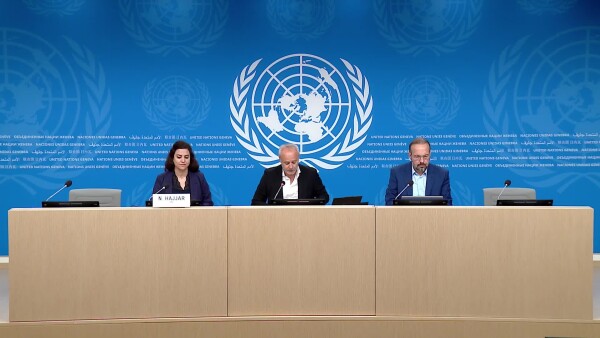
- WHO - Tarik Jašarević with Dr Olivier le Polain, unit head epidemiology and analytics for response, WHO
- Update on Ebola situation in DRC
- UNICEF - Ricardo Pires with Dr Douglas Noble, UNICEF Global Lead for Public Health Emergencies and Global Incident Manager for Ebola
- WHO Tarik Jašarević with Dr Femi Oladapo, Head, Maternal and Perinatal Health Unit, UN Special Research Programme for Human Reproduction (HRP)
Similar Stories
1
1
1
Press Conferences | UN WOMEN , WFP , WHO
UN WOMEN: Sudan Women and girls one year after the fall of El Fasher; increasing drone attacks across the country; WFP: DRC - Ebola spreads to eighth DRC province as WFP delivers food, builds treatment centres and keeps supplies moving; WHO - Update on Ebola (Bundibugyo Virus Disease)
1
12
1
1
Press Conferences , Images | UNOG
Closing Press Conference following the Sixth Consultative Meeting on Enhancing Coordination of Peace Initiatives and Efforts in Sudan

2
17
1
2
Edited News , Press Conferences , Images | OCHA , WMO
Two UN agencies teamed up on Wednesday to issue an appeal for immediate assistance to help communities already being impacted by the strongest El Niño on record.
1
1
1
Press Conferences | CITES
Wildlife trade and conservation policy discussions at the 81st meeting of the CITES Standing Committee (SC81)
1
1
1
Press Conferences | UNHCR , UNCTAD , WMO , OCHA , UNICEF , WHO
UNHCR Hungary’s 1956 Refugee Crisis: 70 Years On, UNCTAD World Investment Forum 2026, Doha, WMO Greenhouse Gas Bulletin and Climate Update for COP31, OCHA Afghanistan: Malnutrition, Girls’ Education and Recovery, UNICEF Yemen: Child Malnutrition and Unsafe Water in Taiz, WHO Inequalities in Noncommunicable Diseases and Risk Factors
1
1
1
Press Conferences | UNHCR
End of UNHCR's 77th Annual Executive Committee (ExCom) meeting week
1
1
1
Press Conferences | UNICEF , IOM , UNHCR
UN Special Assistant to the Personal Envoy Office (SUDAN): Peace Initiatives and Efforts in Sudan; UNICEF: Dire situation of children in Gaza; IOM: Damaged Homes and Energy Attacks Risk Displacing Ukrainians for this winter; UNHCR: update on EXCOM week

1
1
1
Press Conferences | IOM , UNDRR
UN stresses importance of household preparedness for disaster risk reduction.

1
1
1
Statements , Press Conferences | OHCHR

1
1
1
Press Conferences | UNHCR , UNICEF , IFRC , OHCHR , UN WOMEN , IOM , OCHA , WHO
UNHCR – ExCom Meeting, UNICEF – Nepal Recovery, IFRC – Flash Floods, WHO – Mental Health, IOM – South Sudan Floods, OCHA – DRC Humanitarian aid, UNHCR – Sahel Displacement, UNICEF – Yemen Update, IOM – Gaza Shelter, UN Women – Gaza Women, OHCHR – Arrests and detentions of Syrians by Israeli force

2
1
2
Press Conferences | UNCTAD
Presentation of the Trade and Developement Report 2026
Embargoed until 9 October 2026 at 11 a.m. (Geneva Time)
UNCTAD: UNCTAD’s flagship report finds that governments increasingly use industrial, trade, financial and technology policies to pursue economic and national security objectives. Market access and the ability to move into higher-value activities now depend more heavily on technology, finance and geopolitics.

1
1
1
Press Conferences | UPU
Release of the State of the Postal Sector Report 2026