

The United Nations Office at Geneva
Multimedia Newsroom
UN INFORMATION SERVICE GENEVA PRESS BRIEFING
17 April 2026
Lebanon-Israel ceasefire
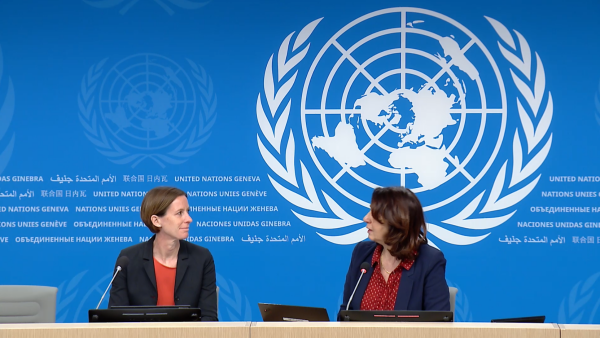
Alessandra Vellucci, for the United Nations Information Service (UNIS), read the following statement:
“The Secretary-General welcomes the announcement of a 10-day ceasefire between Israel and Lebanon and commends the role of the United States in facilitating the ceasefire. He reaffirms the support of the United Nations to all efforts to end hostilities and alleviate the suffering of communities on both sides of the Blue Line. The Secretary-General hopes that this ceasefire will pave the way for negotiations and the full implementation of Security Council resolution 1701 (2006) towards a long-term solution to the conflict. He urges all actors to fully respect the ceasefire and to comply with their obligations under international law, including international humanitarian law, at all times. The Secretary-General further hopes that this agreement will contribute to ongoing efforts toward a lasting and comprehensive peace in the region.”
Impact of the Gaza war on women and girls
Sofia Calltorp, Chief of Humanitarian Action at UN Women in Geneva, stated that a new analysis was showing how the war had affected women and girls in Gaza. Six months after the ceasefire in Gaza, women and girls continued to face severe and persistent risks, as humanitarian needs remain critical and recovery conditions remain fragile. A new analysis published by UN Women showed that more than 38,000 women and girls — including over 22,000 women and 16,000 girls — had been killed in Gaza between October 2023 and December 2025, representing an average of 47 women and girls killed per day. Women and girls accounted for a proportion of deaths much higher than ever before in Gaza. Despite the ceasefire announced in October 2025, reports indicated that killings of women and girls had persisted in recent months, underscoring that the threats to their lives remain ongoing. The report, The Cost of the War in Gaza on Women and Girls, also highlighted that nearly 11,000 women and girls had sustained injuries resulting in lifelong disabilities. The actual number of casualties was likely higher, as many bodies remained trapped under rubble, while the collapse of health information systems had significantly constrained the documentation of deaths and injuries. Nearly one million women and girls had been displaced, many of them repeatedly. Intensive damage to infrastructure had made it impossible for women and girls to access health care and other life-saving services.
UN Women called for the ceasefire to be respected, with full compliance with its terms, respect for international law, strengthened accountability, and the protection of women and girls alongside unimpeded humanitarian assistance at scale. Women and girls had to be at the centre of response and recovery, and meaningful participation in peacebuilding and reconstruction. UN Women remained on the ground in Gaza partnering with women-led and women's rights organizations, providing funding, coordination, and technical support, said Ms. Calltorp.
The full press release is available here.
Answering questions from the media, Ms. Calltorp explained that there was an almost complete lack of services for women in Gaza, including sexual and reproductive rights, and access to sanitary pads.
2025 – the deadliest year for maritime movements of Rohingya refugees
Babar Baloch, for the United Nations Refugee Agency (UNHCR), stated that in 2025, nearly 900 Rohingya refugees had been reported missing or dead in the Andaman Sea and Bay of Bengal, making it the deadliest year on record for maritime movements in South and South‑East Asia. More than 6,500 Rohingya had attempted perilous sea crossings that year, with one in seven reported missing or dead – the highest mortality rate worldwide of any major route for refugee and migrant sea journeys. In recent years, over half of those attempting these crossings had been women and children. The trend continued in 2026, with more than 2,800 Rohingya undertaking dangerous sea journeys between January and 13 April.
While most Rohingya refugees wished to return to Myanmar once conditions allowed for a voluntary, dignified and safe return, ongoing conflict, persecution and the absence of citizenship prospects left them with little hope. Meanwhile, severe funding shortfalls had significantly reduced humanitarian aid in Bangladesh, compounded by insecurity in the camps and limited access to education and livelihoods, pushing refugees towards dangerous onward movement. Mr. Baloch said that some 200,000 Rohingya refugees had taken dangerous sea journeys over the years, of whom over 5,000 had lost their lives in the Andaman Sea, many of them women and children.
UNHCR’s press release can be found here.
Mr. Baloch, responding to questions, said that the continued movement showed a sense of desperation among the displaced Rohingya refugees in Cox’s Bazaar and those who were still in Myanmar. What was particularly alarming was the rate at which the Rohingya were dying in the high seas. Speaking of funding cuts, Mr. Baloch said that over one million Rohingya refugees were generously hosted by Bangladesh, but the funding needed to support the host communities and the refugees was simply missing. For those trafficking refugees, human lives simply did not matter, said Mr. Baloch. No one would put their family on a risky boat if they were not desperate, he stressed. Once the sea journey started, many did not reach their desired destinations. Some ended up back in Bangladesh or Myanmar, while others were rescued on the high seas. UNHCR was appealing to all coastal states in the region to save those at risk and seeking safety. Some Rohingya had arrived to Indonesia, Malaysia, Thailand, and Sri Lanka, he said.
Announcements
Hanane Hafraoui, Programme Officer, Lead of the Global Alliance for Buildings and Construction, at the United Nations Environment Programme (UNEP), informed that the Sustainable Buildings and Construction Summit 2026 would take place on 20-22 April, at the SwissTech Convention Center in Lausanne. The Summit would convene government officials who developped building policies working alongside academics advancing research, private sector and AEC leaders implementing solutions, financiers mobilising investment, and civil society, bridging the gap between policy commitments and on-ground implementation. The Summit would focus on emerging markets and developing economies, where built environment growth would be greatest, driving action to transform the sector into a driver of environmental sustainability through holistic approaches that seamlessly integrate resilience and socio-economic factors. The three-day programme would feature high-level plenaries with government and industry leaders from Africa, Asia, Europe, and Latin America; the Intergovernmental Council for Buildings and Climate Technical Meeting advancing international cooperation on national climate commitments; academic showcases; and cross-disciplinary workshops.
Alessandra Vellucci, for the United Nations Information Service (UNIS), informed that the Secretary-General was in The Hague to attend a ceremony marking the 80th anniversary of the International Court of Justice. He would deliver remarks at the event and hold a series of bilateral meetings.
She further said that the first meeting of the Global Dialogue on AI Governance would take place in Geneva on 6-7 July, along the AI for Good Summit. Ahead of that meeting, the two co-chairs of the Dialogue and the UN Special Envoy on Technology would be in Geneva next week and brief the media ahead of the regular press briefing, on 21 April at 10 am.
Alessandra Vellucci, speaking on behalf of the United Nations Mine Action Service (UNMAS), informed that the 29th International Meeting of Mine Action National Directors and United Nations Advisers (NDM-UN29) would take place at the International Conference Center Geneva (CICG) from 22 to 24 April. This year’s meeting would explore the theme “One Humanity” through more than 40 sessions, including plenaries, side events and workshops. Over three days, meeting participants from more than 80 countries and territories would be able to engage with more than 800 mine action practitioners and National Directors from around the world. On 20 April, a morning briefing would be organized at CICG with the Directors of UN Mine Action and the Geneva International Centre for Humanitarian Demining. On 23 April at noon, the Under-Secretary General for the Department of Peace Operations, Jean-Pierre Lacroix, would hold a press conference. Finally, on 24 April in the morning, there would be another briefing to address specific mine action programmes in the Occupied Palestinian Territory, legacy contamination in the Solomon Islands, Sudan, and Ukraine.
Ms. Vellucci said that on 23 April at 10:30 am, Dario Liguti, Director of the Sustainable Energy Division at the United Nations Economic Commission for Europe (UNECE), would hold a press conference on critical minerals – myths and realities.
Ms. Vellucci stated that the Committee on the Elimination of Racial Discrimination would conclude this morning its review of the report of Cyprus, while the Committee against Torture would begin on 21 April at 10 am its review of the report of Gabon.
Finally, on 20 April, the Chinese Language Day would be marked by an event at the Palais des Nations, at the Salle des Pas Perdus and in the Concordia Hall.
***
TOPICS
UN WOMEN Sofia Calltorp, Chief of Humanitarian Action (PR)
· New UN Women data analysis on the impact of war in Gaza on women and girls, including its massive death toll
UNHCR Babar Baloch (PR)
· UNHCR: 2025 was deadliest year yet for maritime movements of Rohingya refugees
ANNOUNCEMENTS
UNEP Gulnara Roll, Head of Sectoral Transition and Head of GlobalABC Secretariat, UNEP (Zoom)
· Sustainable Buildings and Construction Summit 2026
UNIS on behalf of UNMAS
Similar Stories

1
1
1
Press Conferences | IOM , UNDRR
UN stresses importance of household preparedness for disaster risk reduction.

1
1
1
Statements , Press Conferences | OHCHR

1
1
1
Press Conferences | UNHCR , UNICEF , IFRC , OHCHR , UN WOMEN , IOM , OCHA , WHO
UNHCR – ExCom Meeting, UNICEF – Nepal Recovery, IFRC – Flash Floods, WHO – Mental Health, IOM – South Sudan Floods, OCHA – DRC Humanitarian aid, UNHCR – Sahel Displacement, UNICEF – Yemen Update, IOM – Gaza Shelter, UN Women – Gaza Women, OHCHR – Arrests and detentions of Syrians by Israeli force

2
1
2
Press Conferences | UNCTAD
Presentation of the Trade and Developement Report 2026
Embargoed until 9 October 2026 at 11 a.m. (Geneva Time)
UNCTAD: UNCTAD’s flagship report finds that governments increasingly use industrial, trade, financial and technology policies to pursue economic and national security objectives. Market access and the ability to move into higher-value activities now depend more heavily on technology, finance and geopolitics.

1
1
1
Press Conferences | UPU
Release of the State of the Postal Sector Report 2026
1
1
1
Press Conferences | IOM , ITU , UNECE , UNICEF , WHO , WMO
UNICEF: Ebola, DRC - children orphans or separating them from parents and caregivers; IOM: Humanitarian needs in Djibouti amid arrivals from Yemen and increased migrant movements; WHO: Darfur, scale of health needs far exceeds available resources; WMO co-sponsored Global Heat Forum, Bangkok, monthly Global Seasonal Climate Update; UNECE: UN Forum of Mayors; ITU Plenipotentiary Conference 2026; WHO: child and adolescent obesity guidelines and new global roadmap to tackle pregnancy hypertension, a leading cause of maternal mortality
1
1
1
Press Conferences | OCHA , UN WOMEN , UNHCR , WFP , WHO , WTO , UNEP
OCHA – $160M CERF allocation to 12 underfunded crises; UNHCR – 5.8M refugee children remain out of school amid funding cuts; UN Women – Middle East escalation and food security among women/girls; WHO – Gaza supplies and overall situation; WFP – Yemen food insecurity and impact on global hunger ; UNEP - First International Conference of the Global Framework on Chemicals in Geneva | 16-20 November 2026
1
1
1
Press Conferences | UNHCR , WHO
Yemen's health system nears collapse amid conflict, causing rising casualties and medicine shortages.
1
1
1
Press Conferences | HRC
Update by the Expert Mechanism to Advance Racial Justice and Equality in Law Enforcement
1
1
1
Press Conferences | WIPO , WHO , UNICEF , UNHCR , IOM , WFP , FAO
WIPO Global Innovation Index 2026 launch and press conference, WHO Composition of influenza vaccines for the 2027 Southern Hemisphere flu season, UNICEF Yemen hunger and malnutrition; UNHCR Sudan displacement into Chad; IOM Ebola and population movements in DRC; WFP emergency food assistance in Nepal; and FAO food loss and waste.
2
1
2
Press Conferences | UNCTAD
Gaza reconstruction needs reach $71.5 billion as Palestinian economy and public finances face severe strain. Latest UNCTAD report documents the loss of decades of development gains, economic collapse in Gaza and tightening economic constraints in the West Bank.
The report identifies three immediate priorities: transferring withheld Palestinian revenues, safeguarding the banking system and aligning reconstruction support with the documented scale of damage and economic losses.
1
1
1
Press Conferences | HRC
Press conference on the situation of human rights in Nicaragua by the UN Group of Human Rights Experts