

The United Nations Office at Geneva
Multimedia Newsroom
Ahead of fresh talks in Geneva, UN Syria envoy appeals for progress on detainees, wider ceasefire
Success in next week’s UN-led talks aimed at securing a peaceful future for Syria depends on making progress on a series of thorny issues, UN Special Envoy Geir Pedersen said on Friday, in an appeal to belligerents to extend a fragile ceasefire and release detainees.
Speaking in Geneva, the UN negotiator also urged the international community to show the people of the war-torn country that they have not been forgotten, after almost a decade of war that has reduced large swaths to rubble and likely claimed hundreds of thousands of lives.
Their “frustration” about the lack of progress on a politically agreed end to the fighting was clear, he told journalists, two days after addressing the UN Security Council in New York.
“I told the Security Council that, and I said that many times, that when I meet with Syrians from across the board, they all express to me a deep, deep frustration about the lack of progress on the political front. And as I said, the meeting here in Geneva of the Small Body of the Constitutional Committee will of course not change that, but if it is handled correctly, it can start to build confidence, and it can be the beginning of something that can send hope also to the Syrian people. And this is indeed my hope.”
The convening on Monday of the Small Group of the Syrian Constitutional Committee brings together 15 representatives from Syria’s Government, 15 from the Syrian Negotiations Commission (SNC) and 15 more civil society participants, known as the “middle third”.
A larger group of 150 delegates is also part of the process, but only the smaller group is meeting in Geneva on Monday for a week.
Both bodies meet on the basis of an agreement between the Government of Syria and the opposition to implement a key part of Security Council resolution 2254 (from 2015), which called for setting a schedule and process for drafting a new constitution.
Monday’s gathering will be the first time that delegates will have met after a hiatus of nine months, caused by differences over the agenda which were resolved by March – and then by COVID restrictions – Mr. Pedersen said.
He added that he had been “very pleased when I listened to the Members of the Security Council on Wednesday to hear that they were unanimous in their support for the work we are doing and for the meeting of the Small body of the Constitutional Committee that will start here on Monday. And as I have said many times, if we are to be successful, we also need the support of the international community.”
Highlighting the difficulties associated with conducting the meeting amid the ongoing COVID-19 pandemic, the Special Envoy insisted that necessary precautions will be taken to avoid transmission of possible infection by delegates.
These include moving the venue of discussions to a room with capacity for 200 people, four times the number expected, and ensuring physical distancing. “Obviously, they will all be tested – they are all tested - before they arrive in Geneva, and they will be tested on arrival in Geneva,” Mr. Pedersen said. “Then, of course, they will all be wearing masks.”
In order to make substantive progress during discussions, the Special Envoy insisted that there needs to be “progress when it comes to abductees, to detainees and we need information on missing persons. This I think could perhaps be the one key important development that could help to build trust and confidence and I repeat my strong appeal to the parties on this again.”
Addressing other matters was also crucial, he continued, including the “ceasefire holding in Idlib in the northwest; I’ve asked that this could be strengthened by what I call a nationwide ceasefire in line with Security Council Resolution 2254. This is something I still believe is extremely relevant. And then of course, it goes without saying that at this this very critical time for the Syrian people, with the economy, with the economic collapse, with the pandemic, that everything is done that is possible from the international community to support the Syrian people.”
Highlighting the Syrian-led nature of the constitutional discussions, with the co-chairs of the Government and opposition effectively presiding side by side as co-chairs, the UN Special Envoy noted that the October session had featured some “shouting and screaming”.
But he added: “I’m confident that in my dialogue with the two co-chairs, that the two co-chairs will be able to handle the challenges of the meetings. You know, obviously in the meeting we had late October with the (Larger Group) of 150, it went very well, there were obviously very different narratives, very different perspectives.”
In parallel with the Syrians’ discussions, Mr. Pedersen underscored the keen international interest in the proceedings.
“I’ve been informed that there will be in Geneva during this time most probably, representatives from Russia, Iran and Turkey - the so-called Astana Three - and I believe also from the United States. There may also be others that will be here. But let me emphasise that the Constitutional Committee is of course, the work of that, is of course completely independent.”
- Exterior wide shot, Palais des Nations flag alley, UN Geneva, nations’ flags flying, a beautiful day.
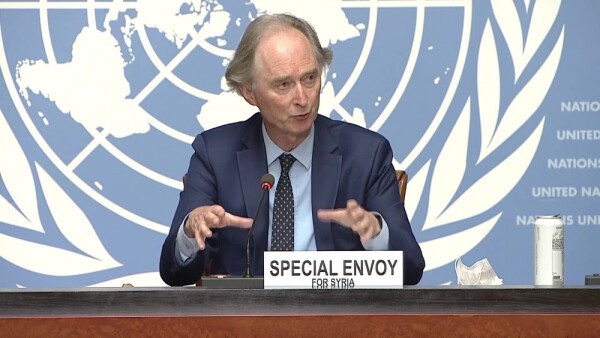
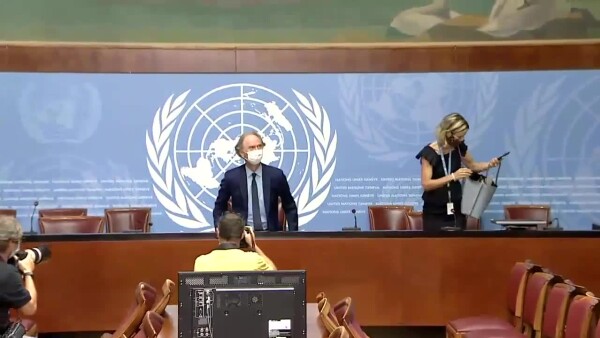
- Medium shot, UN Geneva Press Room III, a mask-wearing UN Special Envoy for Syria Geir Pedersen arriving, journalists (also masked) seated apart from one another, typing on laptops. Mr. Pedersen is followed by his spokesperson Jenifer Fenton (masked); both sit apart at podium. Press photographers take photographs of the Special Envoy.
- Wide shot, UN Geneva Press Room III, showing UN Special Envoy for Syria Geir Pedersen sitting at podium, flanked by spokesperson Jenifer Fenton with a Press photographer seated nearby checking his camera.
- SOUNDBITE (English) — Geir Pedersen, UN Special Envoy for Syria: “I told the Security Council that, and I said that many times, that when I meet with Syrians from across the board, they all express to me a deep, deep frustration about the lack of progress on the political front. And as I said, the meeting here in Geneva of the Small Body of the Constitutional Committee will of course not change that, but if it is handled correctly, it can start to build confidence, and it can be the beginning of something that can send hope also to the Syrian people. And this is indeed my hope.”
- Medium shot, UN Geneva Press Room III, journalists sitting in front of shot, typing on laptops, UN Special Envoy to rear, Press Room III, Palais des Nations.
- SOUNDBITE (English) — Geir Pedersen, UN Special Envoy for Syria: “I was very pleased when I listened to the Members of the Security Council on Wednesday to hear that they were unanimous in their support for the work we are doing and for the meeting of the Small body of the Constitutional Committee that will start here on Monday. And as I have said many times, if we are to be successful, we also need the support of the international community.”
- Medium shot, journalists sitting at table, one has his mask lowered, Press Room III, Palais des Nations.
- SOUNDBITE (English) — Geir Pedersen, UN Special Envoy for Syria: “Obviously, they will all be tested – they are all tested - before they arrive in Geneva, and they will be tested on arrival in Geneva. Then, of course, they will all be wearing masks.”
- Medium close-up, journalist’s hands shown typing and laptop screen showing notes of Special Envoy’s comments, Press Room III, Palais des Nations.
- SOUNDBITE (English) — Geir Pedersen, UN Special Envoy for Syria: “We need to see progress when it comes to abductees, to detainees and we need information on missing persons. This I think could perhaps be the one key important development that could help to build trust and confidence and I repeat my strong appeal to the parties on this again.”
- Medium close-up, rows of empty chairs in foreground, journalists to rear, Press Room III, Palais des Nations.
- SOUNDBITE (English) — Geir Pedersen, UN Special Envoy for Syria: “Then of course it’s the issue about the ceasefire holding in Idlib in the northwest; I’ve asked that this could be strengthened by what I call a nationwide ceasefire in line with Security Council Resolution 2254. This is something I still believe is extremely relevant. And then of course, it goes without saying that at this this very critical time for the Syrian people, with the economy, with the economic collapse, with the pandemic, that everything is done that is possible from the international community to support the Syrian people.”
- Medium close-up, masked journalist checking mobile phone, seated, Press Room III, Palais des Nations.
- SOUNDBITE (English) — Geir Pedersen, UN Special Envoy for Syria: “I’m confident that in my dialogue with the two co-chairs, that the two co-chairs will be able to handle the challenges of the meetings. You know, obviously in the meeting we had late October with the (larger group) of 150, it went very well, there were obviously very different narratives, very different perspectives.”
- Medium shot, journalists seated in foreground, UN Special Envoy to rear, Press Room III, Palais des Nations.
- SOUNDBITE (English) — Geir Pedersen, UN Special Envoy for Syria: “I’ve been informed that there will be in Geneva during this time most probably, representatives from Russia, Iran and Turkey - the so-called Astana Three - and I believe also from the United States. There may also be others that will be here. But let me emphasise that the Constitutional Committee is of course, the work of that, is of course completely independent.”
Similar Stories
1
1
1
Press Conferences | CITES
Wildlife trade and conservation policy discussions at the 81st meeting of the CITES Standing Committee (SC81)
1
1
1
Press Conferences | UNHCR , UNCTAD , WMO , OCHA , UNICEF , WHO
UNHCR Hungary’s 1956 Refugee Crisis: 70 Years On, UNCTAD World Investment Forum 2026, Doha, WMO Greenhouse Gas Bulletin and Climate Update for COP31, OCHA Afghanistan: Malnutrition, Girls’ Education and Recovery, UNICEF Yemen: Child Malnutrition and Unsafe Water in Taiz, WHO Inequalities in Noncommunicable Diseases and Risk Factors
1
1
1
Press Conferences | UNHCR
End of UNHCR's 77th Annual Executive Committee (ExCom) meeting week
1
1
1
Press Conferences | UNICEF , IOM , UNHCR
UN Special Assistant to the Personal Envoy Office (SUDAN): Peace Initiatives and Efforts in Sudan; UNICEF: Dire situation of children in Gaza; IOM: Damaged Homes and Energy Attacks Risk Displacing Ukrainians for this winter; UNHCR: update on EXCOM week

1
1
1
Press Conferences | IOM , UNDRR
UN stresses importance of household preparedness for disaster risk reduction.
1
1
1
Statements , Press Conferences | OHCHR
1
1
1
Press Conferences | UNHCR , UNICEF , IFRC , OHCHR , UN WOMEN , IOM , OCHA , WHO
UNHCR – ExCom Meeting, UNICEF – Nepal Recovery, IFRC – Flash Floods, WHO – Mental Health, IOM – South Sudan Floods, OCHA – DRC Humanitarian aid, UNHCR – Sahel Displacement, UNICEF – Yemen Update, IOM – Gaza Shelter, UN Women – Gaza Women, OHCHR – Arrests and detentions of Syrians by Israeli force
2
1
2
Press Conferences | UNCTAD
Presentation of the Trade and Developement Report 2026
Embargoed until 9 October 2026 at 11 a.m. (Geneva Time)
UNCTAD: UNCTAD’s flagship report finds that governments increasingly use industrial, trade, financial and technology policies to pursue economic and national security objectives. Market access and the ability to move into higher-value activities now depend more heavily on technology, finance and geopolitics.
1
1
1
Press Conferences | UPU
Release of the State of the Postal Sector Report 2026
1
1
1
Press Conferences | IOM , ITU , UNECE , UNICEF , WHO , WMO
UNICEF: Ebola, DRC - children orphans or separating them from parents and caregivers; IOM: Humanitarian needs in Djibouti amid arrivals from Yemen and increased migrant movements; WHO: Darfur, scale of health needs far exceeds available resources; WMO co-sponsored Global Heat Forum, Bangkok, monthly Global Seasonal Climate Update; UNECE: UN Forum of Mayors; ITU Plenipotentiary Conference 2026; WHO: child and adolescent obesity guidelines and new global roadmap to tackle pregnancy hypertension, a leading cause of maternal mortality
1
1
1
Press Conferences | OCHA , UN WOMEN , UNHCR , WFP , WHO , WTO , UNEP
OCHA – $160M CERF allocation to 12 underfunded crises; UNHCR – 5.8M refugee children remain out of school amid funding cuts; UN Women – Middle East escalation and food security among women/girls; WHO – Gaza supplies and overall situation; WFP – Yemen food insecurity and impact on global hunger ; UNEP - First International Conference of the Global Framework on Chemicals in Geneva | 16-20 November 2026
1
1
1
Press Conferences | UNHCR , WHO
Yemen's health system nears collapse amid conflict, causing rising casualties and medicine shortages.