

The United Nations Office at Geneva
Multimedia Newsroom
Press Conferences | OHCHR , WHO , UNOG , WFP , FAO , IOM
UNOG Bi-weekly press briefing 14 July 2020
Human Rights Council
Rhéal LeBlanc, Chief of the Press and External Relations Section at the United Nations Information Service (UNIS), speaking on behalf of the Human Rights Council, informed that this morning the Council was holding a panel discussion on COVID-19 and women’s rights. At noon, there would be an oral briefing by the Commission of Inquiry on Burundi, followed by an interactive discussion, to be followed by the continuation of discussion on Myanmar and the presentation of the report by the Commission of Inquiry on Syria and a discussion.
More information on the forty-fourth session of the Council can be found here.
State of Food Security and Nutrition in the World 2020 report
Maximo Torero, Chief Economist and Assistant Director-General for the Economic and Social Development Department at the Food and Agriculture Organization (FAO), said the world was off track to achieve SDG 2 (Zero Hunger), and, at this pace, in 2030 more than 800 million were expected to be undernourished. In addition, between 80 and 120 million more people could this year go chronically undernourished because of COVID-19. If all forms of malnutrition were counted, as many as two billion people in the world did not have access to all the food they needed. If the world wanted to achieve zero hunger and combat malnutrition, the key was to address the quality of diets; currently, 57 per cent of countries in sub-Saharan Africa and southeast Asia could not afford such diets. Hidden costs behind the production of foods ought also to be considered; if the pattern of nutrition was changed towards healthier options, those hidden costs could be significantly reduced.
The current situation was not on track, and COVID-19 was making things worse, stressed Mr. Torero. The report urged a transformation of food systems to reduce the cost of nutritious foods and increase the affordability of healthy diets. While the specific solutions would differ from country to country, and even within them, the overall answers lay with interventions along the entire food supply chain, in the food environment, and in the political economy that shaped trade, public expenditure and investment policies.
Full FAO press release can be read here.
Elisabeth Byrs, for the World Food Programme (WFP), referring to the report, reiterated that
the world was not on track to achieve zero hunger by 2030. For WFP, FAO and the International Fund for Agricultural Development (IFAD), the three Rome-based UN agencies engaged in the fight against hunger, that was extremely worrying. WFP worked on the frontlines of hunger around the world and was focused on responding to “acute” hunger needs. WFP estimated that the number of acutely food insecure people in the world could increase by 80 per cent - from 149 million in 2019 to 270 million before the end of 2020 – largely due to the socio-economic impact of the COVID-19 pandemic.
The shifting battlefront of the pandemic was currently being felt most keenly in Latin America, where there has been a 269 per cent rise in people facing severe food insecurity. Spikes in food insecurity were already evident in West and Central Africa (135 per cent increase) and Southern Africa (90 per cent increase), estimated the WFP.
The virus was changing the face of hunger by dragging urban populations into destitution, and compounding the effects of climate change, conflict and socioeconomic shocks in regions of the world that had previously escaped severe levels of food insecurity. Ms. Byrs informed that the WFP was mobilising to meet the food needs of up to 138 million people in 2020 – the biggest humanitarian response in its history. This unprecedented crisis required an unprecedented response, and the WFP was appealing for USD 4.9 billion over the next six months to carry out this life-saving work in 83 countries.
Responding to a question, Ms. Byrs said that in 2020, the WFP aimed to assist 138 million acutely malnourished people. Other humanitarian agencies, NGOs and governments were naturally also involved in this monumental task. Mr. Torero explained that it was important to understand the difference between acute and chronical malnutrition; in the global north, thanks to social and unemployment insurance, people who lost jobs usually still had the capacity to feed themselves. Mr. Torero, in response to another question, said if the process of economic recovery did not accelerate in the north, we could also witness a broader problem of access to food. FAO expected that even in developed countries there would be spots of food insecurity.
Stranded migrants in Yemen
Paul Dillon, for the International Organization for Migration (IOM), said that COVID19-related restrictions that had reduced the number of migrant arrivals in Yemen by 90 per cent in recent months had also left tens of thousands of Ethiopians stranded there, subject to forcible relocation, arbitrary detention and abuse, and exposed to the spread of coronavirus with little access to support services. Transportation through the country had been blocked and at least 14,500 migrants had been forcibly transferred between governorates, left stranded in Aden (4,000), Marib (2,500), Lahj (1,000) and Sa’ada (7,000) governorates. In 2019, over 138,000 migrants – an average of 11,500 per month – had arrived in Yemen from the Horn of Africa according to IOM’s Displacement Tracking Matrix, bound for the Kingdom of Saudi Arabia in search of work. In May 2019, 18,904 people had made the crossing, whereas this year only 1,725 arrivals had been recorded.
Agencies like IOM were continuing to assist stranded migrants, but major funding shortages jeopardized the response, putting lives at risk. IOM’s appeal for USD 155 million to support over 5.3 million people by the end of the year was just half-funded, endangering displaced Yemenis and migrants who would be left alone to face the devastating fallout of nearly six years of conflict and the worsening COVID-19 outbreak. Mr. Dillon also informed that soon the IOM would be releasing some new B-roll and photo materials from Yemen.
Full IOM press release can be read here.
It was very difficult to estimate how many migrants there were in Yemen in total, and how many of them were in detention, said Mr. Dillon in response to a question. COVID-19 did make access more challenging, he explained.
Geneva announcements
Fadéla Chaib, for the World Health Organization (WHO), said that Dr. Tedros was in Paris today to attend the Bastille Day celebrations, at the invitation of the French President. This year, the ceremony was primarily dedicated to health professionals fighting the COVID-19 pandemic. On 16 July, at the invitation of the King of Spain, Dr. Tedros would be in Madrid to participate in events honoring health workers and those who had lost their lives to COVID-19. It was not planned for Dr. Tedros to visit health facilities in Madrid, nor would he be delivering formal remarks in either Paris or Madrid.
Ms. Chaib also announced that a PAHO press conference would take place at 11 a.m. Washington time today. Ms. Chaib said the next WHO press briefing with Dr. Tedros would take place on Friday, 17 July, at 5 p.m, but from next week the plan was to have those briefings on Monday and Thursday afternoons.
Rhéal LeBlanc, for the UN Information Service (UNIS), reminded journalists about the “Women Rise for All” online event starting today at 8 a.m. NYC time, which would be hosted by Amina Mohammed, UN Deputy Secretary-General.
The Human Rights Committee, which was pursuing its 129th session online, would hold during this session several public meetings (the next ones today from 4 to 6 p.m), all devoted to the review (second reading) of its General Comment 37 on Article 21 of the Covenant on Civil and Political Rights (Right to peaceful assembly).
The Committee Against Torture had held a brief 69th session the previous day – the first online session so far – during which it had decided it would postpone its November-December session to next year, unless it could be carried out in-situ.
Similar Stories
1
1
1
Press Conferences | WMO , UNHCR , WHO , ILO
WMO: Greenhouse Gas Bulletin; UNHCR: As attacks intensify UNHCR urges support for war ravaged Ukrainians; WHO: Clinical trials in DRC: vaccines and beyond; ILO: New global and regional estimates on domestic work, informality and working conditions
1
1
1
Press Conferences | UN WOMEN , WFP , WHO
UN WOMEN: Sudan Women and girls one year after the fall of El Fasher; increasing drone attacks across the country; WFP: DRC - Ebola spreads to eighth DRC province as WFP delivers food, builds treatment centres and keeps supplies moving; WHO - Update on Ebola (Bundibugyo Virus Disease)
1
12
1
1
Press Conferences , Images | UNOG
Closing Press Conference following the Sixth Consultative Meeting on Enhancing Coordination of Peace Initiatives and Efforts in Sudan

2
17
1
2
Edited News , Press Conferences , Images | OCHA , WMO
Two UN agencies teamed up on Wednesday to issue an appeal for immediate assistance to help communities already being impacted by the strongest El Niño on record.
1
1
1
Press Conferences | CITES
Wildlife trade and conservation policy discussions at the 81st meeting of the CITES Standing Committee (SC81)
1
1
1
Press Conferences | UNHCR , UNCTAD , WMO , OCHA , UNICEF , WHO
UNHCR Hungary’s 1956 Refugee Crisis: 70 Years On, UNCTAD World Investment Forum 2026, Doha, WMO Greenhouse Gas Bulletin and Climate Update for COP31, OCHA Afghanistan: Malnutrition, Girls’ Education and Recovery, UNICEF Yemen: Child Malnutrition and Unsafe Water in Taiz, WHO Inequalities in Noncommunicable Diseases and Risk Factors
1
1
1
Press Conferences | UNHCR
End of UNHCR's 77th Annual Executive Committee (ExCom) meeting week
1
1
1
Press Conferences | UNICEF , IOM , UNHCR
UN Special Assistant to the Personal Envoy Office (SUDAN): Peace Initiatives and Efforts in Sudan; UNICEF: Dire situation of children in Gaza; IOM: Damaged Homes and Energy Attacks Risk Displacing Ukrainians for this winter; UNHCR: update on EXCOM week

1
1
1
Press Conferences | IOM , UNDRR
UN stresses importance of household preparedness for disaster risk reduction.
1
1
1
Statements , Press Conferences | OHCHR
1
1
1
Press Conferences | UNHCR , UNICEF , IFRC , OHCHR , UN WOMEN , IOM , OCHA , WHO
UNHCR – ExCom Meeting, UNICEF – Nepal Recovery, IFRC – Flash Floods, WHO – Mental Health, IOM – South Sudan Floods, OCHA – DRC Humanitarian aid, UNHCR – Sahel Displacement, UNICEF – Yemen Update, IOM – Gaza Shelter, UN Women – Gaza Women, OHCHR – Arrests and detentions of Syrians by Israeli force
2
1
2
Press Conferences | UNCTAD
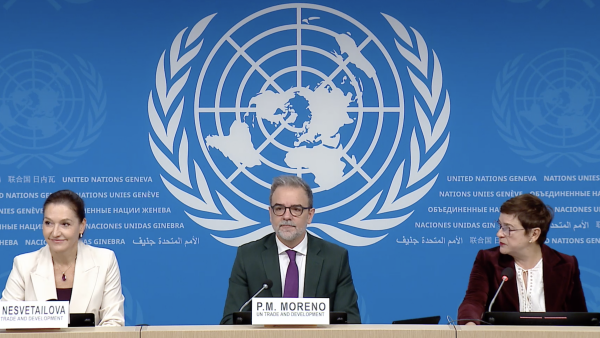
Presentation of the Trade and Developement Report 2026
Embargoed until 9 October 2026 at 11 a.m. (Geneva Time)
UNCTAD: UNCTAD’s flagship report finds that governments increasingly use industrial, trade, financial and technology policies to pursue economic and national security objectives. Market access and the ability to move into higher-value activities now depend more heavily on technology, finance and geopolitics.