

The United Nations Office at Geneva
Multimedia Newsroom
Gaza aid agreement near, say UN humanitarians
UN humanitarians said on Friday that an agreement between the different sides to unlock lifesaving aid deliveries across the border to Gaza was near, just as UN chief António Guterres arrived at the Rafah crossing on the Egyptian side.
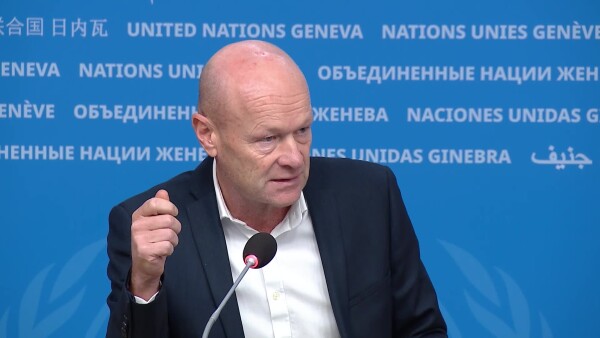
Briefing reporters in Geneva on Friday morning, UN Humanitarian Affairs Coordination Office (OCHA) spokesperson Jens Laerke said on behalf of UN relief chief Martin Griffiths, “We are in deep and advanced negotiations with all relevant sides to make sure that an aid operation into Gaza starts as quickly as possible and with the right conditions”.
“We are encouraged by reports that the different sides are nearing an agreement on the modalities and that the first delivery is due to start in the next day or so,” he said.
For almost two weeks, the enclave has gone without any fuel, food, water and medicine shipments. Earlier this week, the UN chief called for a humanitarian ceasefire and “rapid, unimpeded” aid access. Aid trucks have been waiting at the Rafah border crossing since Saturday. Mr. Laerke stressed that while it was necessary to “provide aid to everyone in Gaza regardless of where they are”, Rafah was “the lifeline” which would offer the most direct route to reach people in need.
In response to questions regarding the scope of the operation, Mr. Laerke said “whether it's enough right now, we don't know” as the situation has “changed dramatically”. But the OCHA spokesperson underscored that while modalities were still under negotiation, “any trucks that go in would be more than no trucks”. He also said that in addition to food, water and medicines, fuel was desperately needed in Gaza as the enclave was under an electricity blackout.“Fuel is a life-saving humanitarian commodity in this crisis,” he insisted.
Meanwhile, the UN human rights office expressed concern on Friday for civilians “caught in the middle of insanity” and “placed in impossible situations” in the Gaza Strip.
OHCHR spokesperson Ravina Shamdasani said the enclave’s residents are “in the midst of unacceptable violence at all times.” She pointed out that they are not able to move due to bombardment in both the north and the south. Fuel shortages and other logistical reasons, in addition to fear of violence and being hit by strikes are also preventing them from fleeing. Ms. Shamdasani explained that after continued bombing in the south, people headed back north as they felt that they “might as well die in [their] own house”. She added that she heard testimony from one person who said that his in-laws decided to go back home up north. “They were killed overnight in an airstrike,” she said.
Commenting on questions regarding an investigation into an explosion at Gaza’s Al Ahli hospital two days ago that killed nearly 500 Palestinians, Ms. Shamdasani said that it is becoming “increasingly difficult” to investigate “because of the inability of people to move around”. Communications are also “being scuppered” by electricity and fuel shortages. Despite this, “we are trying to do what we can remotely to try to piece together what happened,” she said.
Regarding the wounded in Gaza and those needing advanced medical care, WHO spokesperson Margaret Harris, added that normally they have “several hundred” patients every day but now “with at least five hospitals not functioning” and the Turkish Friendship Hospital having to “stop everything within the next 24 hours,” there may be “many many people with their chronic conditions just not getting the care” they need.
ENDS
STORY: Update on OPT - Israel OCHA - OHCHR - WHO
TRT: 03:54
SOURCE: UNTV CH
RESTRICTIONS: NONE
LANGUAGE: ENGLISH
ASPECT RATIO: 16:9
DATELINE: 20 OCTOBER 2023, GENEVA, SWITZERLAND
SHOTLIST
1. Exterior wide shot, United Nations flag flying.
2. Wide shot of panel at press briefing.
3. SOUNDBITE: (ENGLISH) Jens Laerke, OCHA spokesperson: “We are in deep and advanced negotiations with all relevant sides to make sure that an aid operation into Gaza starts as quickly as possible and with the right conditions. We are encouraged by reports that the different sides are nearing an agreement on the modalities and that the first delivery is due to start in the next day or so.”
4. Attendees at briefing and screens
5. SOUNDBITE: (ENGLISH) Ravina Shamdasani, OHCHR spokesperson: “After bombing continued in the south, we've heard testimony from people saying, I might as well die in my own house. So they head back up north. And yesterday, I heard from one person who said that his in-laws decided to go back home up north. They were killed overnight in an airstrike.”
6. Panel and attendees at briefing.
7. SOUNDBITE: (ENGLISH) Ravina Shamdasani, OHCHR spokesperson: “There's continued bombardment. There's bombardment in the south. There's bombardment in the north. There are fuel shortages. People aren't able to move as well for logistical reasons, in addition to their fear of violence, of being hit by strikes.”
8. Close of attendee at briefing.
9. SOUNDBITE: (ENGLISH) Ravina Shamdasani, OHCHR spokesperson: “You have civilians caught in the middle of insanity and placed in impossible situations, whether they move, whether they stay, they're still in the midst of unacceptable violence at all times.”
10. Attendees at briefing.
11. SOUNDBITE: (ENGLISH) Jens Laerke, OCHA spokesperson: “The crossing we're looking at is Rafah. That is the lifeline to get into the area where more and more people are gathering. And that is, of course, from an operational standpoint, what's important for us, that we get the most direct route to where most people in need are.”
12. Screen and attendee at briefing.
13. SOUNDBITE: (ENGLISH) Ravina Shamdasani, OHCHR spokesperson: “It's becoming increasingly difficult to investigate and monitor allegations of human rights violations and international humanitarian law violations on the ground because of the inability of people to move around. And also because of the communication being scuppered by electricity shortages and fuel shortages. So even human rights defenders, our own colleagues are having difficulty sharing information. Having said that, we are trying to do what we can remotely to try to piece together what happened.”
14. Attendees at briefing.
15. SOUNDBITE: (ENGLISH) Margaret Harris, WHO spokesperson: “Normally we would have had several hundred people going every day for advanced medical care and they haven’t of course been able to get those things and now with many of the hospitals, with at least five hospitals not functioning and the Turkish Friendship hospital which provides cancer care saying they’ve had to stop most services and they will have to stop everything within the next 24 hours we have many many people with their chronic conditions just not getting the care.”
16. Attendees at briefing.
17. SOUNDBITE: (ENGLISH) Jens Laerke, OCHA spokesperson: “Whether it's enough right now, we don't know, because we knew very clearly what the needs were before this has happened. Now, things have changed dramatically. And of course, for the worse, it is not possible right now to do a proper humanitarian assessment.”
18. Wide of control room
19. SOUNDBITE: (ENGLISH) Jens Laerke, OCHA spokesperson: “We have all seen and it has been reported and flying around, the twenty trucks. I just want to mention that, that will be, of course, any truck that goes in would be more than the no trucks that are going in right now.”
20. Mid-shot of attendees.
21. Camera operators at briefing.
22. Wide of attendees at briefing
23. Mid-shot of attendee.

Similar Stories
1
1
1
Edited News | OCHA , UNICEF , WFP
Aid agencies warned on Friday of the fast-developing humanitarian emergency inside Taiz City in Yemen, which has been encircled by de facto Houthi forces fighting government troops along the country’s west coast.

2
17
1
2
Edited News , Press Conferences , Images | OCHA , WMO
Two UN agencies teamed up on Wednesday to issue an appeal for immediate assistance to help communities already being impacted by the strongest El Niño on record.

3
16
2
2
Edited News , B-roll , Conferences , Images | UNITED NATIONS , UNOG
Sixth Consultative Meeting on Enhancing Coordination of Peace Initiatives and Efforts for Sudan

1
1
1
Edited News | UNICEF , WHO , UNHCR
Yemen war continues to force families from homes amid hunger and disease
More than 250,000 people have now fled renewed fighting in Yemen, the UN said on Tuesday, citing particular concern for those sheltering in the southwestern city of Taiz and the wider governorate, where access is “essentially blocked”.

1
1
1
Edited News | UNICEF
A little over one year since a ceasefire agreement was announced between Hamas fighters and Israel, more than 340 children have been reported killed and hundreds more injured, the UN Children’s Fund, UNICEF, said on Friday.

1
1
1
Edited News | UNICEF , IFRC
Six weeks after Nepal’s deadly flooding disaster, communities are still struggling to rebuild their lives, but they will need sustained help as global warming increases the risk of another Himalayan catastrophe, the UN Children’s Fund (UNICEF) said on Friday.

1
1
1
Edited News | WHO
In suspected Russia plague death, testing and monitoring underway – WHO
The death of a lab worker in Russia’s Siberia region has sparked concerns about plague being the cause, the UN World Health Organization (WHO) said on Tuesday, adding that it was following the situation closely.

1
1
Edited News | OHCHR , UNOG
UN Human Rights Chief Volker Türk on Friday provided and oral update to the 63rd session of the Human rights Council on Ukraine.

1
1
1
Edited News | OHCHR , UNOG
UN Human Rights Chief Volker Türk on Friday provided and oral update to the 63rd session of the Human rights Council on the human rights situation in Haiti.

1
1
1
Edited News | WHO
Repeated delays in bringing lifesaving medicines, prosthetics and more from Israel into Gaza risk having devastating consequences on Palestinians who urgently need them in the wartorn enclave, the UN World Health Organization (WHO) said on Friday. “A truck full of non-priority supplies or the right supplies arriving too late, doesn't save lives. That's the question that actually matters," said Dr Reinhilde Van De Weerdt, WHO Representative in the OPT.

1
1
1
Edited News | WHO
DRC: Early access to care and oxygen decisive for Ebola patients’ survival – WHO
In the Democratic Republic of the Congo (DRC), health workers fighting the country’s largest-ever Ebola outbreak are struggling to overcome critical challenges to patient care, the UN World Health Organization (WHO) warned on Tuesday.

1
1
1
Edited News | OCHA , UN
Civilians in Iran are continuing to feel the consequences of months of conflict and military escalation, the UN’s top official in the country has said, as loss of life, damage to civilian infrastructure and mounting economic pressures leave many facing continued uncertainty.