

The United Nations Office at Geneva
Multimedia Newsroom
Edited News | IOM , OCHA , UNHCR , WHO
Bi-Weekly Press Briefing: Sudan Update- OCHA - UNHCR - IOM - WHO
STORYLINE
“$1.5 billion funding gap for UN humanitarian response appeal in Sudan; relief efforts scale up as border crossings increase”
While the humanitarian needs for an estimated 100,000 people who have been fleeing the conflict in Sudan into neighbouring countries are getting more and more dramatic, UN humanitarian agencies and partners are facing a funding gap of $1.5 billion for their response in the country.
The UN Office for the Coordination of Humanitarian Affairs (OCHA) reported today at a news briefing at the United Nations (UN) in Geneva that only 14 per cent of the $1.75 billion joint appeal for Sudan in 2023 is funded. The ongoing violence has killed hundreds of people and sent thousands fleeing for safety, as the fighting threatens to destabilize the wider region.
OCHA spokesperson Jens Laerke said that “UN humanitarian organizations and our partners are facing a funding gap of 1.5 billion dollars. We are looking to all donors to look forward and get cash out to the humanitarian organizations already struggling before the recent escalation who will need money to implement the reboot of the response in Sudan that we are working on. Without that, they simply cannot operate”.
Intense clashes erupted two weeks ago amid a military power struggle. The Sudanese armed forces are broadly loyal to General Abdel Fattah al-Burhan, the country’s de facto ruler, while the paramilitary Rapid Support Forces (RSF) are led by General Mohamed Hamdan Dagalo, known as Hemedti.
“We need the guns to fall silent for two reasons: first of all, because we need civilians protected and clearly they are not. We see a lot of civilians being killed in the hundreds. Secondly, we need that safety in order for humanitarian organizations to safely get to those people in need, or the other way around for people to safely move to places where they can access aid”, insisted Jens Laerke.
As cross-border movements increase intensely, the UN Refugee Agency (UNHCR) and its partner organizations are scaling-up relief efforts.
UNHCR’s spokesperson Olga Sarrado said that “over a hundred thousand refugees are estimated to be among those who have now crossed to neighbouring countries including Sudanese refugees, South Sudanese returning and other nationalities who were themselves refugees in Sudan”. She added that “alongside governments and partners, UNHCR the UN Refugee Agency has determined an initial planning figure of more than 800,000 refugees and returnees that may flee Sudan to neighbouring countries”.
Countries neighboring Sudan impacted by this new emergency are already hosting large refugee and internally displaced populations.
“The most significant cross-border movement so far has been Sudanese refugees arriving in Chad and Egypt, and South Sudanese returning to South Sudan”, said Olga Sarrado. “Most new arrivals in Chad and South Sudan are women and children. While UNHCR has already large operations in many neighbouring countries, last week we deployed additional emergency teams and activated our global supply chain to bring relief items especially for Chad and South Sudan at the moment.”
According to the International Organization for Migration (IOM) at least 334,000 people have been internally displaced within Sudan due to the fighting started on 15 April.
IOM’s spokesperson Paul Dillon said that “the number of displaced people in the last two weeks as a result of conflict, exceeds all conflict-related displacements reported in Sudan in 2022, just to give you a sense of the scale of movement since April 15. All areas remain inaccessible to humanitarian agencies, however IOM is able to continue to provide these preliminary displacement figures”.
IOM reported internal displacement in 14 of the country's 18 states. Some 72 per cent, or roughly 240,000 of these new internal displacements, were reported in west and south Darfur.
Paul Dillon added that “of course, these movements are complicated by a whole series of factors- instability and lack of security along transit routes, the lack of fuel and transport services for people who are desperate to leave Sudan fleeing to safety, as well as inflation in the marketplace”.
Humanitarians underscored that the situation remains very dangerous on the streets of some parts of the country. Some markets are reopening, but the majority of the Sudanese are doing their absolute best to keep themselves and their families safe at a time of enormous instability and danger.
“We have spoken about the looting of warehouses and stocks inside Sudan, and that is certainly an enormous problem", said Jens Laerke. “A lot has been looted but not all. There are still some stocks in there that can be distributed. I know for example that UNFPA is supporting partners on the ground with lifesaving healthcare and supplies for safe births. So, you know, wherever the security situation allows, and relief items are available, of course they will be delivered.”
Quoting figures from the Sudanese Federal Ministry of Health from 28 April, the World Health Organization (WHO) reported that in total 528 people have been killed in the conflict and 4,620 people injured.
“We have six containers of supplies for the treatment of injuries and the treatment of severe acute malnutrition that were dispatched by sea and are currently being moved to warehouses in Port Sudan”, said WHO’s Tarik Jašarević. “We have another 30 metric tonnes of emergency supplies to be flown from our logistic hub in Dubai as soon as this becomes possible. So, we are trying really our best to bring these supplies to Sudan.”
WHO recalled that the biggest health risk for Sudanese people right now is related to the lack of access for health workers and patients to health facilities - a large part of which are not any longer operational.
“The majority of health facilities are not functional any longer”, said Tarik Jašarević. “Many of them are partially functional and we know that in situations like this there is an issue of trauma injuries so there is a need for supplies to treat trauma wounds, but also the issue is access to other health services including to maternal health, newborn health, and there is also an issue of lack of clean water.”
-ends-
STORY: Sudan Update: OCHA – UNHCR – IOM – WHO
TRT: 04’54”
SOURCE: UNTV CH
LANGUAGE: ENGLISH/NATS
ASPECT RATIO: 16:9
RELEASE DATE: 02 May 2023
GENEVA, SWITZERLAND
SHOTLIST
- Exterior wide shot: UN flag alley UN Geneva.
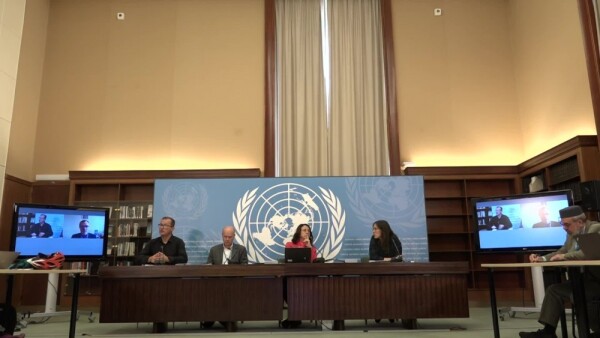
- Wide shot of journalists and speakers, conference room, Palais des Nations, Geneva
- SOUNDBITE (ENGLISH) Jens Laerke Spokesperson for the UN Office for the Coordination of Humanitarian Affairs (OCHA): “UN humanitarian organizations and our partners are facing a funding gap of 1.5 billion dollars. We are looking to all donors to look forward and get cash out to the humanitarian organizations already struggling before the recent escalation who will need money to implement the reboot of the response in Sudan that we are working on. Without that, they simply cannot operate.”
- Wide shot, laptop screen in foreground with podium, speakers and monitor in background, conference room, Palais des Nations
- SOUNDBITE (ENGLISH) Jens Laerke, Spokesperson for the UN Office for the Coordination of Humanitarian Affairs (OCHA): “We need the guns to fall silent for two reasons. First of all, because we need civilians protected and clearly they are not. We see a lot of civilians being killed in the hundreds. Secondly, we need that safety in order for humanitarian organizations to safely get to those people in need, or the other way around for people to safely move to places where they can access aid.”
- Medium shot: speaker at podium
- SOUNDBITE (ENGLISH) Olga Sarrado, UNHCR spokesperson: “Over a hundred thousand refugees are estimated to be among those who have now crossed to neighbouring countries including Sudanese refugees, South Sudanese returning and other nationalities who were themselves refugees in Sudan. Alongside governments and partners, UNHCR the UN Refugee Agency has determined an initial planning figure of more than 800,000 refugees and returnees that may flee Sudan to neighbouring countries.”
- Wide shot: podium and speakers, journalists in foreground
- SOUNDBITE (ENGLISH): Olga Sarrado, UNHCR spokesperson: “The most significant cross-border movement so far has been Sudanese refugees arriving in Chad and Egypt, and South Sudanese returning to South Sudan. Most new arrivals in Chad and South Sudan are women and children while UNHCR has already large operations in many neighbouring countries, last week we deployed already additional emergency teams and activated our global supply chain to bring relief items especially for Chad and South Sudan at the moment.”
- Medium shot: journalists at the table, conference room
- SOUNDBITE (ENGLISH) Paul Dillon, International Organization for Migration (IOM): “The number of displaced people in the last two weeks as a result of conflict, exceeds all conflict-related displacements reported in Sudan in 2022, just to give you a sense of the scale of movement since April 15. All areas remain inaccessible to humanitarian agencies. However, IOM is able to continue to provide these preliminary displacement figures.”
- Medium shot: videocamera, speakers on screen
- SOUNDBITE (ENGLISH) Paul Dillon, International Organization for Migration (IOM): “Of course, these movements are complicated by a whole series of factors- instability and lack of security along transit routes, the lack of fuel and transport services for people who are desperate to leave Sudan fleeing to safety, as well as inflation in the marketplace.”
- Wide shot: journalists, cameras
- SOUNDBITE (ENGLISH) Jens Laerke, Spokesperson for the UN Office for the Coordination of Humanitarian Affairs (OCHA): “We have spoken about the looting of warehouses and stocks inside Sudan, and that is certainly an enormous problem. A lot has been looted but not all. There are still some stocks in there that can be distributed. I know for example that UNFPA is supporting partners on the ground with lifesaving healthcare and supplies for safe births. So, you know, wherever the security situation allows, and relief items are available, of course they will be delivered.”
- Wide shot: podium
- SOUNDBITE (ENGLISH) Tarik Jašarević, World Health Organization (WHO): “We have six containers of supplies for the treatment of injuries and the treatment of severe acute malnutrition that were dispatched by sea and are currently being moved to warehouses in Port Sudan. We have another 30 metric tonnes of emergency supplies to be flown from our logistic hub in Dubai as soon as this becomes possible. So we are trying really our best to bring these supplies to Sudan.”
- Close up: journalists typing
- SOUNDBITE (ENGLISH) Tarik Jašarević, World Health Organization (WHO): “Majority of health facilities are not functional any longer. Many of them are partially functional and we know that in situations like this there is an issue of trauma injuries so there is a need for supplies to treat trauma wounds, but also the issue is access to other health services including to maternal health, new born health and there is also an issue of lack of clean water.”
- Wide shot: cameras, technicians
- Medium shot: journalists
- Close up: journalists typing
Similar Stories

1
1
1
Edited News | UNICEF
A little over one year since a ceasefire agreement was announced between Hamas fighters and Israel, more than 340 children have been reported killed and hundreds more injured, the UN Children’s Fund, UNICEF, said on Friday.

1
1
1
Edited News | UNICEF , IFRC
Six weeks after Nepal’s deadly flooding disaster, communities are still struggling to rebuild their lives, but they will need sustained help as global warming increases the risk of another Himalayan catastrophe, the UN Children’s Fund (UNICEF) said on Friday.

1
1
1
Edited News | WHO
In suspected Russia plague death, testing and monitoring underway – WHO
The death of a lab worker in Russia’s Siberia region has sparked concerns about plague being the cause, the UN World Health Organization (WHO) said on Tuesday, adding that it was following the situation closely.

1
1
Edited News | OHCHR , UNOG
UN Human Rights Chief Volker Türk on Friday provided and oral update to the 63rd session of the Human rights Council on Ukraine.

1
1
1
Edited News | OHCHR , UNOG
UN Human Rights Chief Volker Türk on Friday provided and oral update to the 63rd session of the Human rights Council on the human rights situation in Haiti.

1
1
1
Edited News | WHO
Repeated delays in bringing lifesaving medicines, prosthetics and more from Israel into Gaza risk having devastating consequences on Palestinians who urgently need them in the wartorn enclave, the UN World Health Organization (WHO) said on Friday. “A truck full of non-priority supplies or the right supplies arriving too late, doesn't save lives. That's the question that actually matters," said Dr Reinhilde Van De Weerdt, WHO Representative in the OPT.

1
1
1
Edited News | WHO
DRC: Early access to care and oxygen decisive for Ebola patients’ survival – WHO
In the Democratic Republic of the Congo (DRC), health workers fighting the country’s largest-ever Ebola outbreak are struggling to overcome critical challenges to patient care, the UN World Health Organization (WHO) warned on Tuesday.

1
1
1
Edited News | OCHA , UN
Civilians in Iran are continuing to feel the consequences of months of conflict and military escalation, the UN’s top official in the country has said, as loss of life, damage to civilian infrastructure and mounting economic pressures leave many facing continued uncertainty.
1
1
1
Edited News | WHO , UNICEF
Aid agencies in Yemen highlighted the growing hunger emergency sparked by renewed fighting between Houthi opposition forces and Government troops, after mobile health clinics reported that hundreds of children displaced by the violence are suffering from the most deadly form of malnutrition.
1
1
1
Edited News | UNHCR
Displacement on the rise in Yemen as fighting continues - UNHCR
As hostilities worsen in Yemen, more people have been fleeing their homes, further intensifying the humanitarian crisis within the region, the UN Refugee Agency (UNHCR) warned on Tuesday.
1
1
1
Edited News | IOM , OHCHR , UNFPA , UNOG , UNHCR , WHO
Yemen’s humanitarian crisis growing by the hour amid spike in displacement
Yemenis displaced by renewed fighting have described fleeing for their lives amid shelling and gunfire, aid agencies reported on Friday, while highlighting the dramatic increase in humanitarian needs in the country and in Djibouti, where thousands have sought shelter.
1
1
1
Edited News | OHCHR , UNOG
The UN Human Rights Office issued on Friday a report documenting a shocking pattern of sexual violence amid Russia’s full-scale armed attack on Ukraine.