

The United Nations Office at Geneva
Multimedia Newsroom
The progress in eliminating cluster munitions is overshadowed by a devastating human toll from widespread use in the ongoing war in Ukraine. This is one of the key findings of the Cluster Munition Monitor Report 2022 issued today by the Cluster Munition Coalition which urged both Russia and Ukraine to stop using them and join the 2008 international treaty banning them.
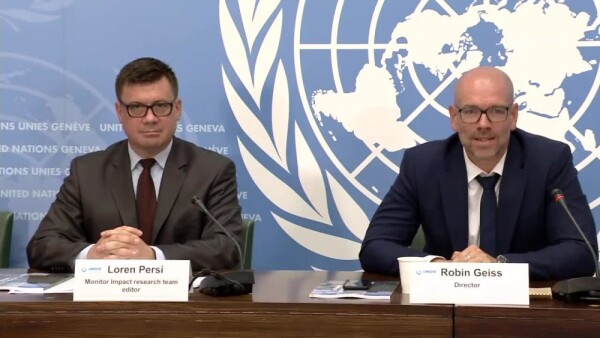
“Many have been documenting the use of cluster munitions in Ukraine on the ground, and we see near daily attacks causing predictable and lasting harm, hitting homes, hospitals and schools », said Mary Wareham, Human Rights Watch Arms Advocacy Director when speaking to journalists at the launch of the report at the United Nations in Geneva. « I know that just yesterday, on Ukraine’s Independence Day, two people were reportedly injured in a cluster munition attack in a village in Kharkiv region.”
Neither Russia nor Ukraine have joined the 2008 Convention on Cluster Munitions, which has 110 States Parties and 13 signatories. The treaty banning cluster munitions comprehensively prohibits the weapon, requires destruction of stockpiles, clearance of areas contaminated by cluster munition remnants, and the provision of risk education and assistance for victims.
“Russia’s recent production of cluster munitions, its widespread use of them in Ukraine is unconscionable and deserves condemnation », said the Human Rights Watch Arms Advocacy Director. « These actions are a sobering reminder of what must be overcome if the international treaty to ban cluster munitions is to succeed in its goal of ending human suffering from these explosive weapons.”
Mary Wareham added that “both Russia and Ukraine should reject cluster munitions and join the international treaty banning them. Ukrainian forces appeared to have used cluster munitions at least twice during this war.”
Launched from the ground or dropped from the air, cluster munitions consist of containers that open and disperser submunitions indiscriminately over a wide area. Many submunitions fail to detonate as intended leaving a trail of explosive remnants and submunitions that threaten lives and deny access to arable land, creating barriers to socioeconomic development.
Preliminary data indicates at least 689 civilian casualties reported during cluster munition attacks for the first half of 2022. This would represent a 300% increase compared to the 2021 global total.
“So far we have some kind of indicative data of up to 700 casualties until June », said Loren Persi, Monitor Impact research team editor. “Now I suggest that is indicative, both because the situation is very difficult to get clear information from, with the ongoing conflict, but also because there is clearly many, many more attacks than there are casualties reported.”
Regarding casualties for the year 2021, the 100-page report has identified at least 149 new cluster munition remnant casualties in 2021. This was the first time in a decade that no new casualties from cluster munition attacks were reported in the year prior to the publication.
“So in 2021, 97% of casualties were civilians, and where the role of the other casualties was known, they were actually deminers, people trying to clear the cluster munitions who were killed and injured during that important and dangerous task », said Loren Persi. « 2/3 of casualties in 2021 were children. Now this is a significant increase in the percentage of child casualties and the ratio of children killed and injured.”
As children are always playing together and with siblings, this explains the high number of casualties, according to Loren Persi.
“Most of those child casualties occurred in States Parties to the Convention on Cluster Munitions. So, these casualties of the cluster munition remnants have been affected by cluster munition used that happened years ago, most often in Southeast Asia, remnants that have remained for decades, and that says something about both the impact of cluster munitions and the importance of the Convention to stop that use,” said Loren Persi.
On a positive note, regarding the stockpile destruction in 2021, Mary Wareham, Human Rights Watch Arms Advocacy Director reported that “virtually all of the cluster munitions that have been declared by States Parties under this convention have now been destroyed. That is a total of nearly 1.5 million cluster munitions and more than 178 million submunitions, and each of those smaller bomblets or submunitions is lethal.”
-ends-
- Medium shot, UN Geneva flag alley.
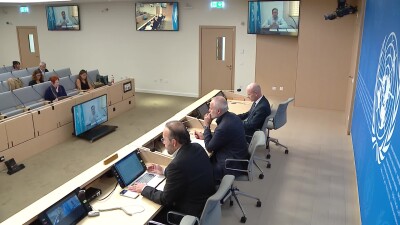
- Wide shot, press room with panel of speakers.
- SOUNDBITE (ENGLISH) Mary Wareham, Human Rights Watch Arms Advocacy Director: “Many have been documenting the use of cluster munitions in Ukraine on the ground, and we see near daily attacks causing predictable and lasting harm, hitting homes, hospitals and schools. I know that just yesterday, on Ukraine’s Independence Day, two people were reportedly injured in a cluster munition attack in a village in Kharkiv region.”
- Close up, report Cluster Munition Monitor 2022 report and computers of journalists.
- SOUNDBITE (ENGLISH) Mary Wareham, Human Rights Watch Arms Advocacy Director: “Russia’s recent production of cluster munitions, its widespread use of them in Ukraine is unconscionable and deserves condemnation. These actions are a sobering reminder of what must be overcome if the international treaty to ban cluster munitions is to succeed in its goal of ending human suffering from these explosive weapons.”
- Medium shot, cameraman.
- SOUNDBITE (ENGLISH) Mary Wareham, Human Rights Watch Arms Advocacy Director: “Both Russia and Ukraine should reject cluster munitions and join the international treaty banning them. Ukrainian forces appeared to have used cluster munitions at least twice during this war.”
- Medium shot, Journalist taking notes, screen showing speakers
- SOUNDBITE (ENGLISH) Loren Persi, Monitor Impact research team editor: “So far we have some kind of indicative data of up to 700 casualties until June. Now I suggest that is indicative, both because the situation is very difficult to get clear information from, with the ongoing conflict, but also because there is clearly many, many more attacks than there are casualties reported.”
- Medium shot, Journalists taking notes.
- SOUNDBITE (ENGLISH) Loren Persi, Monitor Impact research team editor: “So in 2021, 97% of casualties were civilians, and where the role of the other casualties was known, they were actually deminers, people trying to clear the cluster munitions who were killed and injured during that important and dangerous task. 2/3 of casualties in 2021 were children. Now this is a significant increase in the percentage of child casualties and the ratio of children killed and injured.”
- Medium shot, staff monitoring.
- SOUNDBITE (ENGLISH) Loren Persi, Monitor Impact research team editor: “Most of those child casualties occurred in States Parties to the Convention on Cluster Munitions. So, these casualties of the cluster munition remnants have been affected by cluster munition used that happened years ago, most often in Southeast Asia, remnants that have remained for decades, and that says something about both the impact of cluster munitions and the importance of the Convention to stop that use.”
- Medium shot, Journalists taking notes.
- SOUNDBITE (ENGLISH) Mary Wareham, Human Rights Watch Arms Advocacy Director: “Virtually all of the cluster munitions that have been declared by States Parties under this convention have now been destroyed. That is a total of nearly 1.5 million cluster munitions and more than 178 million submunitions, and each of those smaller bomblets or submunitions is lethal.”
- Wide shot, panel of speakers, book flipping.
- Wide shot, camera on tripod, Journalists taking notes.
- Medium shot, journalists taking notes, panel in the background.

Similar Stories
1
1
1
Press Conferences | UN WOMEN , WFP , WHO
UN WOMEN: Sudan Women and girls one year after the fall of El Fasher; increasing drone attacks across the country; WFP: DRC - Ebola spreads to eighth DRC province as WFP delivers food, builds treatment centres and keeps supplies moving; WHO - Update on Ebola (Bundibugyo Virus Disease)
1
12
1
1
Press Conferences , Images | UNOG
Closing Press Conference following the Sixth Consultative Meeting on Enhancing Coordination of Peace Initiatives and Efforts in Sudan

2
17
1
2
Edited News , Press Conferences , Images | OCHA , WMO
Two UN agencies teamed up on Wednesday to issue an appeal for immediate assistance to help communities already being impacted by the strongest El Niño on record.
1
1
1
Press Conferences | CITES
Wildlife trade and conservation policy discussions at the 81st meeting of the CITES Standing Committee (SC81)
1
1
1
Press Conferences | UNHCR , UNCTAD , WMO , OCHA , UNICEF , WHO
UNHCR Hungary’s 1956 Refugee Crisis: 70 Years On, UNCTAD World Investment Forum 2026, Doha, WMO Greenhouse Gas Bulletin and Climate Update for COP31, OCHA Afghanistan: Malnutrition, Girls’ Education and Recovery, UNICEF Yemen: Child Malnutrition and Unsafe Water in Taiz, WHO Inequalities in Noncommunicable Diseases and Risk Factors
1
1
1
Press Conferences | UNHCR
End of UNHCR's 77th Annual Executive Committee (ExCom) meeting week
1
1
1
Press Conferences | UNICEF , IOM , UNHCR
UN Special Assistant to the Personal Envoy Office (SUDAN): Peace Initiatives and Efforts in Sudan; UNICEF: Dire situation of children in Gaza; IOM: Damaged Homes and Energy Attacks Risk Displacing Ukrainians for this winter; UNHCR: update on EXCOM week
1
1
1
Press Conferences | IOM , UNDRR
UN stresses importance of household preparedness for disaster risk reduction.
1
1
1
Statements , Press Conferences | OHCHR
1
1
1
Press Conferences | UNHCR , UNICEF , IFRC , OHCHR , UN WOMEN , IOM , OCHA , WHO
UNHCR – ExCom Meeting, UNICEF – Nepal Recovery, IFRC – Flash Floods, WHO – Mental Health, IOM – South Sudan Floods, OCHA – DRC Humanitarian aid, UNHCR – Sahel Displacement, UNICEF – Yemen Update, IOM – Gaza Shelter, UN Women – Gaza Women, OHCHR – Arrests and detentions of Syrians by Israeli force
2
1
2
Press Conferences | UNCTAD
Presentation of the Trade and Developement Report 2026
Embargoed until 9 October 2026 at 11 a.m. (Geneva Time)
UNCTAD: UNCTAD’s flagship report finds that governments increasingly use industrial, trade, financial and technology policies to pursue economic and national security objectives. Market access and the ability to move into higher-value activities now depend more heavily on technology, finance and geopolitics.
1
1
1
Press Conferences | UPU
Release of the State of the Postal Sector Report 2026