

The United Nations Office at Geneva
Multimedia Newsroom
STORYLINE
The monkeypox outbreak which was declared by the Director-General of the World Health’s Organization’s (WHO), Tedros Adhanom Ghebreyesus, on 23 July as a Global Health Emergency, could be stopped with the right strategies in the right groups, according to WHO’s monkeypox expert.
“The determination of a Public Health Emergency of International Concern (PHEIC) constitutes the highest level of global public health alert that the World Health Organization can offer and can determine and through this we hope to enhance the coordination, cooperation of countries and all stakeholders as well as global solidarity”, said Dr Rosamund Lewis, WHO Technical Lead on Monkeypox while speaking at today’s press briefing at the United Nations in Geneva.
More than 16,000 cases were reported globally this year in more than 75 countries. Some 81 children under the age of 17 were reported as having been infected globally thus far. However, the real number is estimated to be higher.
“WHO has assessed the risk in the European region as high and globally as moderate because other regions are not at the moment as severely affected”, said Dr. Lewis. “But the reason this alert was called is that we wish to ensure that we can stop the outbreak as soon as possible”.
Monkeypox could cause a range of signs and symptoms, including painful sores. Some people develop serious symptoms that require care in a health facility. Pregnant women, children, and immunocompromised person are at higher risk for severe disease.
The virus was first identified in monkeys. It is transmitted through close contact with an infected person. Until this year, the viral disease has rarely spread outside Africa where it is endemic. For the first time in May, cases were reported in the UK, Northern Ireland, Portugal and Spain. Preventing stigma ought to be avoided, as this would harm the response.
“Because at the moment the outbreak is still concentrated in groups with men who have sex with men in some countries, but that is not the case everywhere, it’s really important to appreciate also that stigma and discrimination can be very damaging and as dangerous as any virus itself,” emphasized Dr. Lewis.
The WHO is working with partners to determine a global coordination mechanism and to release and coordinate vaccines. According to WHO’s expert on monkeypox, historically smallpox/monkeypox vaccines had been very effective, but they were now more attenuated and could possible be less effective. Countries currently producing vaccines are Denmark, Japan, and the United States. Some 16,4 million vaccines were currently available in bulk but needed to be finished.
“We are working with member states as well and for example the European Union that is procuring on behalf of more member states”, said WHO’s Dr. Lewis. “At the moment, yes the United States of America has released a significant quantity of vaccines back to manufacture in order to support requests from other countries”.
The current recommendation for persons with monkeypox is to isolate and not travel until they recovered. Contact cases should be checking their temperature and monitoring possible other symptoms for the period of 9 to 21 days.
“At the moment mass vaccination is not required”, said Dr. Lewis. “It is recommended, WHO has recommended an interim guidance vaccination for those who have been exposed, the post-exposure prophylaxis, as well as for those who may be at risk, so preventive vaccination prior to exposure”. She recalled that “a really important point to keep in mind here is that when someone is vaccinated it takes several weeks for an immune response to be generated by the body”.
According to Dr. Lewis, “the majority of cases are – as we mentioned already – in young adults, young men. But that is actually quite a broad range and I think the medium age is 37. We have seen in our data some cases over the age of 50, but not many”.
Dr. Lewis reminded that countries and manufacturers should work with the WHO to ensure diagnostics, vaccines, therapeutics, and other necessary supplies are made available on public health needs and at reasonable cost to countries where they are most need to support the onward spread of monkeypox.
-ends-
STORY: Monkeypox Update - WHO
TRT: 2 mins 44s
SOURCE: UNTV CH
RESTRICTIONS: NONE
LANGUAGE: ENGLISH/NATS
ASPECT RATIO: 16:9
DATELINE: 26 July 2022, GENEVA, SWITZERLAND
SHOTLIST
- Wide shot, UN Geneva flag alley.
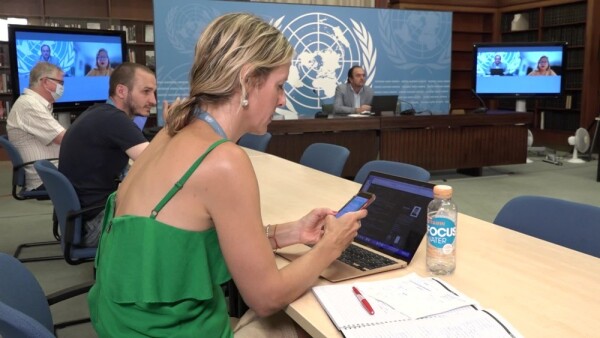
- Wide shot, Press room, UN Geneva.
- SOUNDBITE (ENGLISH): Dr Rosamund Lewis (Zoom from Geneva), WHO Technical Lead on Monkeypox: “The determination of a Public Health Emergency of International Concern (PHEIC) constitutes the highest level of global public health alert that the World Health Organization can offer and can determine and through this we hope to enhance the coordination, cooperation of countries and all stakeholders as well as global solidarity”.
- Medium shot, journalists in room with speaker on podium
- SOUNDBITE (ENGLISH): Dr Rosamund Lewis (Zoom from Geneva), WHO Technical Lead on Monkeypox: “WHO has assessed the risk in the European region as high and globally as moderate because other regions are not at the moment as severely affected. But the reason this alert was called is that we wish to ensure that we can stop the outbreak as soon as possible”.
- Close up, spokesperson on podium with screen in background
- SOUNDBITE (ENGLISH): Dr Rosamund Lewis (Zoom from Geneva), WHO Technical Lead on Monkeypox: “Because at the moment the outbreak is still concentrated in groups with men who have sex with men in some countries, but that is not the case everywhere, it’s really important to appreciate also that stigma and discrimination can be very damaging and as dangerous as any virus itself”.
- Medium shot, cameraman filming
- SOUNDBITE (ENGLISH): Dr Rosamund Lewis (Zoom from Geneva), WHO Technical Lead on Monkeypox: “We are working with member states as well and for example the European Union that is procuring on behalf of more member states. At the moment, yes the United States of America has released a significant quantity of vaccines back to manufacture in order to support requests from other countries”.
- Medium shot, technical person dealing the zoom platform
- SOUNDBITE (ENGLISH): Dr Rosamund Lewis (Zoom from Geneva), WHO Technical Lead on Monkeypox: “At the moment mass vaccination is not required. It is recommended, WHO has recommended an interim guidance vaccination for those who have been exposed, the post-exposure prophylaxis as well as for those who may be at risk, so preventive vaccination prior to exposure. A really important point to keep in mind here is that when someone is vaccinated it takes several weeks for an immune response to be generated by the body”.
- Medium shot, journalists listening
- SOUNDBITE (ENGLISH): Dr Rosamund Lewis (Zoom from Geneva), WHO Technical Lead on Monkeypox: “The majority of cases are – as we mentioned already – in young adults, young men. But that is actually quite a broad range and I think the medium age is 37. We have seen in our data some cases over the age of 50, but not many”.
- Close up, screen with speakers
- Close up, hands typing
- Wide shot, journalists in press room
Similar Stories

1
1
1
Edited News | OCHA , UNICEF , WFP
Aid agencies warned on Friday of the fast-developing humanitarian emergency inside Taiz City in Yemen, which has been encircled by de facto Houthi forces fighting government troops along the country’s west coast.

2
17
1
2
Edited News , Press Conferences , Images | OCHA , WMO
Two UN agencies teamed up on Wednesday to issue an appeal for immediate assistance to help communities already being impacted by the strongest El Niño on record.

3
16
2
2
Edited News , B-roll , Conferences , Images | UNITED NATIONS , UNOG
Sixth Consultative Meeting on Enhancing Coordination of Peace Initiatives and Efforts for Sudan

1
1
1
Edited News | UNICEF , WHO , UNHCR
Yemen war continues to force families from homes amid hunger and disease
More than 250,000 people have now fled renewed fighting in Yemen, the UN said on Tuesday, citing particular concern for those sheltering in the southwestern city of Taiz and the wider governorate, where access is “essentially blocked”.

1
1
1
Edited News | UNICEF
A little over one year since a ceasefire agreement was announced between Hamas fighters and Israel, more than 340 children have been reported killed and hundreds more injured, the UN Children’s Fund, UNICEF, said on Friday.

1
1
1
Edited News | UNICEF , IFRC
Six weeks after Nepal’s deadly flooding disaster, communities are still struggling to rebuild their lives, but they will need sustained help as global warming increases the risk of another Himalayan catastrophe, the UN Children’s Fund (UNICEF) said on Friday.

1
1
1
Edited News | WHO
In suspected Russia plague death, testing and monitoring underway – WHO
The death of a lab worker in Russia’s Siberia region has sparked concerns about plague being the cause, the UN World Health Organization (WHO) said on Tuesday, adding that it was following the situation closely.

1
1
Edited News | OHCHR , UNOG
UN Human Rights Chief Volker Türk on Friday provided and oral update to the 63rd session of the Human rights Council on Ukraine.

1
1
1
Edited News | OHCHR , UNOG
UN Human Rights Chief Volker Türk on Friday provided and oral update to the 63rd session of the Human rights Council on the human rights situation in Haiti.

1
1
1
Edited News | WHO
Repeated delays in bringing lifesaving medicines, prosthetics and more from Israel into Gaza risk having devastating consequences on Palestinians who urgently need them in the wartorn enclave, the UN World Health Organization (WHO) said on Friday. “A truck full of non-priority supplies or the right supplies arriving too late, doesn't save lives. That's the question that actually matters," said Dr Reinhilde Van De Weerdt, WHO Representative in the OPT.

1
1
1
Edited News | WHO
DRC: Early access to care and oxygen decisive for Ebola patients’ survival – WHO
In the Democratic Republic of the Congo (DRC), health workers fighting the country’s largest-ever Ebola outbreak are struggling to overcome critical challenges to patient care, the UN World Health Organization (WHO) warned on Tuesday.

1
1
1
Edited News | OCHA , UN
Civilians in Iran are continuing to feel the consequences of months of conflict and military escalation, the UN’s top official in the country has said, as loss of life, damage to civilian infrastructure and mounting economic pressures leave many facing continued uncertainty.