

The United Nations Office at Geneva
Multimedia Newsroom
Edited News | OHCHR , UNICEF , WHO , UNOG
UNOG Bi-weekly press briefing: Humanitarian Situation in Idlib - Syria OHCHR/WHO/UNICEF
UN right chief, agencies appalled at civilian toll in wartorn Syria’s north-east
Facing freezing temperatures and bombing, more than 900,000 civilians in Syria’s north-west have been forced into ever smaller areas in search of shelter, the UN’s top rights official said on Tuesday.
“As the High Commissioner puts it, ‘No shelter is now safe,’ Michelle Bachelet’s spokesperson, Rupert Colville, said. “And as the Government offensive continues and people are forced into smaller and smaller pockets, she fears even more people will be killed.”
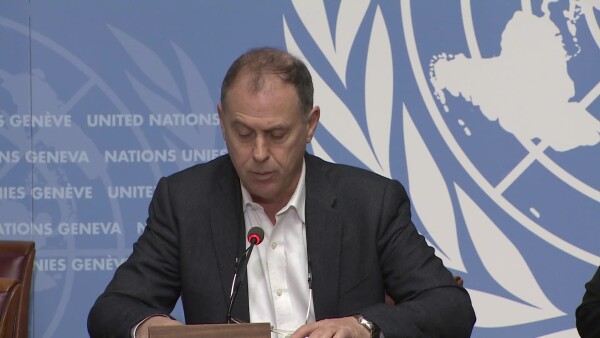
Speaking to journalists in Geneva, Mr. Colville spoke of the High Commissioner’s “horror” at the scale of the humanitarian crisis in north-west Syria.
It was “cruel beyond belief” that mostly women and children sheltering under plastic sheeting were being hit, she said in a statement, noting that those fleeing the fighting have been “squeezed” into areas that are shrinking in size by the hour.
“They simply no longer have anywhere to go,” she added.
“In all, since 1 January this year, during the Syrian Government’s latest major military offensive to retake key areas in Idlib and Aleppo, we have recorded the deaths of 299 civilians in this region of Syria. Around 93 per cent of those deaths were caused by the Syrian Government and its allies,” Mr. Colville said, with the remaining seven per cent of fatalities attributable to non-State armed groups.
More than 80 per cent of the deaths attributable to Government forces and their allies – 246 out of 299 – came after airstrikes, the OHCHR spokesperson added.
Asked whether the attacks on civilians and medical facilities contravened international norms, Mr Colville highlighted their “sheer quantity” in the near nine-year conflict.
Other UN-appointed institutions had greater means to investigate these attacks and ensure justice for victims, he noted, such as the Commission of Inquiry on Syria - which was set up by and reports regularly to the Human Rights Council - and the International, Impartial and Independent Mechanism, established by the UN General Assembly in December 2016.
“The sheer quantity of attacks on these hospitals, medical facilities, schools, would suggest they can’t all be accidental,” Mr. Colville said. “At a minimum, even if they were accidental, it shows lack of proportionality, necessity, precaution and so on, all of which can contribute to something being attributed as a war crime.”
Amid the Syrian Government’s offensive in north-west Syria - the last bastion of opposition non-state armed groups – UN Children’s Fund (UNICEF) warned that of the four million people living in the north-west, just over two million are children.
“Virtually every child, up to 1.8 million of them, require humanitarian assistance,” spokesperson Marixie Mercado said.
- Wide shot: exterior, flag alley, Palais des Nations, United Nations Geneva.
- Wide shot: Press briefing room.
- SOUNDBITE (EN) — Rupert Colville, spokesperson, Office of the High Commissioner for Human Rights (OHCHR): “As the High Commissioner puts it, ‘No shelter is now safe.’ And as the Government offensive continues and people are forced into smaller and smaller pockets, she fears even more people will be killed.”
- Close-up, journalist in foreground, other journalists to rear of shot.
- SOUNDBITE (EN) — Rupert Colville, spokesperson, Office of the High Commissioner for Human Rights (OHCHR): “In all, since 1 January this year, during the Syrian Government’s latest major military offensive to retake key areas in Idlib and Aleppo, we have recorded the deaths of 299 civilians in this region of Syria. Around 93 per cent of those deaths were caused by the Syrian Government and its allies.”
- Close-up shot, camera operator, journalists in background.
- SOUNDBITE (EN) Rupert Colville, spokesperson, Office of the High Commissioner for Human Rights (OHCHR): “The sheer quantity of attacks on these hospitals, medical facilities, schools, would suggest they can’t all be accidental, and at a minimum, even if they were accidental, it shows lack of proportionality, necessity, precaution and so on, all of which can contribute to something being attributed as a war crime.”
- Wide shot, journalists.
- SOUNDBITE (EN) Marixie Mercado, UN Children’s Fund (UNICEF): “Over half a million children – 525,000 and climbing, have been forcibly displaced in north-west Syria since 1 December. At least 77 children were killed or injured in January alone. The breakdown is 28 children killed, and 49 children injured.”
- Close-up, journalist typing.
- SOUNDBITE (EN) Marixie Mercado, UN Children’s Fund (UNICEF): “There are about four million people living in the north-west and just over two million of them are children. Virtually every child, up to 1.8 million of them, require humanitarian assistance.”
- Wide shot, podium
- SOUNDBITE (EN) Marixie Mercado, spokesperson, UN Children’s Fund (UNICEF): “We ask for an immediate cessation of hostilities and an end to the war in Syria for once and for all, and we ask for all humanitarian workers to be able to respond to the massive needs in compliance with international humanitarian law.”
- Close-up, journalist.
- SOUNDBITE (EN) Tarik Jasarevic, spokesperson, World Health Organization (WHO): “The name of the hospital is Kinana General Hospital in the Daret Azza locality. This hospital has been serving about 50,000 people and has been carrying out about 10,000 patient consultations per month. The second facility is Al-Ferdous maternity and childcare hospital. It suffered minor damage, but it is not clear at this moment if the hospital can continue operating.”
- Close-up: journalist writing.
- SOUNDBITE (EN) Tarik Jasarevic, spokesperson, (WHO): “As of today, 74 health facilities have suspended services in Idlib and Aleppo since 1 December last year directly decreasing civilian access to healthcare. Out of nearly 550 health facilities in Syria’s north-west, roughly half are operational.”
- Medium shot: journalists.
- SOUNDBITE (EN) Tarik Jasarevic, spokesperson, (WHO): “Luckily there were no casualties in yesterday’s attacks, but they do bring the total number of attacks on health in Syria this year to six, resulting in 10 deaths and 30 injuries, on top of restricting or denying civilian access to health. All of these six attacks have occurred in the north-west.”
- Close-up: journalist.
- Wide shot: journalists, podium.
- Close-up: journalists typing.
Similar Stories

1
1
1
Edited News | OCHA , UNICEF , WFP
Aid agencies warned on Friday of the fast-developing humanitarian emergency inside Taiz City in Yemen, which has been encircled by de facto Houthi forces fighting government troops along the country’s west coast.

2
17
1
2
Edited News , Press Conferences , Images | OCHA , WMO
Two UN agencies teamed up on Wednesday to issue an appeal for immediate assistance to help communities already being impacted by the strongest El Niño on record.

3
16
2
2
Edited News , B-roll , Conferences , Images | UNITED NATIONS , UNOG
Sixth Consultative Meeting on Enhancing Coordination of Peace Initiatives and Efforts for Sudan

1
1
1
Edited News | UNICEF , WHO , UNHCR
Yemen war continues to force families from homes amid hunger and disease
More than 250,000 people have now fled renewed fighting in Yemen, the UN said on Tuesday, citing particular concern for those sheltering in the southwestern city of Taiz and the wider governorate, where access is “essentially blocked”.

1
1
1
Edited News | UNICEF
A little over one year since a ceasefire agreement was announced between Hamas fighters and Israel, more than 340 children have been reported killed and hundreds more injured, the UN Children’s Fund, UNICEF, said on Friday.

1
1
1
Edited News | UNICEF , IFRC
Six weeks after Nepal’s deadly flooding disaster, communities are still struggling to rebuild their lives, but they will need sustained help as global warming increases the risk of another Himalayan catastrophe, the UN Children’s Fund (UNICEF) said on Friday.

1
1
1
Edited News | WHO
In suspected Russia plague death, testing and monitoring underway – WHO
The death of a lab worker in Russia’s Siberia region has sparked concerns about plague being the cause, the UN World Health Organization (WHO) said on Tuesday, adding that it was following the situation closely.

1
1
Edited News | OHCHR , UNOG
UN Human Rights Chief Volker Türk on Friday provided and oral update to the 63rd session of the Human rights Council on Ukraine.

1
1
1
Edited News | OHCHR , UNOG
UN Human Rights Chief Volker Türk on Friday provided and oral update to the 63rd session of the Human rights Council on the human rights situation in Haiti.

1
1
1
Edited News | WHO
Repeated delays in bringing lifesaving medicines, prosthetics and more from Israel into Gaza risk having devastating consequences on Palestinians who urgently need them in the wartorn enclave, the UN World Health Organization (WHO) said on Friday. “A truck full of non-priority supplies or the right supplies arriving too late, doesn't save lives. That's the question that actually matters," said Dr Reinhilde Van De Weerdt, WHO Representative in the OPT.

1
1
1
Edited News | WHO
DRC: Early access to care and oxygen decisive for Ebola patients’ survival – WHO
In the Democratic Republic of the Congo (DRC), health workers fighting the country’s largest-ever Ebola outbreak are struggling to overcome critical challenges to patient care, the UN World Health Organization (WHO) warned on Tuesday.

1
1
1
Edited News | OCHA , UN
Civilians in Iran are continuing to feel the consequences of months of conflict and military escalation, the UN’s top official in the country has said, as loss of life, damage to civilian infrastructure and mounting economic pressures leave many facing continued uncertainty.