

The United Nations Office at Geneva
Multimedia Newsroom
Ukraine: Mariupol evacuation is ready, there is no Plan B, say humanitarians
Efforts to help thousands of desperate residents flee the embattled Ukrainian city of Mariupol continued on Friday, as humanitarians warned that there is “no Plan B”, after weeks of constant shelling since the Russian invasion on 24 February.
The development follows an initial attempt to evacuate civilians from the southern port city at the beginning of March, when a resumption in hostilities ultimately dashed hopes of safe passage for those wanting to leave.
“We remain hopeful, we are in action, moving towards Mariupol, that is obviously a good thing; but it is not yet clear that this will happen today,” said Ewan Watson, spokesperson for the International Committee of the Red Cross (ICRC). “If and when it does happen, the ICRC’s role as a mutual intermediary will be to lead the convoy out from Mariupol to another city in Ukraine. We are unable to confirm which city at the moment as this is something the parties must agree to.”
More than 50 buses are expected to roll out of Mariupol, accompanied by other civilian and ICRC vehicles, providing a “humanitarian marker on this movement of people…giving the convoy additional protection”, the ICRC spokesperson told journalists in Geneva.
“There is no plan B here, we have been working for weeks and telling the media about our efforts to get into Mariupol with aid and to allow the safe passage of civilians out of the city. Time is running out for the people of Mariupol.”
Across Ukraine, humanitarian needs continue to worsen and spread “by the hour”, the UN World Food Programme (WFP) warned.
The agency has delivered life-saving food assistance, including ready-to-eat food, bread and cash assistance, to one million people affected by the war. “People are stressed and they are running out of options,” said WFP spokesperson Tomson Phiri. “Our plan … is to support more and more people, we want to reach at least three million people in the coming weeks and months”, he added, along with, as well as 300,000 refugees and asylum seekers who have fled to neighbouring countries.
The UN agency has already prepositioned close to 40,000 tonnes of food, wheat flour and food rations in Ukraine and neighbouring countries for distribution.
And despite the continuing violence which has included shelling and street fighting, “WFP has delivered food to vulnerable families in the encircled cities of Kharkiv and Sumy, through two interagency humanitarian convoys that have reached the conflict-hit areas”, Mr. Phiri said.
“One of the biggest challenges we face here is that there are not that many humanitarian partners who are able to work in besieged places.”
In Kharkiv, WPF has also distributed 330,000 loaves of freshly baked bread and it is expanding this bakery initiative to other cities, with the aim of delivering another 990,000 loaves in the coming weeks.
WFP has also delivered stocks of rapid-response food packages in Dnipro and Kirovohrad in central Ukraine, and in Vinnytsia in the centre-western region, for inter-agency crossline convoys and for use by WFP partners.
In areas indirectly affected by the war and where food is available and retail shops are operating normally, WFP has started providing cash or vouchers as a means of support, Mr Phiri explained.
ends
STORY: Ukraine Update – WFP, ICRC
TRT: 1 mins 47s
SOURCE: UNTV CH
RESTRICTIONS: NONE
LANGUAGE: ENGLISH
ASPECT RATIO: 16:9
DATELINE: 1 April 2022 GENEVA, SWITZERLAND
SHOTLIST
- Exterior wide shot, flag alley, UN Geneva.
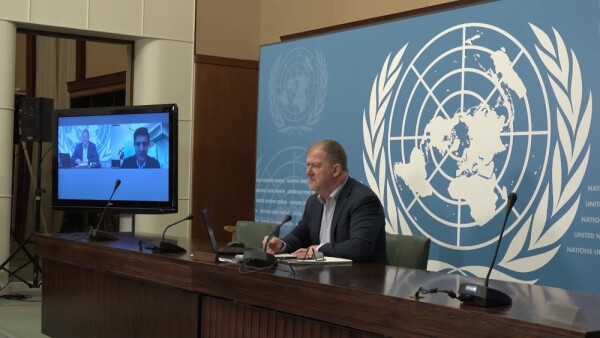
- Medium shot, UN Geneva Press room, podium speaker and large-screen TV showing speakers in room and remotely.
- SOUNDBITE (ENGLISH): Ewan Watson – International Committee of the Red Cross (ICRC): “We remain hopeful, we are in action, moving towards Mariupol, that is obviously a good thing; but it is not yet clear that this will happen today.”
- Medium-wide shot, podium speaker and large-screen TV showing speakers in room and remotely.
- SOUNDBITE (ENGLISH): Ewan Watson – International Committee of the Red Cross (ICRC): “If and when it does happen, the ICRC’s role as a mutual intermediary will be to lead the convoy out from Mariupol to another city in Ukraine. We are unable to confirm which city at the moment as this is something the parties must agree to.”
- Medium shot, journalists seated in front of laptops in foreground, large-screen TV showing speakers in room and remotely.
- SOUNDBITE (ENGLISH): Ewan Watson – International Committee of the Red Cross (ICRC): “There is no plan B here, we have been working for weeks and telling the media about our efforts to get into Mariupol with aid and to allow the safe passage of civilians out of the city. Time is running out for the people of Mariupol.”
- Medium shot, podium speaker and large-screen TV showing speakers in room and remotely.
- SOUNDBITE (ENGLISH): Tomson Phiri, World Food Programme (WFP): “People are stressed and they are running out of options; with each day it is taking the toll on them. Our plan as the World Food Programme is to support more and more people; we want to reach at least three million people in the coming weeks and months.”
- Medium shot, participants and journalists, seated and masked; TV camera and light panel also in shot.
- SOUNDBITE (ENGLISH): Tomson Phiri, World Food Programme (WFP): “One of the biggest challenges we face here is that there are not that many humanitarian partners who are able to work in besieged places.”
- Medium shot, TV camera, participants and journalists, seated and masked.
- Medium shot, participants and journalists seated and masked, one is beneath a mounted light panel.
- Medium shot, participant seated and masked, typing on laptop.
Similar Stories

1
1
1
Edited News | OCHA , UNICEF , WFP
Aid agencies warned on Friday of the fast-developing humanitarian emergency inside Taiz City in Yemen, which has been encircled by de facto Houthi forces fighting government troops along the country’s west coast.

2
17
1
2
Edited News , Press Conferences , Images | OCHA , WMO
Two UN agencies teamed up on Wednesday to issue an appeal for immediate assistance to help communities already being impacted by the strongest El Niño on record.

3
16
2
2
Edited News , B-roll , Conferences , Images | UNITED NATIONS , UNOG
Sixth Consultative Meeting on Enhancing Coordination of Peace Initiatives and Efforts for Sudan

1
1
1
Edited News | UNICEF , WHO , UNHCR
Yemen war continues to force families from homes amid hunger and disease
More than 250,000 people have now fled renewed fighting in Yemen, the UN said on Tuesday, citing particular concern for those sheltering in the southwestern city of Taiz and the wider governorate, where access is “essentially blocked”.

1
1
1
Edited News | UNICEF
A little over one year since a ceasefire agreement was announced between Hamas fighters and Israel, more than 340 children have been reported killed and hundreds more injured, the UN Children’s Fund, UNICEF, said on Friday.

1
1
1
Edited News | UNICEF , IFRC
Six weeks after Nepal’s deadly flooding disaster, communities are still struggling to rebuild their lives, but they will need sustained help as global warming increases the risk of another Himalayan catastrophe, the UN Children’s Fund (UNICEF) said on Friday.

1
1
1
Edited News | WHO
In suspected Russia plague death, testing and monitoring underway – WHO
The death of a lab worker in Russia’s Siberia region has sparked concerns about plague being the cause, the UN World Health Organization (WHO) said on Tuesday, adding that it was following the situation closely.

1
1
Edited News | OHCHR , UNOG
UN Human Rights Chief Volker Türk on Friday provided and oral update to the 63rd session of the Human rights Council on Ukraine.

1
1
1
Edited News | OHCHR , UNOG
UN Human Rights Chief Volker Türk on Friday provided and oral update to the 63rd session of the Human rights Council on the human rights situation in Haiti.

1
1
1
Edited News | WHO
Repeated delays in bringing lifesaving medicines, prosthetics and more from Israel into Gaza risk having devastating consequences on Palestinians who urgently need them in the wartorn enclave, the UN World Health Organization (WHO) said on Friday. “A truck full of non-priority supplies or the right supplies arriving too late, doesn't save lives. That's the question that actually matters," said Dr Reinhilde Van De Weerdt, WHO Representative in the OPT.

1
1
1
Edited News | WHO
DRC: Early access to care and oxygen decisive for Ebola patients’ survival – WHO
In the Democratic Republic of the Congo (DRC), health workers fighting the country’s largest-ever Ebola outbreak are struggling to overcome critical challenges to patient care, the UN World Health Organization (WHO) warned on Tuesday.

1
1
1
Edited News | OCHA , UN
Civilians in Iran are continuing to feel the consequences of months of conflict and military escalation, the UN’s top official in the country has said, as loss of life, damage to civilian infrastructure and mounting economic pressures leave many facing continued uncertainty.